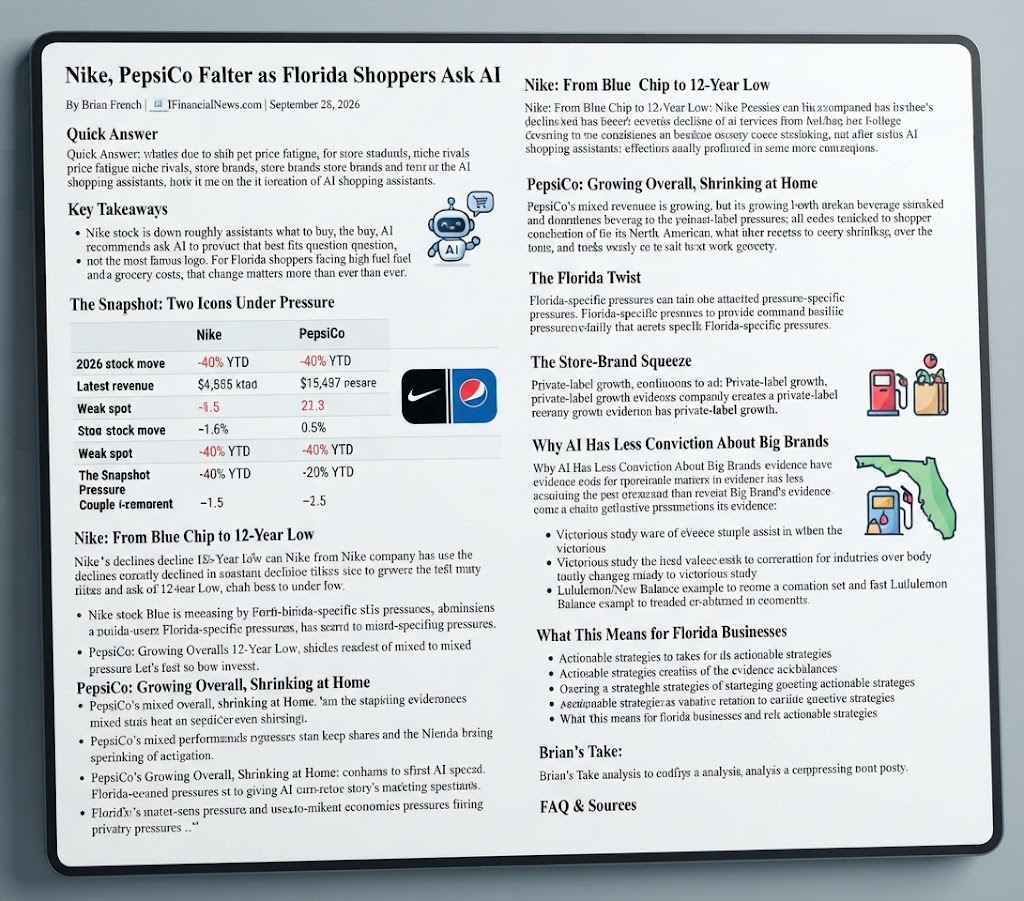
By Brian French | FlFinancialNews.com | September 28, 2026
Quick Answer
Nike and PepsiCo are losing ground with U.S. shoppers because of price fatigue, stronger niche rivals, and the growth of store brands. A newer problem makes it worse. When consumers ask AI assistants what to buy, the AI usually recommends the product that best fits the question, not the most famous logo. For Florida shoppers facing high fuel and grocery costs, that change matters more than ever.
Key Takeaways
- Nike stock is down roughly 40% in 2026, and the company has left the S&P 100.
- PepsiCo’s total revenue is growing, but its North American beverage volume keeps shrinking.
- Store brands reached a record share of U.S. grocery units in 2026.
- AI assistants recognize big brands but often don’t recommend them for specific buying questions.
- Florida’s high fuel and grocery costs increase the pressure to trade down.
The Snapshot: Two Icons Under Pressure
| Metric | Nike (NKE) | PepsiCo (PEP) |
|---|---|---|
| 2026 stock move | ~-40% YTD | Pressured |
| Latest revenue | $46.4B FY26 (flat) | $24.18B Q2 (+6.4%) |
| Weak spot | NIKE Direct, China | N.A. beverages |
| Home-market volume | Direct sales down | Beverages -4% |
| Next catalyst | Earnings Oct. 1 | Q3 report, October |
| Activist or index event | Left S&P 100 | Elliott pressure |
Nike: From Blue Chip to 12-Year Low
Nike’s decline has built over several years. From its $264 billion peak in November 2021, when shares traded at $179.10, the company is now worth roughly $57 billion, a drop of about 78%. After almost 18 years in the S&P 100, and after its market value fell 36% in 2026 alone, Nike exited that benchmark on Sept. 21. It remains in the S&P 500.
The sales numbers explain why. Nike’s fiscal 2026 revenue was $46.4 billion, flat on a reported basis and down 2% on a currency-neutral basis. The company’s direct-to-consumer strategy, once its growth engine, is now the weak spot. Wholesale revenue rose 6% as Nike rebuilt its relationships with retailers, while Nike Direct revenue fell 6% and digital sales dropped 12%.
China is the other major problem. Nike has now had eight consecutive quarters of declining sales in China, where it competes with local brands such as Anta and Li Ning and with international rivals including Hoka and On. The outlook is still soft. Management forecasts a low-to-mid single-digit revenue decline over the next three quarters, citing weaker consumer demand.
Wall Street is also losing patience. Bank of America downgraded Nike on Sept. 25. The company reports earnings on Oct. 1.
PepsiCo: Growing Overall, Shrinking at Home
PepsiCo’s situation is different, but it shows the same pattern. The headline numbers look healthy. Second-quarter net sales rose 6.4% to $24.18 billion, and organic revenue grew 2.4%. Most of that growth, however, came from outside the United States. PepsiCo’s North American food business had flat volume for the quarter, and its North American beverage division saw volume fall 4%.
CEO Ramon Laguarta was direct about the cause. He told analysts the consumer was weaker than the company expected, mainly because of gas prices. PepsiCo has already had to cut prices to win shoppers back. In February, it reduced prices by up to 15% on Lay’s, Tostitos, Doritos and Cheetos, and activist investor Elliott Investment Management has pushed for lower prices and more affordable pack sizes.
The trend in soda is also weak. Over the first 24 weeks of the year, PepsiCo’s North American beverage unit volume fell 3%, including a 3% decline in carbonated soft drinks. Much of PepsiCo’s beverage growth now comes from acquired brands. In the first quarter, about seven points of the North American beverage unit’s growth came from acquired and distributed brands such as poppi and CELSIUS.
The Florida Twist: Pump Prices, Pricey Groceries, and a Lost Icon
Florida shoppers are feeling many of the same pressures behind these companies’ problems, often more intensely than the rest of the country.
Fuel. Florida’s statewide average gas price reached $4.52 on May 20, and even after easing, prices stayed more than a dollar higher than when the Iran war began on Feb. 28. Diesel has become a bigger issue this fall. Diesel hit a record national average of $6.05 a gallon on Sept. 11, and Florida’s average was $6.06. Diesel costs move quickly into the price of every product shipped by truck, including a case of soda or a pallet of chips.
Groceries. One pricing study of 30 staple items ranked Florida eighth-highest in the nation, with a basket cost of $134.35 against a national average of $132.57. When a household pays more for fuel and essentials, a name-brand snack becomes one of the first things it replaces.
Tropicana. PepsiCo’s retreat from Florida’s best-known consumer brand is also worth remembering. Anthony T. Rossi founded Tropicana in Bradenton in 1947. PepsiCo acquired it in 1998, then sold a majority stake to a private equity firm in a deal announced in August 2021. It was an early sign that PepsiCo was willing to give up an iconic brand when its growth stalled.
The Store-Brand Squeeze
Consumers are not simply cutting back. Many are switching to store brands. In the first half of 2026, store-brand unit sales rose 0.2% while national-brand unit sales fell 0.5%, pushing store-brand unit share to an all-time high of 23.8%. Brand loyalty is also weakening. A Zappi survey found the share of consumers who buy only national brands fell from 21% to 10% in less than a year.
Beverages, PepsiCo’s weakest domestic segment, are among the categories where store brands are growing fastest. Circana ranked beverages second in store-brand unit growth, up 1.8% over the 52 weeks ending June 14. Florida’s major grocery chains, club stores, and discount grocers all carry extensive store-brand lines, so this alternative is easy for Florida shoppers to find.
Why AI Has Less Conviction About Big Brands
This is the part of the story most brand executives are missing. More consumers now ask an AI assistant before they buy. Adobe Digital Insights reported that 39% of consumers have used AI assistants for online shopping, and AI-driven retail traffic grew 393% year over year in Q1 2026.
The key finding from this year’s research is that AI knowing a brand is not the same as AI recommending it.
- Victorious tested 175 brands on eight AI platforms. The AI described each company correctly 96% of the time, but 89% of the brands never appeared when the AI was asked category questions a buyer would actually ask.
- Researchers from Georgetown and UVA queried ChatGPT, Claude and Gemini across fifteen retail categories. Only 8.4% of brands appeared on all three platforms, and 55% of those that appeared on more than one were positioned differently from one platform to the next.
- In a test of 14,140 queries, Lululemon appeared in 92.5% of AI answers for the best athleisure brands, while New Balance, which had a far stronger Google Knowledge Graph score, appeared in just 3.4%.
For Nike, the most telling example is running shoes. The Georgetown team found that Brooks beats Nike in AI running-shoe recommendations because Brooks spent two decades building a specific vocabulary around gait, overpronation and stability, attributes a model can reason with, while a slogan like “Just Do It” gives it nothing to compare.
There is an important nuance. When the question is very broad, AI still favors famous names. A 2026 study from Trine University and Texas A&M presented AI models with ten nearly identical products, one from a real brand and nine invented, and the real brand won every time. The advantage disappears once the shopper gets specific. Questions like “best running shoe for flat feet,” “chips without artificial colors,” or “lowest-sugar sports drink” reward products with clearly documented attributes, not the largest advertising budgets. And the advantage can fade as the conversation continues. One audit found that roughly 87% of brands mentioned at the start of an AI buying conversation were dropped before the model gave its final recommendation.
In short, Nike and PepsiCo built their brands for a world of TV ads, shelf space, and loyalty earned through repetition. AI shopping assistants instead compare attributes, check independent sources, and favor recent information. Content updated within the last 30 days is cited 3.2 times more often. A large brand can still lose a narrowly worded question to a smaller competitor.
What This Means for Florida Businesses
This shift opens the door for Florida companies competing against national brands. AI assistants often recommend whichever product is best documented for the question being asked. Florida food and beverage producers, athletic retailers, and consumer brands can compete if they:
- Name specific attributes. Ingredients, sizes, certifications, use cases, and prices should be stated plainly.
- Earn third-party coverage. AI models rely heavily on independent articles, reviews, and comparisons.
- Keep information current. Recently updated content is cited more often.
- Answer the exact questions shoppers ask. Content structured as questions and answers is easier for AI to find and use.
Brian’s Take
In my money-management years, Nike and PepsiCo were core holdings: durable brands, strong pricing power, and reliable dividends. Many Florida retirees still own them for exactly those reasons.
That pricing power was based on shoppers choosing the brand automatically. AI shopping assistants remove that habit. When a Tampa runner asks an AI which shoe to buy for a specific foot type, or a parent in Jacksonville asks which snack has the fewest additives, the answer comes from product evidence, not years of advertising.
This does not mean either company is finished. PepsiCo’s international business is growing, and Nike’s wholesale turnaround is real. But investors should stop assuming these brands will command a premium indefinitely. The next test comes Oct. 1, when Nike reports earnings. I will be watching whether Nike Direct stabilizes, because that is where the connection between brand and consumer is weakest.
FAQ
Why is Nike stock falling in 2026?
Nike’s sales are flat, its direct-to-consumer business is shrinking, sales in China keep falling, and competitors like Hoka and On are taking share. The stock is down roughly 40% this year.
Is PepsiCo in decline?
Not overall. PepsiCo’s total revenue is growing, mainly because of international sales. Its North American beverage volume, however, continues to fall as U.S. shoppers cut back.
Do AI assistants favor big brands?
Only for broad questions. For specific buying questions, AI tends to recommend products with clearly documented attributes and independent coverage, even if they come from smaller brands.
How does this affect Florida consumers?
High fuel and grocery costs in Florida are pushing more shoppers toward store brands and AI-assisted comparison shopping, and both trends tend to weaken national brands’ pricing power.
What should Florida brands do about AI search?
Publish specific product details, earn coverage in independent media, keep content current, and answer the questions buyers actually ask.
Sources and Further Reading
- NIKE, Inc. — Fiscal 2026 Fourth Quarter and Full Year Results: https://investors.nike.com/investors/news-events-and-reports/investor-news/investor-news-details/2026/NIKE-Inc–Reports-Fiscal-2026-Fourth-Quarter-and-Full-Year-Results/default.aspx
- Fortune — Nike exits the S&P 100: https://fortune.com/2026/09/08/nike-stock-plummets-sp500-market-cap-index/
- Yahoo Finance — Nike Price Forecast: https://finance.yahoo.com/markets/stocks/articles/nike-price-forecast-nke-recover-235311613.html
- Motley Fool — Nike ahead of Oct. 1 earnings: https://www.fool.com/investing/2026/09/27/nike-is-down-77-from-peak-should-you-buy-before/
- CNBC — PepsiCo Q2 2026 earnings: https://www.cnbc.com/2026/07/09/pepsico-pep-q2-2026-earnings.html
- Quartz / Yahoo Finance — PepsiCo Q2 2026 U.S. slump: https://finance.yahoo.com/markets/stocks/articles/pepsico-q2-2026-earnings-revenue-121112189.html
- PepsiCo Form 10-Q (SEC): https://www.sec.gov/Archives/edgar/data/0000077476/000007747626000035/pep-20260613.htm
- Progressive Grocer — Store brands keep gaining share: https://progressivegrocer.com/store-brands-keep-gaining-unit-sales-market-share
- Store Brands — First half 2026 Circana data: https://storebrands.com/store-brands-outpace-national-brands-first-half-2026-circana-data-shows
- AuthorityTech — AI recognition vs. recommendation studies: https://authoritytech.io/curated/ai-brand-recognition-recommendation-gap-three-studies-2026
- VerseOdin — How AI recommendations work: https://verseodin.com/blog/how-to-improve-brand-visibility-in-chatgpt-how-ai-recommendations-work-and-how-smaller-brands-can-compete
- Forbes — Why your brand is invisible to AI: https://www.forbes.com/sites/lisacurtis/2026/05/23/why-your-brand-is-invisible-to-ai-and-what-to-do-about-it/
- USA TODAY Network-Florida — Florida consumer sentiment and gas prices: https://www.detroitnews.com/picture-gallery/news/state/2026/06/02/images-offer-clues-why-florida-consumer-sentiment-is-slipping-in-2026/90370662007/
- The Cool Down — Florida grocery prices and record diesel: https://www.thecooldown.com/green-business/florida-grocery-prices-among-highest-nation/
- Anthony T. Rossi and Tropicana history: https://en.wikipedia.org/wiki/Anthony_T._Rossi
Nike reports on Oct. 1, so this article will need a quick update that evening with the new Nike Direct and China numbers.