By Brian French | Florida Authority Network | October 22, 2026
Quick Answer
Energy prices are high today because of the Iran war and the disruption at the Strait of Hormuz. But the forecasts point down. The biggest reason is political: governments around the world want cheaper energy and are using every tool they have to get it, from record emergency oil releases to pressure on producers and refiners. Add a coming oil surplus, a wave of new natural gas supply, weaker demand and falling battery costs, and the path for oil and gas is lower. Electricity is the main exception.
Key Takeaways
- The EIA forecasts Brent crude falling from about $105 a barrel this quarter to about $84 in 2027.
- The IEA expects global oil supply to exceed demand by about 5 million barrels a day in 2027.
- Governments released oil from strategic reserves on a record scale in 2026, led by a 400-million-barrel coordinated IEA action.
- A historic wave of new LNG capacity is expected to push global natural gas prices down.
- Battery storage costs fell 27% to a record low in 2025.
- Residential electricity prices are still rising, driven by grid spending and data center demand.
Where Energy Prices Stand Today
Energy markets in October 2026 are still living with the aftermath of the war with Iran, which began Feb. 28 and choked traffic through the Strait of Hormuz. In 2025, about 20 million barrels a day of crude and oil products passed through the strait, roughly a quarter of the world’s seaborne oil trade.
Oil is expensive right now. Brent futures closed near $110 a barrel on Oct. 16. In its October outlook, the U.S. Energy Information Administration raised its fourth-quarter 2026 Brent forecast to $105 a barrel, $14 above its September estimate.
The forecasts still point down. The EIA expects Brent to fall to about $84 a barrel in 2027, as production and exports from the Middle East recover through convoys and export workarounds.
Gulf producers are still well below normal. The seven core OPEC+ members pumped 25 million barrels a day in August, roughly 5 million barrels a day below prewar levels in February.
| Forecast (EIA, October 2026) | Brent price |
|---|---|
| 2025 actual average | $69 |
| 2026 average | $96 |
| Fourth quarter 2026 | $105 |
| 2027 average | $84 |
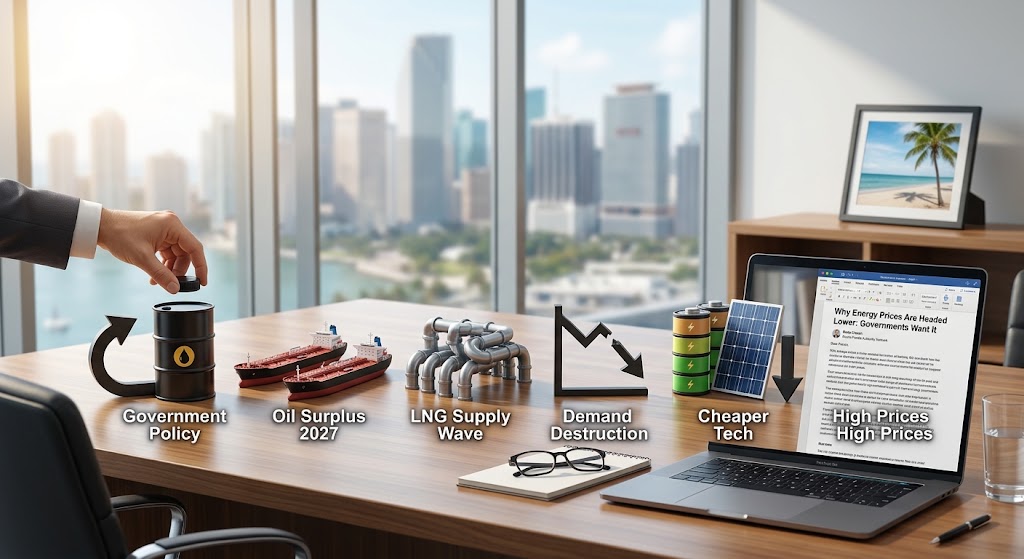
The question for businesses and households is not whether prices are high today. It is where they go next. The case for lower prices rests on six forces, and the most important one is not geology or technology. It is political will.
Reason 1: Governments Want Lower Energy Prices
The single biggest driver of future energy prices is that nearly every major government on earth is now working to push them down. That has not always been true. Producer nations have often wanted high prices, and some consumer governments have accepted higher prices to meet other goals. In 2026, the priority has shifted decisively toward affordability.
Why governments care so much
Inflation. Energy feeds into the price of almost everything: food, freight, airfare, manufacturing and housing. High oil prices make central banks’ jobs harder and squeeze household budgets.
Elections. U.S. midterm elections are on Nov. 3. Affordability, especially gasoline, has loomed large over the midterm campaigns. Politicians of every party know that voters notice the price at the pump.
National security. The war showed how quickly a single chokepoint can disrupt the world economy. Governments now treat abundant, affordable energy as a security priority.
Industrial competition. The race to build artificial intelligence and advanced manufacturing depends on cheap power. Countries that make energy expensive risk losing factories and data centers to those that don’t.
What governments are actually doing
Record emergency stock releases. In March 2026, the 32 member countries of the International Energy Agency unanimously agreed to release 400 million barrels from emergency reserves, the largest coordinated drawdown ever. The U.S. committed 172 million barrels from the Strategic Petroleum Reserve. By July, about 290 million barrels had been released, and IEA members still held more than 1 billion barrels in reserve.
Direct pressure on the industry. President Trump has pushed for low prices and appealed to OPEC to increase output, even as some U.S. producers worry about their margins. The White House has met with refiners and fuel distributors to find ways to expand refining capacity and bring down gasoline prices. Trump has also asked oil companies to invest a combined $100 billion to rebuild Venezuela’s oil industry.
Faster permitting. The administration declared a national energy emergency to speed approvals for energy and infrastructure projects.
State action on power costs. Florida’s Legislature passed a measure in 2026 that in part requires companies building large AI data centers to pay for their own electric and water utilities, shielding other ratepayers from those costs.
When governments that control strategic reserves, permitting, trade policy and diplomatic leverage all push in the same direction, markets eventually follow. Governments cannot set the price of oil by decree. But they can add supply, remove bottlenecks and change incentives, and in 2026 they are doing all three at once.
Reason 2: A Large Oil Surplus Is Coming in 2027
The second reason is that supply is set to outrun demand once Middle East exports recover.
The IEA sees a big surplus. In its first look at 2027, the IEA projected oil supply to surge by 8 million barrels a day while demand rises by only 2 million. That implies supply exceeding demand by about 5 million barrels a day.
The EIA agrees. The EIA’s October outlook projects 2027 production outrunning demand by 4.91 million barrels a day.
OPEC+ has room to add barrels. OPEC+ still has about 2 million barrels a day of cuts in place for most members through the end of 2026. The group is working on 2027 production baselines that will shape how those cuts are unwound.
U.S. production is at record levels. U.S. crude and liquids production is projected to reach nearly 24 million barrels a day in 2026, about 22% of global supply.
The IEA itself noted that a 2027 surplus could give countries a chance to rebuild depleted inventories or create new strategic reserves. That refilling could slow the decline somewhat, but it also means governments will be buying at lower prices, not higher ones.
Reason 3: The LNG Wave Will Push Natural Gas Lower
Natural gas is the fuel behind much of the world’s electricity, heating and industry. A historic increase in liquefied natural gas supply is underway.
Unprecedented growth. Vitol’s head of LNG described supply additions of more than 50% between 2024 and 2030 as an unprecedented increase that will put stress on prices. New projects such as Golden Pass LNG in Texas and Qatar’s North Field Expansion are major contributors.
Forecasters expect lower prices. Bernstein expects about 150 million tons a year of new LNG supply between 2026 and 2028, with spot prices averaging roughly $9 per million BTU over that period. The IEA has said the LNG wave is likely to put downward pressure on prices and improve market liquidity.
There is a caveat. War damage to Qatar’s Ras Laffan liquefaction complex is expected to delay Qatar’s planned expansion and keep gas markets tighter through 2026 and 2027. The wave is delayed, not cancelled.
Reason 4: Demand Has Been Shaken
High prices change behavior, and some of that change sticks.
Global oil demand is down this year. The IEA cut its 2026 demand forecast to 103.3 million barrels a day, a 1.1 million barrel-per-day drop from 2025, noting that consumption cuts spread well beyond the sectors first affected by the war.
Big buyers pulled back. China’s June crude imports fell 41.3% to their lowest level in almost a decade.
The rebound is modest. The IEA expects only a relatively modest demand recovery to 105.3 million barrels a day in 2027.
When households, airlines and factories learn to use less during a crisis, some of those savings become permanent. That leaves less demand to absorb the coming supply.
Reason 5: Technology Keeps Getting Cheaper
Over the longer term, cheaper technology puts a ceiling on what fossil fuels can charge.
Battery storage hit a record low. BloombergNEF found the global benchmark cost of a four-hour battery project fell 27% in 2025 to $78 per megawatt-hour, the lowest since it began tracking in 2009.
Solar plus storage is competitive. Developers added 87 gigawatts of combined solar and storage in 2025 at an average cost of $57 per megawatt-hour.
More declines are expected. BNEF forecasts cost reductions by 2035 of 30% for solar, 25% for battery storage and about 20% for wind.
Every cheaper alternative gives utilities, businesses and governments another option when fossil fuel prices rise, which limits how high those prices can stay.
Reason 6: High Prices Cure High Prices
The oldest rule in commodity markets still applies. Prices near $100 a barrel encourage more drilling, more efficiency and more substitution. They also give every government a reason to act, which loops back to Reason 1. Elevated prices are their own most powerful counterforce.
| Force | Direction | Timing |
|---|---|---|
| Government policy and reserve releases | Lower | Now and ongoing |
| 2027 oil supply surplus | Lower | 2027 |
| LNG supply wave | Lower | 2027–2030 |
| Demand destruction | Lower | Now |
| Falling technology costs | Lower | Long term |
| War risk and infrastructure damage | Higher | Near term |
| Grid spending and data centers | Higher (electricity) | Ongoing |
The Big Exception: Electricity
An honest forecast has to address the one energy price still heading up for most Americans: electricity.
Rates keep climbing. The average U.S. residential electricity price rose 18% between January 2025 and April 2026, according to EIA data. The EIA expects residential prices to rise more slowly in 2027, by about 2%, but says increases have occurred in every region.
Data centers are part of the story. Electricity sold to the commercial sector, which includes data centers, is expected to grow 5.3% in 2027, and commercial use is likely to surpass residential use for the first time on record. Utilities also cite higher fuel costs and spending to harden grids against extreme weather.
This is where Reason 1 matters again. Governments know that rising power bills are politically dangerous. That is why states are moving to make large data centers cover more of their own costs, and why cheaper gas from the LNG wave and cheaper storage should eventually ease the pressure. Electricity is likely to be the last energy price to turn, not one that never turns.
The Risks to This Forecast
The war could flare again. In July, the IEA warned that renewed attacks in the Gulf could upend its forecast of a 2027 surplus.
Infrastructure repairs take time. Damage to Gulf energy facilities, including Qatar’s gas complex, could delay supply recovery.
Refilling reserves adds demand. Governments that drained strategic stocks will eventually buy them back.
Low prices discourage investment. If prices fall too far, producers may cut drilling, setting up the next price spike.
Electricity has its own dynamics. Grid costs and data center growth can keep power prices rising even if fuel costs fall.
What This Means for Florida
Florida is especially sensitive to energy prices. Tourism depends on affordable airfare and gasoline. Logistics companies in Jacksonville, Miami and Tampa run on diesel. Homeowners and businesses face some of the highest cooling loads in the country.
For Florida businesses, the outlook suggests a few practical moves:
- Avoid locking in long fuel contracts at today’s peak unless budget certainty is worth the premium.
- Budget for electricity separately from fuel. Power costs may keep rising even as gasoline and diesel ease.
- Look at solar and storage economics again. Record-low battery costs have changed the math for many commercial buildings.
- Plan tourism and travel promotions for 2027, when lower fuel prices could support airfare and road travel.
- Watch policy as closely as markets. In this cycle, government action is the biggest price signal.
Brian’s Take
When I managed money, I learned that you don’t fight the Fed. In energy today, the lesson is similar: don’t fight governments that are determined to lower prices.
Look at what happened in 2026. Thirty-two countries emptied a record 400 million barrels from their reserves. The White House leaned on refiners, oil companies and OPEC. States started making data centers pay their own way. That is not a world where policymakers are comfortable with expensive energy. It is a world where cheap energy has become a political necessity in every major economy.
Markets usually follow when that much political force points in one direction, especially when the supply numbers agree. The IEA and the EIA both see a large surplus next year, and the LNG wave is coming behind it.
The caution is electricity. Power bills are driven by grids, storms and data centers as much as by fuel, and they will be slower to turn. But the overall direction is clear. For Florida businesses planning 2027 budgets, I would plan for cheaper fuel, keep a close eye on power costs, and remember that in this market, the most important forecast often comes from a government press release, not a geology report.
This article is analysis and opinion based on public data and forecasts. It is not investment advice.
Frequently Asked Questions
Will oil prices go down in 2027?
Major forecasters expect them to. The EIA projects Brent falling from about $105 a barrel in the fourth quarter of 2026 to about $84 in 2027, as Middle East exports recover and supply exceeds demand.
Why do governments want lower energy prices?
Lower energy prices reduce inflation, ease household budgets, support industry and help incumbents politically. Energy security has also become a national priority after the Iran war.
How much oil did governments release in 2026?
IEA members agreed to a record 400-million-barrel coordinated release in March 2026, including 172 million barrels from the U.S. Strategic Petroleum Reserve.
Will natural gas prices fall?
A historic wave of new LNG supply is expected to push global gas prices lower over 2027–2030, though war damage to Qatari facilities may delay part of it.
Why are electricity prices still rising?
Grid upgrades, storm hardening, higher fuel costs and growing demand from data centers are pushing residential power rates up.
What could stop energy prices from falling?
A renewed escalation in the Middle East, slow repairs to damaged infrastructure, governments refilling reserves or producers cutting investment could all slow the decline.
Sources and Further Reading
- U.S. Energy Information Administration, Short-Term Energy Outlook, October 2026
- “EIA Sees Smaller Oil Crunch in 2026,” Rigzone (October 2026)
- “EIA Lifts Its 2026 Brent Forecast to 96 Dollars,” Edge Consultancy
- “EIA Forecasts Brent Crude at $105 in Q4 2026, Falling to $84 in 2027,” IndexBox / ENGINE
- Oil price forecast data, World Oil Monitor (October 2026)
- “IEA Sees Significant 2027 Oil Surplus After Hormuz Recovery,” Reuters via BNN Bloomberg
- “IEA Cuts 2026 Demand Forecast, Sees Huge 2027 Surplus,” Argus Media
- “New Middle Eastern Tensions Threaten to Erase Expected Oil Supply Glut,” S&P Global (July 2026)
- “IEA to Release Largest Ever Oil Stock Reserve,” NACS
- “IEA Countries to Release Oil Amid Middle East Conflict,” Fuel Oil News
- “IEA Says Substantial Emergency Oil Stocks Remain After Record Release,” Reuters via Engineering News
- “OPEC+ Set to Keep November Oil Output Targets Steady,” Khaleej Times / Reuters
- “Trump’s Push for Cheap Energy Collides With U.S. Oil, LNG Growth,” Pipeline & Gas Journal
- “Trump to Meet With US Oil Refiners as White House Pushes to Lower Gas Prices,” Qatar Tribune / Bloomberg
- “Household Savings From Energy Dominance: One Year Later,” America First Policy Institute
- “Higher Supply This Decade Will Bring Stress to LNG Market, Vitol Exec Says,” Reuters via CTV News
- “LNG Prices in 2026: From Seller’s Market to Buyer’s Advantage,” Energy Tracker Asia
- “IEA Sees Global Natural Gas Demand Falling as LNG Supply Tightens,” Pipeline & Gas Journal
- “Battery Storage Costs Hit Record Lows,” BloombergNEF
- “Trump Vowed to Slash Electricity Prices,” NewsNation
- “Data Centers, Electricity and Residential Rates,” Utility Dive (EIA data)
- “Florida House Again Rejects Gov. DeSantis’ AI, Vaccine Measures,” NBC Miami / News Service of Florida