By Brian French | Florida Authority Network | October 5, 2026
Quick Answer
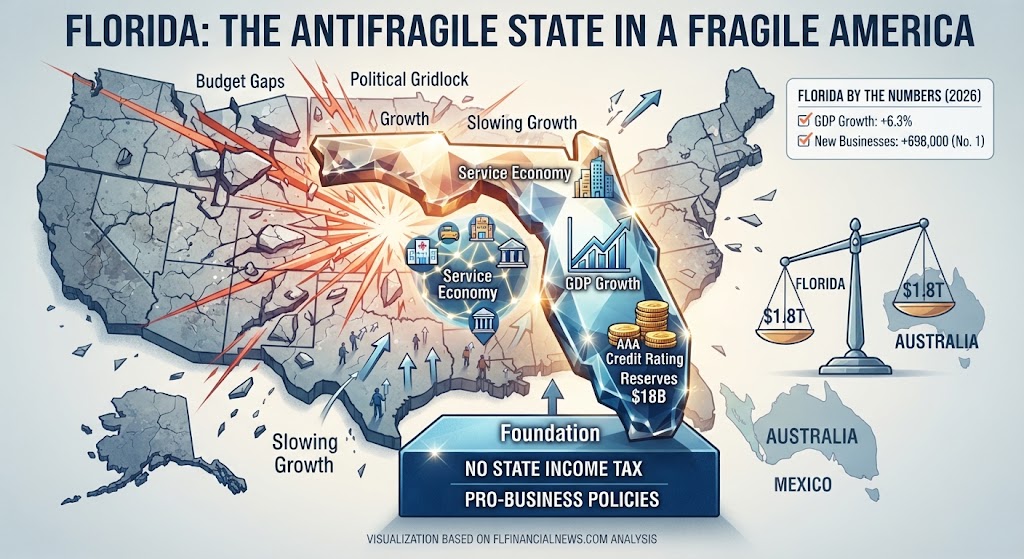
Florida fits the description of an “antifragile” state: an economy that tends to gain from stress instead of breaking under it. It has a $1.8 trillion economy that grew 6.3% in the past year, no state income tax, nearly $18 billion in reserves and AAA credit ratings. It also has a service-based economy that adapts quickly, and the land and political will to keep building.
What Does “Antifragile” Mean for a State Economy?
Author Nassim Nicholas Taleb coined the word “antifragile” for systems that gain from disorder. A fragile system breaks under pressure. A robust one holds steady. An antifragile one gets stronger.
For a state, antifragility comes down to three questions:
- When stress hits the nation, do people, capital and companies move toward the state or away from it?
- Can the economy change direction quickly when conditions change?
- Does the state have the fiscal cushion and the political will to act while others stall?
In 2026, Florida answers yes on most of these counts. America as a whole has slower population growth, strained state budgets and deep political gridlock.
Why Is Florida’s Economy Considered Antifragile?
A Service Economy That Can Change Quickly
Florida’s economy runs mostly on services: health care, tourism, finance, professional services, real estate, logistics and trade. That is a strength under stress. Service businesses can reprice, retrain and relocate faster than heavy industry tied to one factory or one commodity.
The numbers show that range:
- Health care keeps hiring: Health care and social assistance added 41,300 jobs over the past year. That demand is driven by demographics and holds up through business cycles.
- Tourism keeps setting records: Florida drew a record 143.3 million visitors in 2025, even with headwinds for national tourism.
- Global ties are diversifying: Brazil is now Florida’s second-largest international visitor market, with visitors up 10.4%.
A Pro-Business Policy Foundation
Florida’s appeal to business rests on structural choices that are hard to reverse:
- No personal state income tax: It is written into the state constitution.
- AAA credit ratings: Florida holds the top rating from every major agency.
- A full rainy-day fund: The fund is at its $5.0 billion constitutional cap, up from $1.5 billion in 2019.
- Debt paydown: More than half of the debt the state has taken on since statehood has been repaid ahead of schedule.
Entrepreneurs are responding. Florida led the nation with about 698,000 new businesses formed in 2025.
Room to Grow, and the Political Will to Build
Many coastal states have run out of buildable land, or their permitting systems make building nearly impossible. Florida still has large growth corridors along I-4, in Polk and Pasco counties, across Central Florida and in the Panhandle. These areas are absorbing new residents and companies.
Polk County has drawn 22,000 to 34,000 U.S. movers a year since 2021, among the top five counties in the nation. Pasco County posted Florida’s second-highest migration gains in 2025.
The growth also has political backing. Florida’s leaders have consistently treated growth as a goal to pursue rather than a problem to manage.
Florida by the Numbers (2026)
| Metric | Figure |
|---|---|
| State GDP | $1.8 trillion |
| GDP growth (past year) | 6.3% |
| Global economic rank | 14th |
| 2025 visitors | 143.3 million |
| New businesses formed (2025) | ~698,000 (No. 1) |
| Total state reserves | ~$18 billion |
| Rainy-day fund | $5.0 billion (capped) |
| Unemployment (Aug. 2026) | 4.5% (U.S. 4.1%) |
| CNBC Top States rank | No. 8 (from No. 3) |
How Does Florida Compare to a Fragile America?
Population pressure: Population growth in the U.S. has slowed sharply as international migration fell. Florida still gained 201,191 residents through migration in 2025. That is well below the 2022 peak, but it is still growth.
Fiscal pressure: Many states face budget gaps and pension problems. Florida’s FY 2026-27 budget totals $117.6 billion, and it is the fourth straight year of declining state spending.
Economic scale: Florida’s economy is now larger than Australia’s and Mexico’s. The Florida Chamber Foundation projects it will become a top-10 global economy by 2030.
What Are the Risks to Florida’s Antifragile Thesis?
An honest antifragile analysis has to name the stressors. In 2026 they are real:
- Domestic migration has slowed sharply: Net domestic migration fell from about 208,000 a year in 2020-2022 to roughly 22,000 in 2025, a drop of about 90%.
- Big metro counties are losing residents: Miami-Dade, Broward, Orange, Hillsborough and Pinellas all lost more residents to other counties and states than they gained.
- Insurance and housing costs: Rising property insurance and home prices are holding back middle-class newcomers.
- Unemployment is above the national rate: Florida’s 4.5% August rate is above the national 4.1% and above its own 3.8% from a year earlier.
- Rankings slipped: Florida fell to No. 8 in CNBC’s 2026 Top States for Business, down from No. 3. CNBC cited a softening housing market, concerns about power grid reliability and slower permit approvals.
- Tax-cut math: A proposed homestead exemption on the November ballot assumes continued in-migration that has already slowed.
Brian’s Take
Being antifragile does not mean being immune. It means a system can take stress and come out ahead. Florida’s 2026 numbers show both sides. Migration into the big metros has cooled, and growth is shifting to mid-sized counties like Polk, Pasco and Marion. That is how antifragility works in practice: growth moves to where the land and costs still make sense, instead of stopping.
The underlying structure is what matters most to investors and business owners. It includes no income tax, AAA credit ratings, an $18 billion cushion, a flexible service economy and leaders willing to build. Few states can match that combination. The risks are insurance, affordability and infrastructure. These are problems that capital and policy can solve, not structural decline. I would watch three indicators over the next 12 months: insurance rate filings, permit times and domestic migration into the I-4 corridor.
Frequently Asked Questions
Is Florida’s economy growing faster than the U.S. economy?
Yes. Florida’s GDP grew 6.3% over the past year. According to the Florida Chamber Foundation, Florida has outpaced national growth by an average of 2.3 percentage points over the past four years.
Why do businesses move to Florida?
The main reasons are no personal state income tax, a large workforce (CNBC ranks it No. 2 in the nation), strong access to capital and a pro-growth regulatory climate. Florida also led the nation in new business formation in 2025.
Is migration to Florida slowing down?
Yes. Net domestic migration fell about 90% from its pandemic-era peak. Total migration still added more than 201,000 residents in 2025, and growth is concentrated in mid-sized counties such as Polk, Pasco and Marion.
What is Florida’s credit rating?
Florida holds AAA ratings from every major credit rating agency. It also has nearly $18 billion in total reserves.
What are the biggest threats to Florida’s economy?
The biggest threats are property insurance costs, housing affordability, power grid reliability, slower permitting and the drop in domestic and international migration.
Sources and Further Reading
- Business Observer – “Florida GDP now bigger than Australia, Mexico” (July 2026): https://www.businessobserverfl.com/news/2026/jul/16/florida-gdp-bigger/
- Florida Chamber Foundation – 2026 Economic Outlook: https://www.flchamber.com/florida-chamber-foundations-2026-economic-outlook-predicts-florida-economy-expected-to-outperform-the-nation/
- University of Florida News – “Florida migration slowed sharply in 2025” (July 2026): https://news.ufl.edu/2026/07/florida-migration/
- Fortune – “Florida’s big tax cut plan assumes a level of migration that has already collapsed 90%” (July 2026): https://fortune.com/2026/07/15/florida-tax-cut-migration-collapse/
- WUWF / News Service of Florida – “Florida jobless rate falls for the third straight month” (Sept. 2026): https://www.wuwf.org/florida-news/2026-09-18/florida-jobless-rate-falls-for-the-third-straight-month
- Business Observer – “Report: Florida leads nation in new business creation” (Jan. 2026): https://www.businessobserverfl.com/news/2026/jan/23/florida-new-business-creation/
- Office of the Governor – Florida welcomes 143.3 million visitors in 2025: https://www.flgov.com/eog/news/press/2026/governor-ron-desantis-announces-another-record-breaking-year-florida-tourism
- Florida Department of Education – FY 2026-2027 budget signing summary: https://www.fldoe.org/newsroom/latest-news/icymi-governor-ron-desantis-signs-florida-fiscal-year-2026-2027-budget-capping-eight-years-of-conservative-leadership-and-historic-results.stml
- Gulfshore Business – “Florida falls to No. 8 in CNBC business rankings” (July 2026): https://www.gulfshorebusiness.com/gb-daily/florida-falls-to-no-8-in-cnbc-business-rankings/article_1ad28438-059e-45b0-acaa-20fa75e6665f.html
- CNBC – America’s Top States for Business 2026: https://www.cnbc.com/2026/07/09/americas-top-states-for-business-full-rankings.html
- Nassim Nicholas Taleb – Antifragile: Things That Gain from Disorder (Random House, 2012)