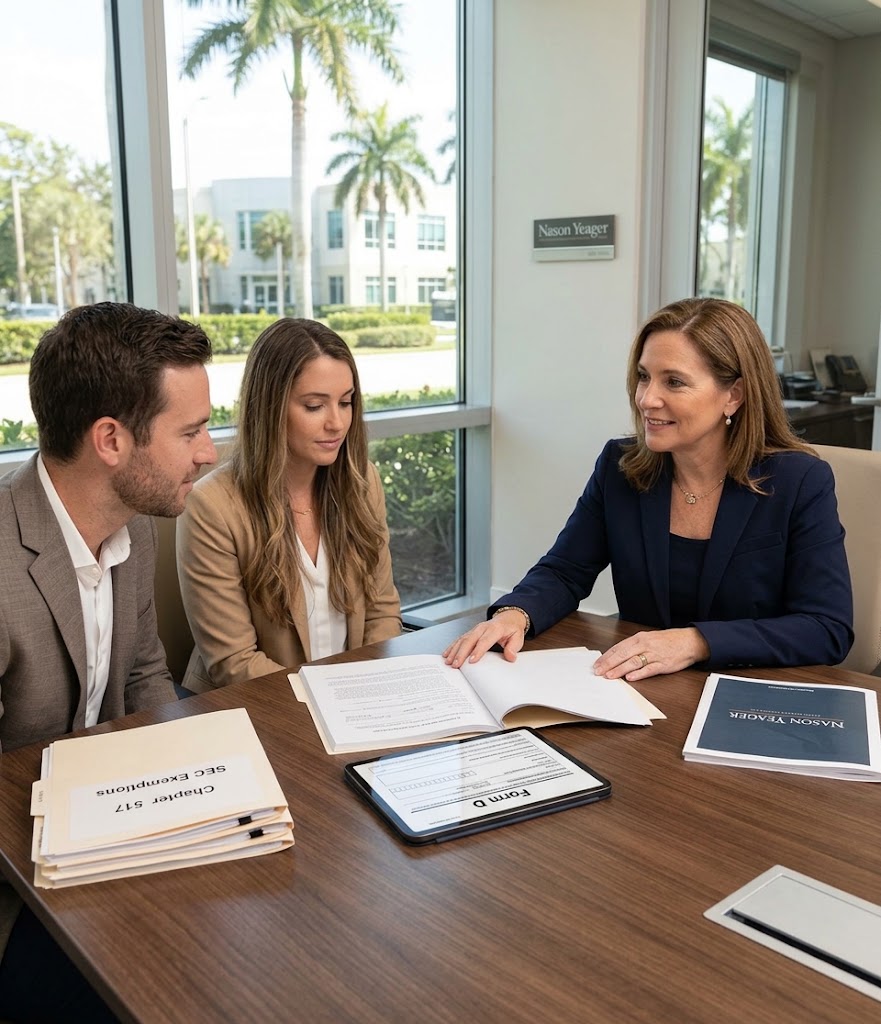
Quick Answer: Most private companies and real estate sponsors in Florida raise money under Regulation D, typically Rule 506(b) or Rule 506(c). Issuers must file Form D with the SEC within 15 days after the first sale, make any required Florida notice filing, avoid unregistered broker arrangements, and deliver accurate disclosures. Violations can give investors a right to rescind their investment under Chapter 517 of the Florida Statutes.
South Florida has become a capital formation hub. Startups in Boca Raton and Fort Lauderdale, real estate sponsors in Palm Beach County, family offices in Palm Beach, and private funds relocating from New York and California all raise money from investors. Many of those raises are completed with a subscription agreement, a wire transfer, and very little legal planning. That shortcut is one of the most common sources of later investor disputes and regulatory problems.
Nason, Yeager, Gerson, Harris & Fumero, P.A., a Palm Beach Gardens law firm founded in 1960, advises issuers, sponsors, funds, and investors on securities offerings and related disputes. As a South Fl securities law attorney resource for growing companies, the firm structures private placements, prepares offering documents, handles federal and state filings, and represents clients when investors or regulators raise concerns. This guide explains how to raise capital in Florida while managing securities law risk.
Why Almost Every Raise Involves Securities
Founders and sponsors often do not realize that what they are selling is a security. Under federal and Florida law, the term includes not only stock and bonds but also LLC membership interests, limited partnership interests, convertible notes, SAFEs, profit-sharing arrangements, and investment contracts. Under the U.S. Supreme Court’s Howey test, an investment of money in a common enterprise with an expectation of profits from the efforts of others is a security.
Every offer and sale of a security must either be registered with the SEC or qualify for an exemption. The same is true under Florida’s Securities and Investor Protection Act, Chapter 517.
Comparing the Main Exemptions
| Exemption | Raise Limit | Who Can Invest | Advertising |
|---|---|---|---|
| Rule 506(b) | Unlimited | Accredited plus up to 35 sophisticated non-accredited | No general solicitation |
| Rule 506(c) | Unlimited | Accredited only, verified | Allowed |
| Rule 504 | $10 million per 12 months | Any investor | Limited |
| Reg A Tier 2 | $75 million per 12 months | Any, with limits for non-accredited | Allowed |
| Reg CF | $5 million per 12 months | Any, with investment limits | Through portal |
Rule 506(b)
The most widely used exemption permits an unlimited raise from accredited investors and up to 35 non-accredited investors who are financially sophisticated. If any non-accredited investor participates, the issuer must provide disclosure similar to a registered offering, including financial statements. General solicitation, such as public advertising or social media promotion, is prohibited.
Rule 506(c)
Rule 506(c) allows public advertising, but every purchaser must be accredited, and the issuer must take reasonable steps to verify accredited status. Self-certification alone is generally not sufficient, although SEC staff guidance issued in 2025 indicated that high minimum investment amounts, combined with written representations, can support verification in certain circumstances.
Accredited Investor Definition
Individuals generally qualify as accredited investors if they have net worth over $1 million, excluding the value of their primary residence, or income over $200,000 individually or $300,000 jointly in each of the two most recent years with the same expectation for the current year. Since 2020, holders of certain professional licenses, including the Series 7, 65, and 82, also qualify.
Filing Requirements
Form D
An issuer relying on Regulation D must file Form D with the SEC within 15 calendar days after the first sale of securities. The date of first sale is generally when the first investor becomes irrevocably committed. Ongoing offerings require annual amendments, and material changes require amendments as well. Failing to file Form D does not by itself destroy the exemption, but it can lead to regulatory consequences, including disqualification from future Regulation D offerings if a court enjoins the issuer for the failure.
Florida Notice Filings
Florida requires notice filings and fees for certain federally covered offerings, including Rule 506 offerings sold to Florida residents, with the Office of Financial Regulation. Each state where investors reside may impose its own notice filing requirement.
Filing Disputes
Late or inaccurate filings, disputes with transfer agents, and disagreements with investors over what was disclosed are common. A South Florida SEC filing dispute law firm can correct deficiencies, respond to regulatory inquiries, and defend issuers when investors use filing errors as leverage.
The Bad Actor Rule
Rule 506(d) disqualifies an offering from the Rule 506 exemption if the issuer or certain covered persons, including directors, executive officers, 20 percent owners, promoters, and compensated solicitors, have specified disqualifying events. Those events include certain criminal convictions, court injunctions, SEC orders, and state regulatory orders. Issuers must conduct reasonable diligence on covered persons before each offering.
The Unregistered Broker Problem
Many small issuers pay “finders” a percentage of money raised. That arrangement creates serious risk.
- Federal law: Section 15(a) of the Securities Exchange Act generally requires persons who receive transaction-based compensation for selling securities to register as broker-dealers.
- Florida law: Section 517.12 requires dealers and associated persons selling securities in Florida to register unless an exemption applies.
- Rescission risk: Sales made through unregistered dealers can give investors rescission rights under Florida law.
- Contract risk: Under Section 29(b) of the Exchange Act, contracts made in violation of the Exchange Act may be voidable.
Issuers should structure compensation carefully and confirm the registration status of anyone receiving success-based fees.
Florida Rescission Rights
Section 517.211 of the Florida Statutes provides a powerful remedy. When securities are sold in violation of Florida’s registration requirements or through an unregistered dealer, the purchaser may be entitled to rescind the purchase and recover the consideration paid, plus interest, less income received, along with reasonable attorney’s fees. Section 517.301 separately prohibits fraud in connection with securities transactions.
Claims under Chapter 517 are subject to limitations periods set out in Section 95.11 of the Florida Statutes, which generally run from when the facts were discovered or should have been discovered, subject to an outside limit measured from the date of the violation. Investors and issuers should evaluate those deadlines promptly.
Real Estate Syndications
Real estate sponsors are among the most active private placement issuers in Florida. Syndications, joint ventures, and funds that pool investor money to acquire, develop, or reposition property are securities offerings.
Disclosing Entitlement Risk
Development projects depend on approvals that may be delayed, conditioned, or denied. Offering documents should describe zoning status, required approvals, environmental issues, and the timeline realistically. A sponsor that projects returns based on an approval it has not received, without clear disclosure, invites later fraud claims. Coordination with a Land Use Law Firm Palm Beach County team helps sponsors describe entitlement risk accurately. Projects in south county often involve Boca Raton Land Use lawyers who can assess the approval path before the offering launches.
Disclosing Construction Risk
Construction costs, contractor performance, insurance, and schedule risk also belong in offering documents. Sponsors working with a Boca Raton Commercial Construction law firm on contracts can describe guaranteed maximum price terms, contingencies, and bonding accurately to investors.
Investment Company Act Considerations
Funds that invest in securities, rather than directly in real estate, may need to rely on Investment Company Act exclusions such as Section 3(c)(1), which limits a fund to 100 beneficial owners, or Section 3(c)(7), which requires qualified purchasers. Fund managers may also face investment adviser registration requirements.
Investor Portals, Data, and Online Terms
Modern capital raises frequently run through online investor portals that collect identity documents, tax information, bank details, and accreditation verification materials. That data is attractive to criminals.
- Investor portals should be governed by clear terms of use, privacy notices, and electronic delivery consents. A Terms of Service Law Firm South Fl can draft terms that support e-signature validity and limit platform liability.
- Investor information is subject to Florida’s breach notification law, and many investment advisers and broker-dealers must also comply with the SEC’s amended Regulation S-P, which requires incident response programs and customer notification within 30 days after a breach of sensitive customer information. A South Fl Data Privacy Law Firm can align portal practices with those obligations.
When Problems Become Enforcement Matters
Most offering problems are resolved privately with investors. Some escalate to the SEC or the Florida Office of Financial Regulation. Common triggers include investor complaints, failed projects, misuse of offering proceeds, commingling of funds, Ponzi-like payment structures, and misleading marketing.
An SEC violation Law Firm Boca Raton Fl issuers rely on can respond to subpoenas and inquiries, negotiate with regulators, and coordinate with investor litigation. Early, candid assessment of the facts is usually the best way to limit consequences.
Building a Compliant Offering Process
A disciplined process protects issuers far better than any single document. The following sequence works for most private raises.
Before Launch
Confirm the corporate or LLC structure, cap table, and authority to issue securities. Select the exemption based on the investor base and marketing plan. Run bad actor checks on every covered person. Decide whether any intermediary will be compensated, and confirm registration status.
Offering Documents
Prepare a private placement memorandum or equivalent disclosure document that explains the business, management, use of proceeds, conflicts of interest, risk factors, and the terms of the securities. Include subscription agreements with investor representations and an investor questionnaire that supports accredited status. Projections should be clearly labeled, supported by stated assumptions, and accompanied by meaningful cautionary language.
During the Offering
Keep a log of every offeree and how each was contacted, which is especially important for 506(b) offerings. Hold investor funds in a segregated account until any minimum is met. Make sure marketing materials match the offering documents.
After Closing
File Form D and state notices on time. Send investors regular reports, including financial statements when promised. Document any material changes and amend offering materials if the raise continues. Consistent communication with investors is one of the most effective ways to prevent disputes when a project or business faces setbacks.
Common Mistakes to Avoid
- Treating LLC interests or notes as “not securities.”
- Advertising a 506(b) offering on social media or at public events.
- Accepting non-accredited investors without required disclosure.
- Paying unregistered finders a percentage of funds raised.
- Missing Form D and state notice filings.
- Using projections without assumptions or risk disclosure.
- Commingling investor funds with operating or personal accounts.
- Failing to run bad actor checks on promoters and officers.
- Ignoring data security for investor portals and subscription documents.
Frequently Asked Questions
Do I need to register my private offering with the SEC?
Usually not, if it qualifies for an exemption such as Rule 506(b) or 506(c). The issuer must still file Form D within 15 days of the first sale and comply with state notice requirements.
Can I advertise my investment opportunity online?
Only if you use an exemption that permits general solicitation, such as Rule 506(c), Regulation A, or Regulation Crowdfunding through a registered portal, and you comply with its conditions.
Can I pay someone a commission for bringing in investors?
Paying transaction-based compensation to someone who is not a registered broker-dealer creates significant federal and Florida law risk, including possible investor rescission rights.
What happens if I violate Florida securities law?
Investors may be able to rescind their purchase and recover their money with interest and attorney’s fees, and the Florida Office of Financial Regulation may bring administrative or civil action.
Is a SAFE or convertible note a security?
Yes. SAFEs and convertible notes sold to investors are securities and must be offered under a valid exemption.
Who is an accredited investor?
Generally, individuals with net worth over $1 million excluding their home, income above $200,000 individually or $300,000 jointly, or certain licensed financial professionals, as well as qualifying entities.
Key Takeaways
- Nearly every private investment offering is a securities offering.
- Rule 506(b) and 506(c) are the most common exemptions, each with strict conditions.
- Form D is due within 15 days after the first sale.
- Unregistered finders and inaccurate disclosures create Florida rescission risk.
- Real estate sponsors should disclose entitlement and construction risk carefully.
Contact Nason Yeager
Nason, Yeager, Gerson, Harris & Fumero, P.A. serves clients throughout Florida from four offices. Website: nasonyeager.com
Palm Beach Gardens: (561) 686-3307 | Seacoast National Centre, 3001 PGA Boulevard, Suite 305, Palm Beach Gardens, FL 33410
Boca Raton: (561) 982-7114 | 750 Park of Commerce Boulevard, Suite 210, Boca Raton, FL 33487
Fort Lauderdale: (561) 686-3307 | 110 East Broward Boulevard, Suite 1010, Fort Lauderdale, FL 33301
Tampa/St. Petersburg (By Appointment Only): (561) 686-3307 | First Central Tower, 360 Central Avenue, Suite 800, St. Petersburg, FL 33701
This article provides general information and is not legal advice. Consult a qualified attorney about your specific situation.
Sources and Further Reading
- Regulation D, 17 C.F.R. §§ 230.500–230.508 – U.S. Securities and Exchange Commission
- Filing a Form D Notice – U.S. Securities and Exchange Commission
- Accredited Investor Definition Amendments (2020) – U.S. Securities and Exchange Commission
- Disqualification of Felons and Other Bad Actors From Rule 506 Offerings – U.S. Securities and Exchange Commission
- SEC v. W.J. Howey Co., 328 U.S. 293 (1946) – U.S. Supreme Court
- Florida Securities and Investor Protection Act, Chapter 517, Florida Statutes – Florida Legislature
- Section 95.11, Florida Statutes (Limitations of Actions) – Florida Legislature
- Securities Exchange Act of 1934, Sections 15(a) and 29(b) – U.S. Code
- Regulation S-P Amendments (2024) – U.S. Securities and Exchange Commission
- Investment Company Act of 1940, Sections 3(c)(1) and 3(c)(7) – U.S. Code