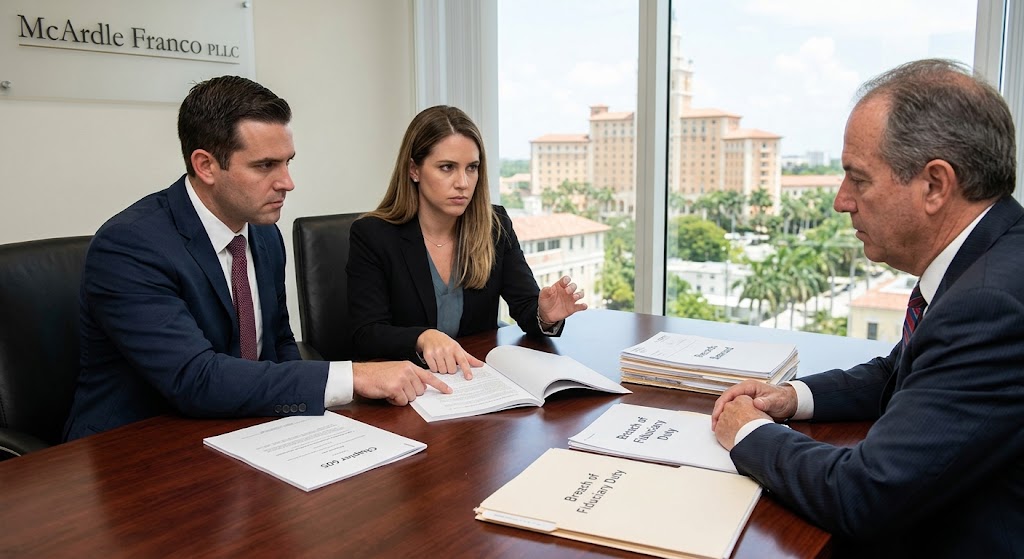
Quick Answer: When co-owners of a Florida corporation or LLC disagree, their rights come from the company’s governing documents and from Florida’s Business Corporation Act and Revised LLC Act. Common remedies include books-and-records demands, derivative lawsuits, claims for breach of fiduciary duty, judicial dissolution for deadlock or oppression, and court-supervised or negotiated buyouts. Most disputes are resolved through negotiation or mediation, but owners should preserve evidence and act quickly to protect their interests.
Most businesses in South Florida are closely held. Family companies, real estate partnerships, restaurant groups, professional practices, investment vehicles, and startups are typically owned by a handful of people who once trusted each other completely. When those relationships break down over money, control, strategy, or a family rift, the result can threaten the company itself. Bank accounts are frozen, employees take sides, customers notice, and value erodes while the owners fight.
McArdle Franco PLLC, a Coral Gables law firm established in 2002, represents business owners, investors, and companies in commercial disputes throughout Florida. As a South Florida business litigation law firm whose lawyers also handle corporate structuring and transactions, the firm understands both how ownership arrangements are built and how they come apart. This article explains how Florida law treats disputes among co-owners and what options are available.
Why Co-Owner Disputes Happen
| Trigger | Typical Conflict |
|---|---|
| Unequal effort | One owner works full time, another is passive |
| Compensation | Salaries, bonuses, or perks seen as disguised distributions |
| Distributions | Majority withholds profits to pressure minority |
| Strategy | Disagreement over growth, debt, sale, or exit |
| Information | Minority denied access to financial records |
| Self-dealing | Owner diverts opportunities or contracts with own affiliates |
| Family transitions | Death, divorce, or next generation joins ownership |
| Deadlock | Equal owners cannot make decisions |
Recognizing which kind of dispute is underway helps identify the right legal tools.
Start With the Governing Documents
The first step in any co-owner dispute is reviewing the company’s documents. For corporations, that means the articles of incorporation, bylaws, and any shareholder agreement. For LLCs, it means the articles of organization and operating agreement. For partnerships, it means the partnership agreement.
These documents often control:
- Voting rights and which decisions require supermajority or unanimous approval
- Management authority of officers, managers, or managing members
- Transfer restrictions and rights of first refusal
- Buy-sell provisions triggered by death, disability, deadlock, or departure
- Valuation methods for buyouts
- Dispute resolution clauses, including mediation and arbitration
- Fiduciary duty modifications, particularly in LLC operating agreements
Florida’s statutes provide default rules when documents are silent, but well-drafted agreements usually govern. A Coral Gables business dispute lawyer will analyze these documents before recommending any course of action.
Information Rights
Minority owners frequently lack access to the information needed to evaluate whether they are being treated fairly.
Corporations
Under Section 607.1602 of the Florida Statutes, shareholders have the right to inspect and copy certain corporate records upon written demand made at least five business days in advance, and broader categories of records if the demand is made in good faith, for a proper purpose, and describes the records with reasonable particularity. If the corporation refuses, the shareholder may ask a court to order inspection and may recover costs, including attorney’s fees, in many circumstances.
LLCs
Under Section 605.0410, members of an LLC have information rights that depend on whether the LLC is member-managed or manager-managed. Members of manager-managed LLCs may obtain information that is material to their rights and duties under the operating agreement or the statute, subject to reasonable conditions.
A well-documented records demand is often the first formal step in a dispute. It can reveal problems, create leverage, and sometimes resolve misunderstandings.
Fiduciary Duties Among Owners
Directors, Officers, and Controlling Shareholders
Directors and officers of Florida corporations owe duties of care and loyalty to the corporation. They must act in good faith, with the care an ordinarily prudent person would exercise, and in a manner they reasonably believe to be in the corporation’s best interests. Transactions in which a director has a conflict of interest are scrutinized under Section 607.0832.
LLC Members and Managers
Under Section 605.04091, members of member-managed LLCs and managers of manager-managed LLCs owe duties of loyalty and care to the company and its members. The duty of loyalty includes accounting for company property and opportunities, refraining from dealing with the company on behalf of adverse parties, and refraining from competing with the company. Operating agreements may modify, but generally cannot eliminate, those duties.
Common Breaches
- Diverting corporate opportunities to an owner’s other businesses
- Paying excessive compensation to controlling owners
- Entering self-dealing contracts with affiliates
- Using company assets for personal purposes
- Freezing out minority owners from management and distributions
- Concealing financial information
Derivative Versus Direct Claims
A central question in owner disputes is whether a claim belongs to the company or to the individual owner.
Derivative Claims
When the harm is to the company, such as diversion of assets or opportunities, the claim generally belongs to the company and must be brought derivatively. Before filing a derivative suit on behalf of a Florida corporation, a shareholder must generally make a written demand on the corporation and wait 90 days, unless the demand is rejected earlier or irreparable injury would result. Similar requirements apply to LLCs under Section 605.0802.
Direct Claims
A direct claim is appropriate when the owner suffered a harm separate from other owners or when a special duty was owed to the owner individually. Florida courts apply a two-part test from cases including Dinuro Investments, LLC v. Camacho (Fla. 3d DCA 2015), which examines whether the owner suffered a direct harm and a special injury, or whether there is a separate statutory or contractual duty owed to the owner.
Choosing the wrong vehicle can result in dismissal, so this analysis matters from the start. A shareholder dispute attorney Miami business owners consult can evaluate which claims belong to whom.
Judicial Dissolution and Court-Ordered Remedies
When owners cannot resolve their differences, Florida law allows courts to dissolve the company or grant alternative relief in certain circumstances.
Corporations
Under Section 607.1430, a court may dissolve a corporation in a proceeding by a shareholder if:
- The directors are deadlocked in management, the shareholders cannot break the deadlock, and irreparable injury is threatened or the business can no longer be conducted to the advantage of shareholders generally
- The shareholders are deadlocked in voting and have failed to elect directors for a statutory period
- Corporate assets are being misapplied or wasted
- Those in control have acted in a manner that is illegal or fraudulent
The Buyout Election
Section 607.1436 allows the corporation or other shareholders to elect to purchase the petitioning shareholder’s shares at fair value, which can convert a dissolution case into a valuation dispute. If the parties cannot agree, the court determines fair value. This mechanism often shapes settlement negotiations.
LLCs
Under Section 605.0702, a court may dissolve an LLC if, among other grounds, the conduct of its activities is unlawful, it is not reasonably practicable to carry on the company’s activities in conformity with its governing documents, or the managers or controlling members have acted illegally or fraudulently or are wasting company assets. Courts may also order alternative remedies, such as appointing a receiver or custodian.
Receivers and Custodians
When a company is deadlocked or assets are at risk, a court may appoint a receiver or custodian to manage the business during the litigation. This is an extraordinary remedy, but it can preserve value when owners are paralyzed.
Valuation Disputes
Most owner disputes ultimately become disputes about price. Key valuation questions include:
| Issue | Why It Matters |
|---|---|
| Standard of value | Fair value versus fair market value |
| Valuation date | Before or after the alleged wrongdoing |
| Discounts | Minority and marketability discounts may or may not apply |
| Normalization | Adjusting for excess owner compensation or personal expenses |
| Contract formula | Buy-sell agreements may fix the method |
Independent valuation experts, forensic accountants, and careful financial analysis are essential. Disputes over valuation can often be narrowed through expert exchanges and mediation.
Partnership Disputes
General and limited partnerships are governed by Florida’s Revised Uniform Partnership Act and Revised Uniform Limited Partnership Act. Partners owe each other duties of loyalty and care, and partnership agreements typically address dissociation, withdrawal, and buyout rights. Real estate partnerships and joint ventures are common in South Florida and frequently generate disputes over capital calls, management fees, sale timing, and distribution waterfalls.
Special Issues in Family-Owned Companies
Family businesses are among the most common sources of owner disputes in South Florida, and they bring their own complications.
Generational Transitions
When founders pass ownership to children, siblings may receive equal shares but play very different roles. A child who runs the business day to day may expect greater compensation or control, while siblings who are passive owners may expect regular distributions. Without clear agreements, those expectations collide.
Death of an Owner
When an owner dies, the interest may pass to a surviving spouse, children, or a trust. New owners may have no business experience and different financial needs. Personal representatives and trustees also owe fiduciary duties to beneficiaries, which can create additional claims. Buy-sell agreements and estate plans that address the business directly reduce these risks.
Divorce
A divorcing spouse may claim an interest in the business or its appreciation as a marital asset. Transfer restrictions and buy-sell provisions can protect the company, but they must be drafted carefully and consistently with Florida family law.
Emotional Dynamics
Family disputes often involve long-standing personal conflicts that have little to do with the business. Experienced counsel can help separate legal and financial issues from personal ones, and mediators with family business experience can be especially effective.
Protecting the Company During the Dispute
Whatever the cause, the company’s employees, customers, lenders, and vendors should be insulated from the conflict as much as possible. Interim agreements governing who signs checks, who manages operations, and how information is shared can prevent damage while the dispute is resolved.
Practical Steps When a Dispute Begins
- Review governing documents and identify dispute resolution requirements.
- Preserve evidence, including emails, texts, financial records, and bank statements.
- Avoid self-help, such as locking out co-owners or moving funds, which can create liability.
- Make a records demand to understand the company’s financial position.
- Evaluate fiduciary claims and whether they are direct or derivative.
- Consider interim protection, such as injunctions or receivers, if assets are at risk.
- Explore negotiated exits, including buyouts, splits, or sales.
- Engage in mediation, which resolves most owner disputes.
The Role of Alternative Dispute Resolution
Owner disputes are often personal, and public litigation can harm both the company and its relationships. Mediation allows owners to reach creative solutions, such as dividing assets, restructuring ownership, or staged buyouts, that a court could not order. Many operating and shareholder agreements require arbitration, which offers privacy and the ability to choose a decision-maker with business expertise.
McArdle Franco’s litigators routinely represent clients in arbitration and mediation and work alongside the firm’s transactional lawyers to design settlement structures that actually work, including new operating agreements, promissory notes, and security arrangements.
Preventing Future Disputes
The best time to address owner disputes is before they happen. A Florida contract dispute law firm that also drafts governing documents will recommend:
- Clear decision-making rules and deadlock-breaking mechanisms
- Buy-sell provisions with realistic valuation methods and funding
- Defined roles, compensation, and expectations for each owner
- Information rights and regular financial reporting
- Dispute resolution clauses requiring mediation before litigation
- Restrictive covenants appropriate under Section 542.335
Related Disputes
Owner disputes often overlap with other commercial conflicts. A company’s lease, loan, or acquisition agreements may be affected when owners fight. A Miami commercial litigation attorney evaluating an owner dispute will also look at the company’s obligations to third parties. Businesses that operate from leased premises may need a South Fl commercial lease litigation attorney if the dispute affects rent payments, guaranties, or occupancy.
Frequently Asked Questions
Can a majority owner force out a minority owner in Florida?
Not without a contractual or legal basis. Governing documents may provide buyout rights, but majority owners who freeze out minority owners, withhold distributions in bad faith, or engage in self-dealing may face fiduciary duty claims and judicial dissolution proceedings.
What can I do if my business partner won’t show me the books?
Send a written records demand under Section 607.1602 for corporations or Section 605.0410 for LLCs. If the company refuses, a court can order inspection and may award attorney’s fees.
What is a derivative lawsuit?
It is a lawsuit brought by an owner on behalf of the company to recover for harm done to the company. Florida generally requires a written demand on the company and a waiting period before filing.
Can a court dissolve my company?
Yes, in certain circumstances, including deadlock, misapplication or waste of assets, or illegal or fraudulent conduct by those in control. Courts may also order alternative relief, such as a buyout or receivership.
How is my ownership interest valued in a buyout?
It depends on the governing documents and the legal proceeding. Statutory buyouts in dissolution cases use fair value, while buy-sell agreements may specify a formula or appraisal process.
Do I have to arbitrate my dispute?
If the operating agreement, shareholder agreement, or partnership agreement contains an arbitration clause, Florida courts generally enforce it.
Key Takeaways
- Governing documents control most co-owner disputes.
- Florida law gives owners information rights enforceable in court.
- Fiduciary duty claims may be direct or derivative, and the distinction matters.
- Judicial dissolution and statutory buyouts provide remedies for deadlock and misconduct.
- Mediation and arbitration resolve most owner disputes efficiently.
About McArdle Franco PLLC
McArdle Franco PLLC is a Coral Gables law firm established in 2002 that counsels and represents businesses throughout Florida, across the nation, and internationally in business litigation, real estate, land development and construction, business structuring, and transaction structuring. The firm’s litigators practice in state and federal court and represent clients in arbitration, mediation, and administrative proceedings. The firm was named a Tier 2 firm in Miami for Litigation – Construction in the 2026 edition of Best Law Firms® and was ranked in Chambers USA 2025 for Litigation: General Commercial in Florida.
Contact McArdle Franco PLLC
Address: 255 Alhambra Circle, Suite 925, Coral Gables, FL 33134
Phone: (305) 442-2214
Email: info@mcper.com
Website: mcardlefranco.com
This article provides general information and is not legal advice. Consult a qualified attorney about your specific situation.
Sources and Further Reading
- Florida Business Corporation Act, Chapter 607, Florida Statutes – Florida Legislature
- Florida Revised Limited Liability Company Act, Chapter 605, Florida Statutes – Florida Legislature
- Inspection of Records by Shareholders, Section 607.1602, Florida Statutes – Florida Legislature
- Grounds for Judicial Dissolution, Section 607.1430, Florida Statutes – Florida Legislature
- Election to Purchase Instead of Dissolution, Section 607.1436, Florida Statutes – Florida Legislature
- Standards of Conduct for Members and Managers, Section 605.04091, Florida Statutes – Florida Legislature
- Dinuro Investments, LLC v. Camacho, 141 So. 3d 731 (Fla. 3d DCA 2015) – Florida Third District Court of Appeal
- Revised Uniform Partnership Act, Chapter 620, Florida Statutes – Florida Legislature
- Business Litigation Practice – McArdle Franco PLLC
- Best Law Firms 2026 and Chambers USA 2025 Rankings – McArdle Franco PLLC Press Release