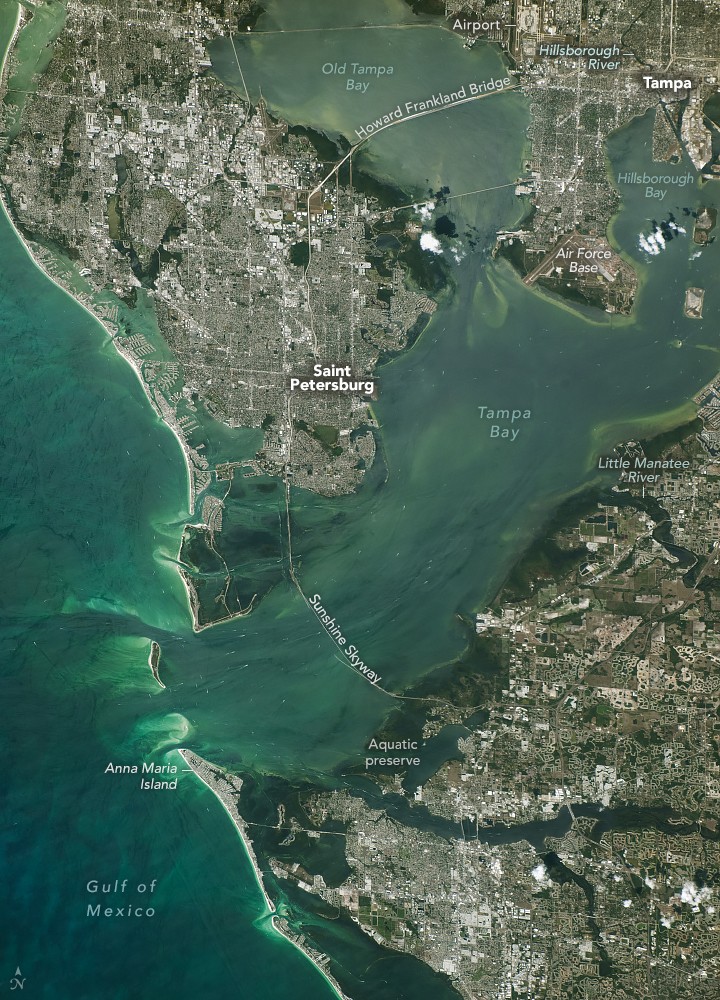
Tampa Bay and the St. Petersburg peninsula, home of Raymond James Financial, photographed from the International Space Station. Source: NASA, public domain
Quick Answer: St. Petersburg-based Raymond James Financial (NYSE: RJF) reported record fiscal 2026 results on October 28, 2026: net revenues of $15.79 billion (up 12%), net income available to common shareholders of $2.37 billion (up 11%) and diluted earnings per share of $11.91 (up 16%). Client assets under administration reached $1.94 trillion, record advisor recruiting drove $98 billion of domestic net new assets, and the company returned about $1.7 billion to shareholders.
One of Florida’s best-known homegrown financial companies just closed out another record year. Raymond James Financial, the St. Petersburg wealth management, investment banking, asset management and banking group, reported results for its fiscal year ended September 30, 2026, in a Form 8-K filed October 28, 2026. Chief Executive Officer Paul Shoukry described the period as the firm’s sixth consecutive year of record annual revenues and earnings.
The more useful story sits beneath the headline numbers: where the growth came from, what it cost, and how the company, founded in 1962, is spending its capital.
What did Raymond James report for fiscal 2026?
How much revenue and profit did the company earn?
Net revenues for fiscal 2026 totaled $15.791 billion, up 12% from fiscal 2025’s record of about $14.07 billion. Pre-tax income rose to $3.075 billion from $2.714 billion. Net income available to common shareholders climbed 11% to $2.365 billion from $2.130 billion, and diluted earnings per share rose 16% to $11.91 from $10.30. On an adjusted, non-GAAP basis diluted EPS was $12.41, up 16% from $10.66.
Earnings per share grew faster than net income because the share count shrank. Common shares outstanding fell to 192.0 million at September 30, 2026, from 198.1 million a year earlier because of buybacks.
How did the fourth quarter look?
In the fiscal fourth quarter (July through September 2026), net revenues were $4.269 billion, up 15% from the prior-year quarter and 9% from the fiscal third quarter. Net income available to common shareholders was $666 million, up 10%, and diluted EPS was $3.40, up 15%. Adjusted diluted EPS was $3.59. Both revenue and adjusted EPS topped consensus estimates, according to 24/7 Wall St.
Return on common equity was 20.6% for the quarter and 18.7% for the full year. Adjusted return on tangible common equity was 26.6% for the quarter and 23.0% for the year.
| Metric | Fiscal 2026 | Fiscal 2025 | Change |
|---|---|---|---|
| Net revenues | $15.79 billion | $14.07 billion | +12% |
| Pre-tax income | $3.075 billion | $2.714 billion | +13% |
| Net income available to common | $2.365 billion | $2.130 billion | +11% |
| Diluted EPS | $11.91 | $10.30 | +16% |
| Adjusted diluted EPS (non-GAAP) | $12.41 | $10.66 | +16% |
| Client assets under administration | $1.94 trillion | $1.73 trillion | +12% |
| Book value per share | $68.38 | $62.72 | +9% |
| Common shares outstanding | 192.0 million | 198.1 million | -3% |
Source: Raymond James Financial fiscal 2026 earnings release and investor presentation (Form 8-K, Oct. 28, 2026); fiscal 2025 revenue and client assets as reported by the company for the year ended Sept. 30, 2025.
Which business segments drove the growth?
All four operating segments grew revenue in fiscal 2026, but profit growth was uneven.
| Segment | FY2026 net revenues | Revenue change | FY2026 pre-tax income | Pre-tax change |
|---|---|---|---|---|
| Private Client Group | $11.475 billion | +13% | $1.736 billion | +1% |
| Capital Markets | $1.870 billion | +6% | $214 million | +47% |
| Asset Management | $1.424 billion | +20% | $593 million | +18% |
| Bank | $1.944 billion | +9% | $725 million | +48% |
Source: Raymond James Financial fiscal 2026 earnings release (Form 8-K, Oct. 28, 2026). Segment figures do not sum to consolidated totals because of the Other segment and intersegment eliminations.
Why did Private Client Group profit barely move?
The Private Client Group, the network of financial advisors who serve individual investors, is the core of the company. It generated about 73% of consolidated net revenues in fiscal 2026. Segment revenue rose 13% to $11.475 billion, helped by rising market values in fee-based accounts. PCG assets in fee-based accounts reached $1.163 trillion at September 30, 2026, up 15% from a year earlier.
Pre-tax income, however, rose only 1% to $1.736 billion. The main reason is deliberate spending on advisor recruiting. The company reported PCG recruiting and retention-related compensation of $460 million for fiscal 2026, up 24%, including $125 million in the fourth quarter alone, up 28%. In the fourth quarter, segment pre-tax income did pick up, rising 10% to $458 million on revenue of $3.056 billion.
What happened in Capital Markets?
Capital Markets, which houses investment banking, fixed income and public finance, posted fiscal 2026 net revenues of $1.870 billion, up 6%, and pre-tax income of $214 million, up 47%. The fourth quarter was notably stronger: segment revenue rose 7% year over year and 15% sequentially, and investment banking revenues reached $361 million, up 17% from a year earlier and 27% from the prior quarter, led by mergers and acquisitions advisory work, affordable housing investments and debt underwriting. Fixed income brokerage revenues were lower. On the earnings call, management also pointed to recent additions including GreensLedge and MBS Capital Markets, the latter folded into the public finance business.
How did Asset Management and the Bank perform?
Asset Management had the fastest revenue growth of any segment, up 20% to $1.424 billion, with pre-tax income up 18% to $593 million. Financial assets under management reached $342.9 billion at September 30, 2026, up 25% from a year earlier, though down 1% from June. Part of that growth came from Clark Capital Management Group, an investment manager whose acquisition Raymond James completed on May 1, 2026, and which now operates as an independent boutique within Raymond James Investment Management.
The Bank segment, which includes Raymond James Bank, a Florida-chartered state member bank supervised by the Federal Reserve and the Florida Office of Financial Regulation, posted record pre-tax income of $725 million, up 48%, on net revenues of $1.944 billion, up 9%. Net bank loans hit a record $57.5 billion, up 11%, and bank deposits stood at $63.3 billion. Securities-based loans, which let clients borrow against investment portfolios, grew 32% to $26.2 billion and now account for roughly 46% of net loans. Residential mortgage loans rose 12%. Management said credit quality remains strong, and the bank recorded an $8 million benefit for credit losses in the fourth quarter.
One soft spot: the Bank segment’s net interest margin was 2.60% in the fourth quarter, down 11 basis points from both the prior year and the prior quarter, and quarterly Bank pre-tax income of $180 million was down 13% from the fiscal third quarter even though it was up 35% year over year.
How many advisors does Raymond James have, and how is recruiting going?
What is the latest advisor count?
Raymond James now discloses its financial advisor headcount annually rather than quarterly, and the fiscal 2026 earnings release and call did not include an updated total. The most recent figure in the company’s annual report on Form 10-K is 8,943 financial advisors as of September 30, 2025: 3,878 employee advisors and 5,065 independent contractor advisors. That 10-K also reported approximately 19,500 associates. The fiscal 2026 10-K, which typically follows in late November, should update both numbers.
How big was fiscal 2026 recruiting?
On the October 2026 earnings call, Shoukry said advisors recruited in the domestic employee and independent contractor channels during fiscal 2026 had trailing 12-month production of $538 million, up from $407 million in fiscal 2025, and managed more than $82 billion of client assets at their prior firms, compared with about $58 billion the prior year. The company called these record recruiting results and also cited strong advisor retention.
The payoff shows up in asset flows. Domestic PCG net new assets totaled $98.3 billion in fiscal 2026, up 88% from $52.4 billion in fiscal 2025, representing a 6.4% growth rate on beginning-of-year assets. Fourth-quarter domestic net new assets were $22.8 billion, a 5.3% annualized pace.
| Recruiting and flow metric | Fiscal 2026 | Fiscal 2025 |
|---|---|---|
| Trailing 12-month production of recruits | $538 million | $407 million |
| Client assets at recruits’ prior firms | More than $82 billion | About $58 billion |
| Domestic PCG net new assets | $98.3 billion | $52.4 billion |
| PCG recruiting and retention compensation | $460 million (+24%) | Not separately compared |
| Total financial advisors (year end) | Not yet disclosed | 8,943 |
Source: Raymond James fiscal 2026 earnings release and Q4 fiscal 2026 earnings call; Raymond James Form 10-K for fiscal 2025; InvestmentNews coverage of fiscal 2025 results.
Is the recruiting spending worth it?
The reported numbers cut both ways. The firm spent $460 million on recruiting and retention compensation in a single year and saw PCG pre-tax income essentially flat despite 13% revenue growth. But it brought in advisors producing $538 million of annual revenue and nearly doubled net new assets, which feed fee-based revenue, cash balances for the bank and assets for the asset management arm in future years. Management has said it expects an adjusted compensation ratio of about 65% given its business mix, and the full-year adjusted pre-tax margin of 20.3% came in above the company’s 20% target.
How much capital did Raymond James return to shareholders?
Raymond James returned approximately $1.7 billion to shareholders in fiscal 2026 through share repurchases and dividends, up from more than $1.5 billion in fiscal 2025. Buybacks accounted for $1.25 billion, covering roughly 8 million shares at an average price of $156. Repurchases slowed sharply in the fourth quarter to $50 million; on the earnings call, management indicated buybacks had been paused while the company evaluated acquisition opportunities. As of September 30, 2026, $1.05 billion remained under the board’s repurchase authorization.
The quarterly common dividend was $0.54 per share, including the payment made on October 15, 2026, to shareholders of record on October 1. Fourth-quarter common dividends totaled $104 million.
The company estimated a Tier 1 leverage ratio of 12.1% and a total capital ratio of 24.2% at fiscal year end, well above regulatory minimums. Total common equity attributable to the company was $13.1 billion, up from $12.4 billion, and tangible book value per share rose to $55.96 from $54.12.
What does Raymond James mean for Florida’s economy?
How large is its Florida footprint?
Raymond James is incorporated in Florida and keeps its principal executive offices at 880 Carillon Parkway in St. Petersburg. According to its most recent 10-K, its principal location consists of about 1.25 million square feet of office space that it owns in the Carillon Office Park. It also owns about 65 acres in Pasco County held for potential development. Local reporting notes that the Wesley Chapel site, purchased in 2016 after incentive agreements with Pasco County and the state, still had no vertical construction as of April 2026.
The company does not break out Florida employment in its filings. What is clear is that the corporate headquarters campus and the Florida-chartered bank are rooted in the Tampa Bay area, and on the earnings call Shoukry referred to visiting recruiting meetings at the home office. The company has said it spends about $1.1 billion a year on technology for its platform.
What should readers watch in fiscal 2027?
Management offered no formal revenue or earnings guidance for fiscal 2027 but cited record client asset levels and a strong investment banking pipeline, while acknowledging several geopolitical and macroeconomic uncertainties. Specific items to watch include:
- Cash balances and interest income. Domestic cash sweep and Enhanced Savings Program balances were $57.96 billion at September 30, 2026, down 1% from June. Management told analysts it expects combined net interest income and bank deposit program fees in the first fiscal quarter of 2027 to be up about 1% from the fourth quarter’s $674 million.
- Expenses. The company guided to non-compensation expenses of about $2.5 billion in fiscal 2027, roughly 8% growth, and an effective tax rate of about 25%.
- Buybacks and deals. With $1.05 billion of authorization left and capital ratios well above minimums, the balance between repurchases and acquisitions will be closely watched.
This article is news and analysis based on public company disclosures and is not investment, tax or legal advice.
Frequently Asked Questions
When does Raymond James’ fiscal year end?
Raymond James’ fiscal year ends September 30. Fiscal 2026 covered October 1, 2025, through September 30, 2026, and results were released October 28, 2026.
How much in client assets does Raymond James oversee?
Client assets under administration were $1.94 trillion at September 30, 2026, up 12% year over year. PCG assets in fee-based accounts were $1.16 trillion and financial assets under management were $342.9 billion.
Where is Raymond James headquartered?
The company is headquartered at 880 Carillon Parkway in St. Petersburg, Florida, where it owns about 1.25 million square feet of office space in the Carillon Office Park. It is incorporated in Florida and has been publicly traded on the New York Stock Exchange under the symbol RJF since 1983.
How many financial advisors work with Raymond James?
The latest disclosed figure is 8,943 advisors as of September 30, 2025. The company reports headcount annually, and an updated figure was not included in the fiscal 2026 earnings release.
Sources and Further Reading
- Raymond James Financial Reports Fourth Quarter and Fiscal 2026 Results, earnings release filed on Form 8-K, Raymond James Financial, Inc. / U.S. Securities and Exchange Commission
- Fiscal Fourth Quarter 2026 Earnings Presentation, filed on Form 8-K, Raymond James Financial, Inc. / U.S. Securities and Exchange Commission
- Raymond James Financial Q4 Fiscal 2026 Earnings Call Transcript, via Webull
- Form 10-K for the Fiscal Year Ended September 30, 2025, Raymond James Financial, Inc. / U.S. Securities and Exchange Commission
- Raymond James Financial Declares Quarterly Dividend on Common Stock (August 26, 2026), Raymond James Financial, Inc.
- Raymond James Completes Acquisition of Clark Capital Management Group (May 1, 2026), Raymond James Financial, Inc.
- Raymond James Says Advisor Choice Its Biggest Recruiting Advantage, The Wealth Advisor
- Raymond James Posts Record Earnings, Hails Advisor Growth in Q4 (fiscal 2025), InvestmentNews
- Raymond James Q4 2026: EPS Beats Expectations on Record Recruiting, 24/7 Wall St.
- Tampa Bay’s Top Companies No. 2: Raymond James, Tampa Bay Business and Wealth
- The Raymond James Office Campus That Wesley Chapel Has Never Seen Built, Wesley Chapel Community News