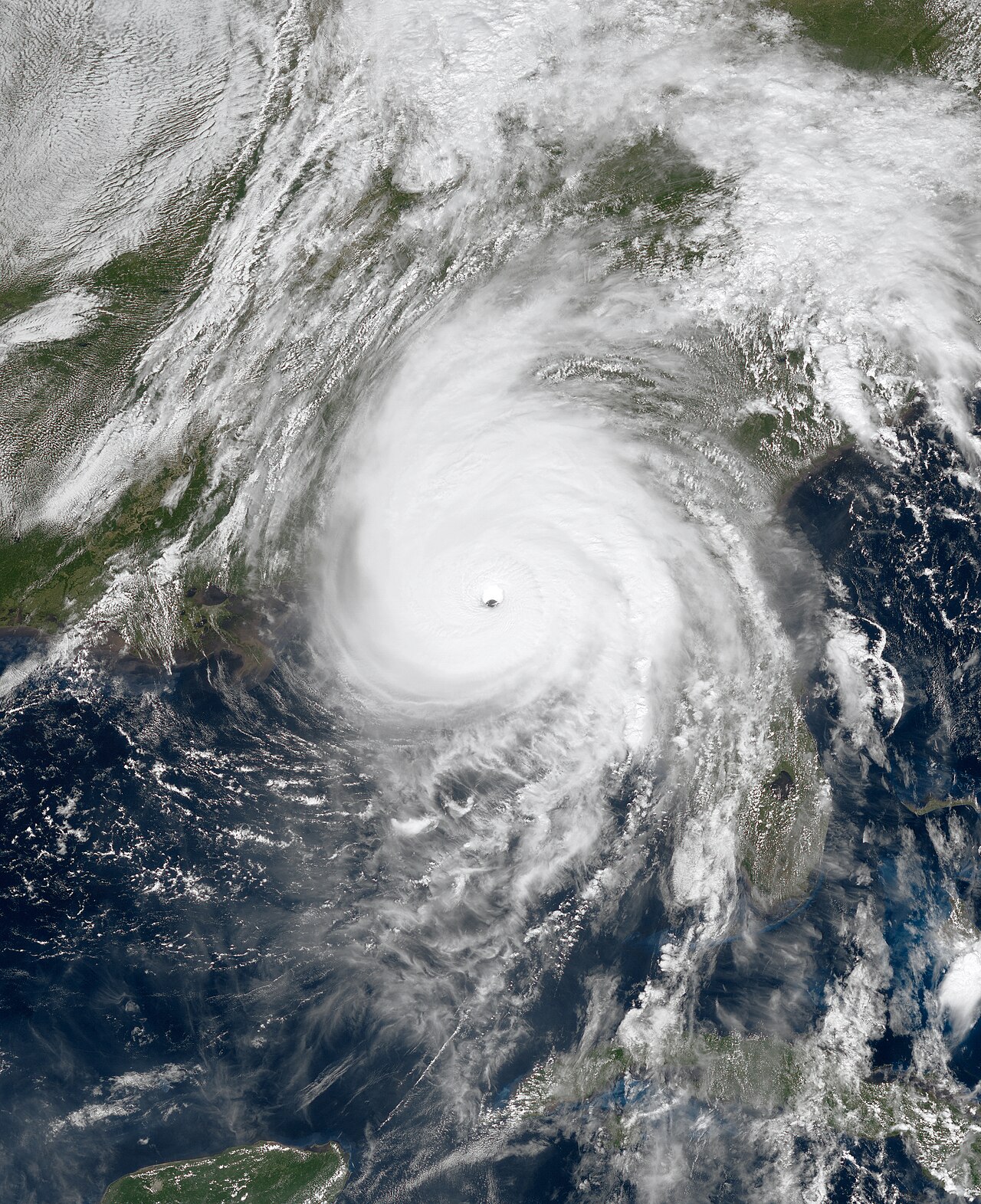
Hurricane Michael nears the Florida Panhandle on Oct. 10, 2018. Source: NASA/NOAA, Wikimedia Commons, Public domain.
Quick Answer: Fort Lauderdale-based Universal Insurance Holdings (NYSE: UVE) earned $52.5 million, or $1.80 per diluted share, in the third quarter of 2026, up 31.8% from a year earlier, as its net combined ratio improved to 91.0% from 96.4%. A cheaper reinsurance program and no catastrophe or prior-year reserve charges drove the gain, while Florida direct premiums written fell 3.3% and premiums from other states rose 18.5%.
Universal Insurance Holdings, the Fort Lauderdale parent of Universal Property & Casualty Insurance Company (UPCIC) and American Platinum Property and Casualty Insurance Company (APPCIC), reported its third quarter 2026 results on October 22. The numbers show what a Florida homeowners insurer looks like a few years after the state’s December 2022 legal reforms: margins are wider, reinsurance costs less, and the company’s Florida book is shrinking slightly even though it has more Florida policies in force.
What did Universal Insurance report for the third quarter of 2026?
Total revenue rose 9.6% to $439.3 million from $401.0 million in the third quarter of 2025. Net income available to common stockholders rose 31.8% to $52.5 million. Diluted earnings per share were $1.80, up from $1.38. Adjusted diluted EPS, a non-GAAP measure that strips out investment gains and losses and some other items, was $1.93, up 41.9% from $1.36.
The company reported an annualized return on common equity of 32.7%, slightly below the 33.4% of a year earlier, and an annualized adjusted return of 32.3%, up from 30.6%. Book value per share reached $23.37 at September 30, up 32.4% from $17.65 a year earlier. Adjusted book value per share, which excludes accumulated other comprehensive loss, was $25.90, up 38.2%.
In the release, Chief Executive Officer Stephen J. Donaghy said the company “delivered a very strong 32.7% annualized return on common equity” and that “new business trends are solid, including 8% growth in policies in force.”
| Metric | Q3 2026 | Q3 2025 | Change |
|---|---|---|---|
| Total revenue | $439.3M | $401.0M | +9.6% |
| Net premiums earned | $403.2M | $359.7M | +12.1% |
| Net income to common | $52.5M | $39.8M | +31.8% |
| Diluted EPS | $1.80 | $1.38 | +30.4% |
| Adjusted diluted EPS | $1.93 | $1.36 | +41.9% |
| Net combined ratio | 91.0% | 96.4% | -5.4 pts |
| Book value per share | $23.37 | $17.65 | +32.4% |
How did the first nine months of 2026 compare?
For the nine months ended September 30, revenue rose 5.3% to $1.26 billion. Net income available to common stockholders rose 42.7% to $166.0 million, and diluted EPS rose to $5.73 from $4.03. The annualized return on common equity for the period was 37.0%, and the nine-month net combined ratio was 90.8%, compared with 96.4% in the first nine months of 2025.
Why did Universal’s combined ratio improve so much?
The combined ratio adds the loss ratio (claims and claim-handling costs as a share of premiums) to the expense ratio. Below 100% means the insurer made money on underwriting before investment income. Universal’s improvement came almost entirely from the loss side.
The net loss ratio fell to 64.6% from 70.2%. The 10-Q attributes the decline mainly to three things: a lower ceded premium ratio, no net prior-year reserve development compared with $3.9 million in the third quarter of 2025, and no new catastrophe losses. The filing states that no catastrophe events or prior-year reserve development occurred in 2026 through September. It also says weather-related loss activity in the third quarter was higher than a year earlier but stayed within management’s expected range.
The expense ratio edged up to 26.4% from 26.2%. The policy acquisition cost ratio held at 17.7%, while other operating costs rose to 8.7% of net premiums earned from 8.5%. Reporting by Insurance Business tied the higher expenses to multi-state expansion and higher acquisition costs outside Florida.
| Underwriting ratio | Q3 2026 | Q3 2025 | 9M 2026 | 9M 2025 |
|---|---|---|---|---|
| Ceded premium ratio | 27.6% | 32.7% | 30.3% | 31.5% |
| Net loss ratio | 64.6% | 70.2% | 64.5% | 71.0% |
| Net expense ratio | 26.4% | 26.2% | 26.3% | 25.4% |
| Net combined ratio | 91.0% | 96.4% | 90.8% | 96.4% |
Are claims from past hurricanes still affecting the balance sheet?
They are shrinking. Unpaid losses and loss adjustment expenses fell to $616.1 million at September 30 from $680.7 million at December 31, 2025. The 10-Q says the decrease mainly reflects the settlement of claims from Hurricanes Debby, Helene and Milton, other earlier hurricanes and prior accident years. Reinsurance recoverables fell to $157.0 million from $232.9 million over the same period, and the amount due from the Florida Hurricane Catastrophe Fund (FHCF), $69.7 million at year-end 2025, was zero at September 30.
How did Universal’s reinsurance program change for 2026-2027?
Reinsurance is the largest single cost for a Florida-focused homeowners carrier, and it is the main reason Universal’s results improved. Universal announced its 2026-2027 program on May 28, 2026, effective June 1. According to that announcement, the top of the combined tower for a single event across all states, including Florida, is $2.623 billion, about $50 million higher than the 2025-2026 program. The combined first-event retention, the amount the insurers pay before reinsurance responds, stayed at $45 million.
The 10-Q gives a more detailed layer description and lists $2.768 billion of single-event capacity for the all-states tower with the same $45 million first-event retention. It also shows:
- A first-event layer of 100% of $66 million in excess of $45 million, placed through a captive reinsurer that Universal consolidates as a variable interest entity.
- Second-event private market cover of $66 million in excess of $45 million, and third- and fourth-event cover of $86 million in excess of $25 million.
- Mandatory FHCF coverage estimated at about $1.53 billion for UPCIC and about $26.4 million for APPCIC.
- $352 million of multi-year capacity already contracted for the 2027-2028 treaty year, including $277 million that sits below the FHCF layer.
The May announcement named Nephila Capital/Markel, RenaissanceRe, Munich Re, Chubb Tempest Re, Ariel Re, Everest Re and Lloyd’s syndicates among the largest private participants, each rated “A” or higher by AM Best. Chief Risk Officer Matthew J. Palmieri said the catastrophe reinsurance market was moderating after a benign 2025 Atlantic hurricane season and cited Florida’s insurance reforms as a stabilizing factor. Artemis, which tracks the reinsurance and insurance-linked securities market, noted that Universal has not sponsored a catastrophe bond since 2021.
How much did Universal save on reinsurance?
The 10-Q reports that ceded written premium for the program fell 12.0% to $613.8 million from $697.5 million. Ceded premiums earned in the third quarter dropped to $153.5 million from $174.4 million, and the ceded premium ratio, ceded premiums as a share of direct premiums earned, fell 5.1 points to 27.6%. That is the main reason net premiums earned grew 12.1% while direct premiums earned grew only about 4%.
There is a trade-off on the revenue line. Commission revenue fell to $11.8 million from $14.6 million, and the release said the 10.8% drop in commissions, policy fees and other revenue combined was largely due to the new program.
How exposed is Universal to Florida?
Florida remains the core of the business, but it is no longer where the growth is. Universal was offered in 19 states at September 30, according to the 10-Q, and Florida accounts for the majority of its policies in force.
| At or for Q3 | Florida 2026 | Florida 2025 | Other states 2026 | Other states 2025 |
|---|---|---|---|---|
| Direct premiums written (Q3) | $414.4M | $428.6M | $194.5M | $164.1M |
| Policies in force | 598,104 | 561,546 | 355,507 | 322,342 |
| Premiums in force | $1.568B | $1.572B | $661.3M | $563.0M |
| Total insured value | $198.4B | $185.0B | $231.2B | $200.0B |
Florida direct premiums written fell $14.2 million, or 3.3%, in the quarter, while other states rose $30.3 million, or 18.5%. For the nine months, Florida premiums written were essentially flat at $1.229 billion, up 0.5%, while other states rose 17.0% to $508.2 million. Florida still produced about 68% of third-quarter direct premiums written.
The policy count tells a different story from the premium line. Universal had 6.5% more Florida policies in force than a year earlier, yet Florida premiums in force slipped 0.3%. In other words, the average Florida policy is bringing in less premium. Insured value outside Florida, $231.2 billion, now exceeds the $198.4 billion insured in Florida.
Why are Universal’s Florida premiums falling?
The 10-Q does not give a single cause, but it points to two factors. Universal took a 5.1% average Florida rate decrease effective October 16, 2025, and it has a further 5.0% decrease effective October 16, 2026, pending regulatory approval. The filing also cites “heightened competition” from new and established insurers in Florida.
That competition is a direct product of the reforms. Insurance Business, citing a May 2026 announcement by Florida Insurance Commissioner Mike Yaworsky, reported that 20 insurers have entered the Florida property and casualty market since the 2022-2023 legislative changes, bringing more than $850 million in new capital. The same report cited Guy Carpenter data showing Florida domestic property insurers posted a 76.8% combined ratio in 2025.
Outside Florida, Universal is moving rates the other way. The 10-Q lists approved increases ranging from 4.6% in Maryland to 39.9% in Wisconsin, effective between January 2026 and February 2027, plus pending filings in New Hampshire (7.9%), Virginia (15.6%), Maryland (9.5%) and Michigan (7.5%).
What does Hurricane Isaias mean for Universal’s fourth quarter?
Hurricane Isaias made landfall as a Category 2 storm in the Florida Panhandle on October 9, 2026, after the quarter closed, so it is not in the third-quarter numbers. Insurance Business reported that it came ashore near the Santa Rosa-Okaloosa county line, that Moody’s RMS estimated industry insured losses of $2.5 billion to $4.5 billion, and that the Florida Office of Insurance Regulation counted about $582 million in insured losses from 46,509 claims filed through October 15.
Universal’s 10-Q gives a preliminary estimate that its Isaias losses may exceed the insurance subsidiaries’ $45 million retention but stay below a $111 million consolidated retention, which adds the $66 million captive layer. The company expects the financial effects to show up in the fourth quarter. In the earnings release, Donaghy said claims activity has been “less significant than initially anticipated.”
How is Universal returning capital to shareholders?
Universal paid its regular quarterly dividend of $0.16 per share, declared July 8 and paid August 7, unchanged from a year earlier. Nine-month dividends were $0.48 per share, and cash dividends paid totaled $13.8 million.
On buybacks, the 10-Q shows the company repurchased 174,000 shares for about $7.5 million in the third quarter and 506,000 shares for $19.2 million in the first nine months. Under the $20 million program authorized January 7, 2026, it had bought 499,170 shares at an average of $37.82. The earnings release said about $1.1 million remained under the current program at quarter-end, and on October 29, 2026, the board authorized an additional $20.0 million. Shares outstanding fell to about 27.6 million from 28.0 million a year earlier.
What does the capital and debt picture look like?
Stockholders’ equity rose to $646.0 million from $551.0 million at year-end 2025, even as accumulated other comprehensive loss widened to $69.9 million from $26.2 million, mostly reflecting unrealized losses on the bond portfolio. Total assets reached $3.18 billion.
The company refinanced during the year. It issued $100 million of 7.75% senior notes due 2031 on June 16 and redeemed its $100 million of 5.625% notes due 2026 the next day, so its debt now carries a higher coupon. It also fully repaid a $25 million UPCIC surplus note on September 21. The $50 million revolving credit facility had no borrowings at quarter-end. Debt, net of issuance costs, was $97.3 million.
At the insurance company level, UPCIC reported statutory capital and surplus of $510.2 million at September 30, up from $476.0 million, against a Florida minimum threshold of $191.7 million. APPCIC had $35.3 million. The 10-Q says no dividends were paid by the insurers to their holding company in the nine months, and UPCIC did not meet the threshold to pay an ordinary dividend.
What should Florida readers take from Universal’s results?
The quarter reflects three trends visible across Florida’s homeowners market. First, reinsurance has become cheaper, and that saving flows straight to an insurer’s net premiums and margins. Second, competition has returned, and Universal is cutting Florida rates while still adding Florida policies. Third, the company is spreading its risk beyond Florida, where it is raising rates and growing premiums at double-digit rates.
The 10-Q also notes that while the December 2022 reforms improved Florida claim and litigation trends, their durability “remain uncertain” because of possible political or legislative changes. Isaias will be the first test of the 2026-2027 reinsurance structure. Fourth-quarter results will show how much of that storm Universal keeps on its own books.
This article is news and analysis only and is not investment, legal or tax advice.
Frequently Asked Questions
What was Universal’s combined ratio in Q3 2026?
The net combined ratio was 91.0%, compared with 96.4% in the third quarter of 2025. The net loss ratio was 64.6% and the net expense ratio was 26.4%.
How much of Universal’s business is in Florida?
Florida produced $414.4 million of the $608.9 million in third-quarter direct premiums written, about 68%. The company had 598,104 Florida policies in force at September 30.
How large is Universal’s 2026-2027 reinsurance program?
The May 2026 announcement put the top of the single-event all-states tower at $2.623 billion, with a $45 million first-event retention. The 10-Q describes $2.768 billion of single-event capacity, including about $1.53 billion of estimated FHCF coverage for UPCIC.
Will Hurricane Isaias hurt Universal’s results?
Isaias losses will be booked in the fourth quarter. Universal’s preliminary estimate is that losses may exceed its $45 million retention but stay below its $111 million consolidated retention.
Sources and Further Reading
- Universal Reports Third Quarter 2026 Results, Exhibit 99.1 to Form 8-K, Universal Insurance Holdings, Inc. (U.S. Securities and Exchange Commission)
- Form 10-Q for the quarterly period ended September 30, 2026, Universal Insurance Holdings, Inc. (U.S. Securities and Exchange Commission)
- Universal’s Insurance Subsidiaries Complete 2026-2027 Reinsurance Program, Exhibit 99.1 to Form 8-K, Universal Insurance Holdings, Inc. (U.S. Securities and Exchange Commission)
- Universal lifts reinsurance tower to $2.623bn, ILS capital from Nephila a key participant, Artemis
- Universal’s reinsurance bill falls as Florida market turns a corner, Insurance Business