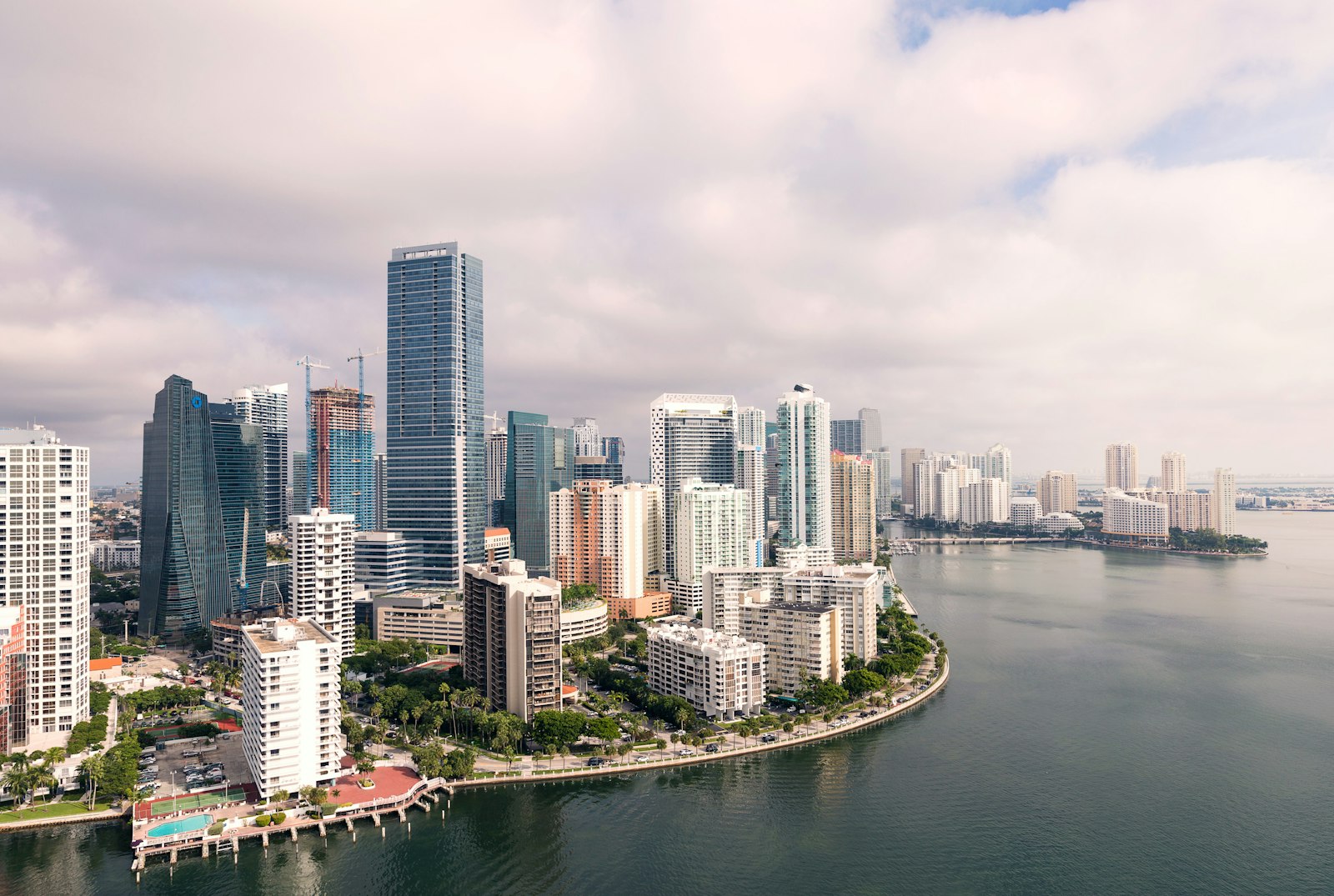
Downtown Miami and Brickell, the center of Florida's largest deposit market. Source: Ryan Parker/Unsplash, Unsplash License.
Quick Answer: FDIC Summary of Deposits data as of June 30, 2026 show $876.6 billion in deposits held at 4,283 bank offices in Florida, up about $17.3 billion, or 2.0%, from June 2025. Bank of America remains the state’s largest deposit holder at $170.3 billion, or 19.4% of the market, and the four largest branch networks (Bank of America, Wells Fargo, JPMorgan Chase and Truist) together hold about 47% of Florida deposits.
Every year the Federal Deposit Insurance Corporation asks each insured bank with branches to report how much money sits in each of its offices as of June 30. The result, the Summary of Deposits (SOD), is the most detailed public map of where Floridians and Florida businesses keep their money and which banks hold it. This report compares the Florida figures from the June 30, 2026 survey, now available through the agency’s public data service, with the 2025 survey.
All figures below are branch-level deposits that banks assign to offices located in Florida. They reflect where a bank books a deposit, which is not always where the customer lives, a point that matters a great deal in Tampa Bay and Jacksonville.
How much money is deposited in Florida banks in 2026?
Florida bank offices held $876.55 billion in deposits as of June 30, 2026, compared with $859.24 billion a year earlier. That is an increase of roughly $17.3 billion, or 2.0%. The number of reporting offices rose from 4,257 to 4,283, a net gain of 26 locations, even as some large banks trimmed their Florida networks.
The 2026 Florida data cover 192 institutions with at least one Florida office, down from 195 in 2025.
| Snapshot (as of June 30) | 2025 | 2026 | Change |
|---|---|---|---|
| Total deposits in Florida offices | $859.24 billion | $876.55 billion | +$17.3 billion (+2.0%) |
| Bank offices in Florida | 4,257 | 4,283 | +26 |
| Institutions with Florida offices | 195 | 192 | -3 |
| Share held by four largest branch networks | 47.8% | 47.3% | -0.5 pt |
| Share held by Florida-headquartered institutions | 26.1% | 26.5% | +0.4 pt |
Source: FDIC Summary of Deposits, June 30, 2025 and June 30, 2026; FlFinancialNews.com calculations.
Which banks have the most deposits in Florida?
Bank of America is again Florida’s largest bank by deposits, with $170.3 billion across 414 offices, or 19.4% of the statewide total. Its Florida deposits were essentially flat, down 0.3% from $170.8 billion, and its office count fell by 11. Because the rest of the market grew, its share slipped from 19.9% to 19.4%.
Wells Fargo ranks second with $90.6 billion (10.3%) and still operates the largest branch network in the state at 458 offices, five fewer than a year earlier. JPMorgan Chase is third with $79.0 billion (9.0%), and it was the most aggressive grower among the giants: its Florida deposits rose 4.3% and it added 12 offices to reach 431. Truist is fourth with $74.5 billion (8.5%) and held its network steady at 441 offices.
Fifth place belongs to Raymond James Bank, the Florida-headquartered bank subsidiary of Raymond James Financial, with $41.4 billion reported at a single office in the Tampa Bay metro. Sixth is EverBank, also headquartered in Florida, with $33.5 billion through 12 offices. Both rank far higher by deposits than their physical footprints would suggest, a reflection of how deposits gathered nationally are booked at a headquarters office.
| Rank | Institution | FL deposits 2026 | Share 2026 | Share 2025 | Deposit change | FL offices 2026 (2025) |
|---|---|---|---|---|---|---|
| 1 | Bank of America | $170.34B | 19.4% | 19.9% | -0.3% | 414 (425) |
| 2 | Wells Fargo | $90.65B | 10.3% | 10.5% | +0.6% | 458 (463) |
| 3 | JPMorgan Chase | $79.04B | 9.0% | 8.8% | +4.3% | 431 (419) |
| 4 | Truist | $74.51B | 8.5% | 8.6% | +1.1% | 441 (441) |
| 5 | Raymond James Bank | $41.40B | 4.7% | 4.5% | +7.9% | 1 (1) |
| 6 | EverBank | $33.49B | 3.8% | 3.8% | +2.8% | 12 (11) |
| 7 | Regions Bank | $26.37B | 3.0% | 3.1% | -1.1% | 270 (270) |
| 8 | Citibank | $22.35B | 2.5% | 2.6% | +0.7% | 56 (53) |
| 9 | City National Bank of Florida | $22.11B | 2.5% | 2.5% | +2.7% | 30 (31) |
| 10 | PNC Bank | $21.03B | 2.4% | 2.3% | +7.1% | 196 (190) |
| 11 | BankUnited | $20.73B | 2.4% | 2.5% | -4.2% | 51 (50) |
| 12 | TD Bank | $20.51B | 2.3% | 2.6% | -8.4% | 159 (166) |
| 13 | Fifth Third Bank | $19.35B | 2.2% | 2.1% | +6.5% | 218 (191) |
| 14 | SouthState Bank | $18.84B | 2.1% | 2.0% | +8.6% | 93 (92) |
| 15 | Seacoast National Bank | $16.68B | 1.9% | 1.5% | +33.4% | 105 (79) |
Source: FDIC Summary of Deposits, June 30, 2025 and June 30, 2026; shares and changes are FlFinancialNews.com calculations. Deposits are those booked at Florida offices only.
Who gained and lost Florida deposit share?
The clearest winner was Seacoast National Bank. Its Florida deposits jumped 33.4% to $16.7 billion and its office count rose from 79 to 105. Most of that came through acquisition: Seacoast closed its purchase of Villages Bancorporation, parent of Citizens First Bank, on October 1, 2025, for roughly $829 million. According to Seacoast, Citizens First operated 19 branches with about $3.5 billion in deposits as of June 30, 2025, and held more than half of the deposit market in the Wildwood-The Villages area.
Among large regional banks, Fifth Third added 27 Florida offices, the biggest branch expansion of any bank in the state, and grew deposits 6.5%. PNC added six offices and grew deposits 7.1%. Florida-headquartered SouthState grew 8.6%. On the other side, TD Bank’s Florida deposits fell 8.4%, or about $1.9 billion, as its office count dropped from 166 to 159. BankUnited’s Florida deposits declined 4.2% to $20.7 billion, and First Horizon’s fell 3.0% to $11.1 billion as it closed three Florida offices.
What happened to Synovus in Florida?
Synovus Bank no longer appears as a separate institution in the 2026 data. Pinnacle Financial Partners and Synovus completed their merger at the start of 2026, with the bank merger closing January 2, 2026, and Synovus Bank merging into Pinnacle Bank, according to the companies. In the June 2026 survey Pinnacle Bank reported $12.2 billion in Florida deposits across 85 offices. A year earlier, Synovus Bank had $11.8 billion at 83 Florida offices and Pinnacle Bank had about $77 million at two, so the combined franchise grew about 2.9%. The companies have said the combined bank will keep both brands until a conversion to the Pinnacle name expected in early 2027.
How concentrated is Florida’s deposit market?
Florida remains a market dominated by national banks. The four largest branch networks (Bank of America, Wells Fargo, JPMorgan Chase and Truist) together held about $414.5 billion, or 47.3% of Florida deposits, down slightly from 47.8% a year earlier. The 10 largest deposit holders accounted for about 66.3% of the state’s total.
The flip side is a long tail of smaller banks. Only 27 of the 192 institutions with Florida offices held more than $4 billion in Florida deposits in 2026. The rest range from midsize regional players such as Hancock Whitney ($5.0 billion) and Ameris ($5.9 billion) down to young, single- or few-office institutions such as Portrait Bank, Echelon Bank and Gala Bank, each with three or fewer Florida offices and well under $100 million in deposits.
How much do Florida-headquartered banks hold?
Institutions headquartered in Florida held $231.9 billion, or 26.5% of deposits in Florida offices, as of June 30, 2026, up from $224.3 billion and 26.1% in 2025. Their deposits grew 3.4%, faster than the 2.0% statewide rate. The group is shrinking in number, however: the SOD lists 82 Florida-headquartered institutions with Florida offices in 2026, down from 86 a year earlier, and 52 of them held less than $1 billion in deposits, compared with 56 in 2025.
That Florida-headquartered total is heavily weighted toward a few names. Raymond James Bank and EverBank alone account for about $74.9 billion, nearly a third of it. Among banks with large in-state branch networks, the biggest home-grown players by Florida deposits are City National Bank of Florida ($22.1 billion), BankUnited ($20.7 billion), SouthState ($18.8 billion) and Seacoast ($16.7 billion).
| Florida-headquartered institution | FL deposits, June 30, 2026 | FL offices |
|---|---|---|
| Raymond James Bank | $41.40B | 1 |
| EverBank | $33.49B | 12 |
| City National Bank of Florida | $22.11B | 30 |
| BankUnited | $20.73B | 51 |
| SouthState Bank | $18.84B | 93 |
| Seacoast National Bank | $16.68B | 105 |
| Amerant Bank | $8.36B | 24 |
| Ocean Bank | $6.21B | 25 |
| Bradesco Bank | $5.00B | 1 |
| Banesco USA | $4.28B | 5 |
| First Federal Bank | $3.34B | 25 |
| Capital City Bank | $3.33B | 53 |
Source: FDIC Summary of Deposits, June 30, 2026 (institutions whose headquarters state is Florida).
What are the deposit market shares in Miami, Tampa, Orlando and Jacksonville?
The four largest metro areas held about 76% of Florida’s bank deposits in 2026. The figures below use the FDIC’s metropolitan statistical area assignments for each office.
| Metro area | Deposits 2026 | Change vs 2025 | Offices 2026 (2025) | Largest deposit holder (share) |
|---|---|---|---|---|
| Miami-Fort Lauderdale-West Palm Beach | $348.8B | +3.7% | 1,340 (1,333) | Bank of America (15.7%) |
| Tampa-St. Petersburg-Clearwater | $131.5B | +2.7% | 609 (603) | Raymond James Bank (31.5%) |
| Jacksonville | $120.9B | +1.9% | 263 (256) | Bank of America (52.4%) |
| Orlando-Kissimmee-Sanford | $68.8B | -1.9% | 466 (464) | Truist (19.1%) |
Source: FDIC Summary of Deposits, June 30, 2025 and June 30, 2026; shares are FlFinancialNews.com calculations.
Who leads the Miami-area deposit market?
South Florida is by far the state’s largest deposit market, with $348.8 billion, about 39.8% of the state total, and growth of 3.7%. It is also the most competitive. Bank of America leads with $54.6 billion (15.7%), followed by JPMorgan Chase at $43.7 billion (12.5%) and Wells Fargo at $37.4 billion (10.7%). Citibank, which reported all of its Florida deposits, $22.3 billion, within the region, ranks fourth at 6.4%. Truist ($21.5 billion) and City National Bank of Florida ($21.4 billion) follow closely, with BankUnited at $19.5 billion (5.6%).
Amerant ($8.2 billion), Ocean Bank ($6.2 billion), Bradesco Bank ($5.0 billion), Northern Trust ($4.6 billion) and Banesco USA ($4.3 billion) each hold sizable Miami-area deposits.
Why does Raymond James lead Tampa Bay?
In the Tampa-St. Petersburg-Clearwater metro, which held $131.5 billion, Raymond James Bank’s $41.4 billion at one office gives it a 31.5% share. That figure reflects deposits the bank books at its one office in the metro, not a retail branch network. Among banks with conventional branch systems, Bank of America ($13.9 billion, 10.6%), Truist ($13.5 billion, 10.3%) and Wells Fargo ($12.2 billion, 9.3%) are nearly tied, followed by JPMorgan Chase ($8.3 billion), Regions ($7.2 billion), Fifth Third ($4.6 billion) and Valley National ($4.0 billion). Locally based The Bank of Tampa held $2.6 billion.
Why are Jacksonville’s numbers so high?
Jacksonville’s $120.9 billion in deposits is outsized for a metro its size because two banks book large national balances there. Bank of America reported $63.4 billion in the metro (52.4%) across 25 offices, and EverBank $29.8 billion (24.6%) across six. The Jacksonville Daily Record, analyzing the 2025 data, reported that most of Bank of America’s Jacksonville total was credited to a single office and that the numbers include large institutional deposits that may not come from area residents. By branch count, Wells Fargo leads the metro with 39 offices and $6.3 billion, with Truist at $6.2 billion and Ameris Bank at $2.4 billion.
Why did Orlando deposits fall?
The Orlando metro was the only one of the four largest Florida markets to post a decline, slipping 1.9% to $68.8 billion even as the office count edged up to 466. Truist leads with $13.1 billion (19.1%), followed by Bank of America ($12.2 billion, 17.7%), JPMorgan Chase ($9.8 billion, 14.3%) and Wells Fargo ($9.3 billion, 13.6%). The four together control nearly two-thirds of the market. Regions, Fifth Third and Seacoast each hold between $2.2 billion and $3.0 billion. The SOD data themselves do not explain the decline.
What about Southwest Florida and rural counties?
Growth was uneven outside the big four metros. The North Port-Sarasota-Bradenton area fell 2.7% to $29.1 billion, and Cape Coral-Fort Myers dropped 5.3% to $21.1 billion, while Naples-Marco Island rose 1.9% to $19.2 billion. Offices outside any metropolitan area held $15.0 billion, up 2.4%, across 124 locations, the same count as in 2025.
This article is news and analysis based on public data and is not legal, tax or investment advice.
Frequently Asked Questions
What is the FDIC Summary of Deposits?
It is an annual FDIC survey of deposits held at every branch office of insured institutions as of June 30. Institutions with branches must file by July 31; banks with only a main office are included using their June Call Report figures.
What is the largest bank in Florida by deposits?
Bank of America, with $170.3 billion in Florida offices as of June 30, 2026, or 19.4% of the state’s deposits.
Which bank has the most branches in Florida?
Wells Fargo, with 458 Florida offices in 2026, followed by Truist (441), JPMorgan Chase (431) and Bank of America (414).
What is the largest Florida-headquartered bank by Florida deposits?
Raymond James Bank, with $41.4 billion, followed by Jacksonville’s EverBank at $33.5 billion. Among branch-based banks, City National Bank of Florida leads at $22.1 billion.
Do SOD figures show where depositors live?
No. They show the office where a bank books each deposit. Banks that gather deposits nationally or online can report very large balances at one Florida office, which inflates totals in metros such as Jacksonville and Tampa Bay.
Does the SOD include credit unions?
No. It covers FDIC-insured banks and savings institutions. Credit union deposits are reported separately to the National Credit Union Administration.
Sources and Further Reading
- Summary of Deposits, June 30, 2026 and June 30, 2025 data — Federal Deposit Insurance Corporation (BankFind Suite API)
- Summary of Deposits Survey and Filing for June 30, 2026 (FIL-25-2026) — Federal Deposit Insurance Corporation
- Pinnacle and Synovus Complete Merger to Become Regional Bank Growth Champion — Synovus Financial Corp.
- Seacoast Completes Acquisition of Villages Bancorporation, Inc. — Seacoast Banking Corporation of Florida (SEC Form 8-K exhibit)
- Bank of America Leads Northeast Florida Market in Deposits — Jacksonville Daily Record