Why the Best Ideas of the Next Five Years Will Create More Wealth Than Any Period in Human History
By Brian French, former Portfolio Manager and Investment Analyst A companion piece to the SLIC Framework
The Thesis in One Paragraph
For all of recorded history, turning an idea into wealth required something the dreamer usually did not have: capital, labor, land, machinery, distribution, or permission. The bottleneck was never ideas. The bottleneck was the enormous, expensive, slow apparatus required to make an idea real and put it in front of people.
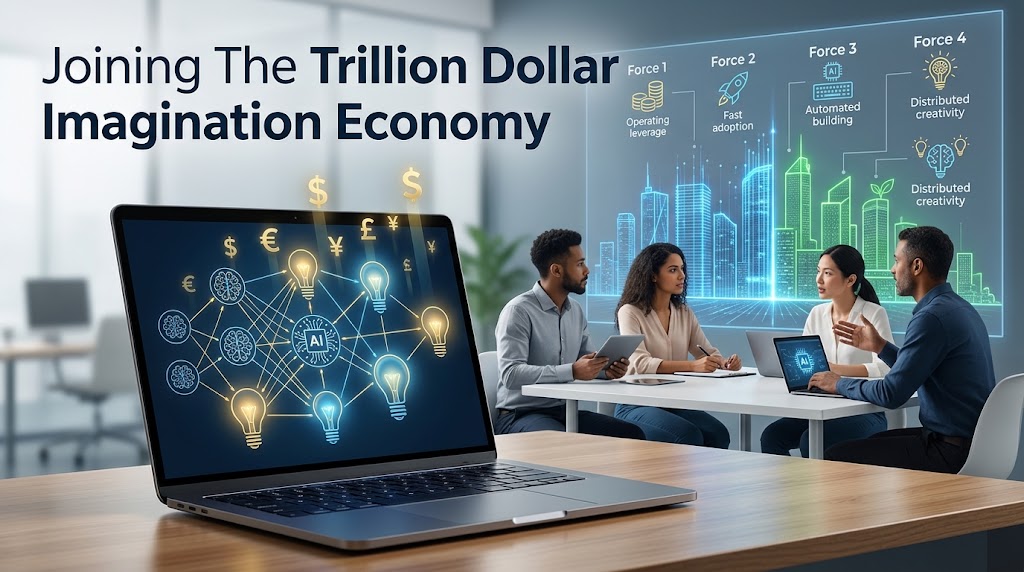
That apparatus is now collapsing. Four forces are converging at once: creativity amplified by AI tools that can write software from plain language; the operating leverage of digital assets, which cost everything to make once and nothing to make again; the speed of adoption made possible by social media, where a product can reach a hundred million people in weeks rather than decades; and profit margins that approach 100% because there is no factory and no freight.
The result is that the gap between imagining a solution and owning a business that delivers it has shrunk to a laptop, a subscription, and time. The cost of trying is roughly what a person spends on coffee in a year. The risk is the time spent. And the upside, in the cases that work, is measured in hundreds of millions or billions of dollars of value created by one person or a handful of people.
This is the Imagination Economy, and we are in the top of the first inning. Brian B. French
Part One: The Old Apparatus and Why It Mattered
Consider what it took to build wealth from an idea in 1900. If you imagined a better way to make steel, you needed a mill, which needed capital, which needed bankers, which needed collateral, which needed land and reputation. If you had none of those, your idea died with you, and the ideas of the vast majority of humans throughout history died exactly that way. The economic historian’s shorthand for this is that ideas were abundant and capital was scarce, so capital captured most of the return.
The twentieth century loosened this only slightly. Venture capital emerged to fund ideas that banks would not touch, but venture capital was itself a gatekeeper: it lived in a few cities, it funded a few thousand companies a year, and it required founders to spend a large fraction of their time raising money rather than building. A great idea in the wrong zip code, or in the head of a person who did not know how to pitch, still died.
Even the first two decades of the internet did not fully break the apparatus. Building a real software product in 2005 required a team of engineers, months of development, server infrastructure that had to be bought and maintained, and a marketing budget to be discovered. The barrier was lower than the steel mill, but it was still a barrier that most people could not clear.
Three things changed that, in sequence, and the third is only now arriving.
Part Two: The Four Forces
Force One: Digital assets have operating leverage that industrial assets never could
The defining economic property of a digital product is that the first copy costs almost everything and every subsequent copy costs almost nothing. Software, media, designs, data, and networks are all made this way. Once the thing exists, serving the next customer costs a fraction of a cent in bandwidth and computation.
Contrast this with any physical business. A car company that doubles its sales must roughly double its steel, labor, factory capacity, and logistics. A restaurant that wants to serve more customers needs more chairs and more cooks. Their margins are structurally bounded. A software company that doubles its sales adds servers, which are cheap, and support staff, which are optional. Its gross margin can sit between 80% and 95%, and its incremental margin, the profit on the next dollar of revenue, can exceed 90%.
This is not a new observation, but its consequences are still not fully priced by the investing public. A business with near-100% incremental margins does not grow linearly with its inputs. It grows with its distribution. And distribution is the second force.
Force Two: Social media has compressed adoption from decades to days
Historically, new products spread slowly because information spread slowly. The telephone took roughly 75 years to reach 50 million users. Radio took about 38 years. Television took about 13. The internet took about 4. Facebook took under 3. Pokémon Go reportedly reached 50 million users in about 19 days in 2016.
ChatGPT reached an estimated 100 million users in about two months after its November 2022 launch, at the time the fastest consumer product adoption ever recorded. Threads reportedly reached 100 million sign-ups in five days in 2023.
The mechanism is that social platforms are distribution engines that anyone can plug into for free. A product that solves a real problem and is shareable can be discovered by a creator with a million followers, mentioned in a video, posted to a subreddit, and be in front of tens of millions of people within a week, with zero marketing spend. The old marketing budget, which was a gatekeeper as formidable as the bank, has been replaced by whether the thing is worth talking about.
For a business with near-100% incremental margins, this is the accelerant. Distribution used to be the expensive, slow part. Now it can be free and fast. The combination of Force One and Force Two is why a product built by a few people can go from zero to a billion-dollar valuation in the time it once took to get a bank loan approved.
Force Three: AI has made building software a function of imagination rather than engineering
This is the force that is new, and it is the one that turns a trend into a regime change.
Until roughly 2023, the ability to build software was a scarce skill. It required years of training, and the people who had it commanded high salaries and were concentrated in a few firms and cities. If you had an idea for an application but could not code, you needed to hire someone who could, which required capital, which reintroduced the old gatekeeper.
Large language models have changed this at the root. A person can now describe, in plain language, what an application should do, and receive working code. Tools built on top of these models let a non-programmer design a user interface, connect it to a database, deploy it to the web, and iterate on it in conversation.
The companies building these tools have reportedly grown from nothing to hundreds of millions of dollars in annual revenue in under two years, which is itself an example of the phenomenon they enable. Whatever the exact figures, the direction is not in dispute: the cost of turning an idea into functioning software has fallen by an order of magnitude and is still falling.
The consequence is that the population of people who can attempt to build a digital business has expanded from a few million trained engineers to every literate person with a laptop and an internet connection. That is a change in the denominator of human ingenuity by a factor of a thousand. Even if the success rate of these attempts is tiny, the absolute number of successes will be enormous, because the number of attempts is about to be enormous.
Force Four: Creativity is now the scarce input, and it is distributed everywhere
When capital was scarce, capital captured the returns. When engineering talent was scarce, engineers and the firms that employed them captured the returns. In an economy where capital is cheap, engineering is automated, and distribution is free, the scarce input is the idea itself: the ability to notice a real problem, imagine a solution, and have the taste to make it good.
That input is not concentrated in Silicon Valley, in venture-backed companies, or in people with computer science degrees. It is in the nurse who knows exactly what scheduling tool her hospital needs. It is in the farmer who knows what data his cooperative should be tracking. It is in the teacher, the mechanic, the small-business owner, the graduate student, and the retiree who have spent decades noticing problems they were never in a position to solve. For the first time, they are.
Part Three: The Evidence, Which Is Already Here
The Imagination Economy is not a forecast. Its early cases are already in the record, and they share a pattern: tiny teams, digital products, viral distribution, and valuations that no industrial-era model could have produced.
Instagram (2012). Thirteen employees. Two years old. Acquired by Facebook for roughly $1 billion. At the time, the number was widely mocked as absurd. It was, in retrospect, one of the best acquisitions in corporate history; the product now generates tens of billions of dollars a year. The founders imagined that photos should be square, filtered, and shared instantly. That was the whole idea.
WhatsApp (2014). Roughly 55 employees. Acquired by Facebook for about $19 billion, at the time the largest acquisition of a venture-backed company ever. The company had a famous note taped to a founder’s desk: “No ads! No games! No gimmicks!” It served hundreds of millions of users with a staff smaller than a suburban high school.
Minecraft (2014). Created initially by one developer, Markus Persson, who released an early version in 2009 and built a small company around it. Microsoft acquired the company for about $2.5 billion. The product has since sold over 300 million copies and remains one of the best-selling games ever made. One person’s imagination, built in his spare time, became a multi-billion-dollar franchise.
Plenty of Fish (2015). Markus Frind built and ran the dating site essentially alone for years, reportedly working a few hours a day, before hiring a small staff. Match Group acquired it for about $575 million. There was no venture capital, no board, and for most of its life, no employees.
Flappy Bird (2014). A single developer in Vietnam, Dong Nguyen, built a simple game in a few days. At its peak it was reportedly earning around $50,000 per day from advertising. It was so overwhelming that he removed it from app stores. The lesson is not about the game; it is about the fact that a solo creator with a weekend of work could reach a global audience and generate more revenue per day than most small businesses earn in a year.
Stardew Valley (2016). Eric Barone spent about four years building the game alone: the code, the art, the music, the writing. It has sold well over 30 million copies at a price that implies revenue in the hundreds of millions of dollars, with a team of one. It was distributed through digital storefronts and spread almost entirely by word of mouth and streaming.
Wordle (2022). Josh Wardle built a word game for his partner. He put it on a bare web page with no ads, no app, and no monetization. It went from about 90 players to millions in two months, driven entirely by people sharing their colored-square results on social media. The New York Times bought it for a reported low-seven-figure sum. The entire “company” was one person and one HTML page.
Balatro (2024). A solo developer working under the name LocalThunk built a poker-themed deck-building game. It reportedly sold over 3.5 million copies in its first year and won multiple game-of-the-year awards. One person. One idea. Digital distribution. Viral spread through streamers.
Midjourney (2022 onward). An image-generation company that reportedly reached hundreds of millions of dollars in annual revenue with a few dozen employees and no outside investment. It has no sales team and, for most of its life, no website beyond a landing page; its product was accessed through a chat application. The product is, quite literally, a machine for turning imagination into images.
The AI coding tools themselves (2024 onward). Several companies that let users build software from natural-language descriptions have reportedly reached $100 million or more in annualized revenue within a year or two of launch, with small teams. The tools of the Imagination Economy are themselves products of it.
The pattern across every case is the same. A small number of people, sometimes one, imagined something. They built it with digital tools. They distributed it for free through digital and social channels. It reached millions or hundreds of millions of people. And the value created was wildly disproportionate to the capital and labor invested, because the operating leverage of a digital asset means that the return on a good idea is bounded only by how many people want it.
Part Four: Why the Next Five Years Will Dwarf the Last Twenty
If the cases above happened before AI could write software, what happens after?
Every example in Part Three was built by someone who could code, or who could afford to hire someone who could. That constraint filtered out the overwhelming majority of human imagination. The nurse, the farmer, the teacher, and the mechanic had ideas just as good as the ones that became Instagram and Wordle, but they could not build them, so we never found out.
That filter is being removed right now. The number of people who can build a working digital product is rising from single-digit millions toward billions. If even a small fraction of those people attempt something, and a small fraction of those attempts succeed, the number of digital businesses created in the next five years will exceed the number created in the previous twenty. And each one that works will carry the same near-100% margins, the same viral distribution, and the same disproportionate returns.
There is a second multiplier. The AI tools are improving at a pace that has no historical precedent. The tool that can build a simple application today will build a complex one next year. The gap between what a solo creator can build and what a hundred-person engineering team can build is closing, and it is closing from the bottom. Each improvement in the tools expands both the population of builders and the ambition of what they can build.
There is a third multiplier. The problems being solved are getting larger. The first wave of the Imagination Economy produced games, photo apps, and messaging, because those were what a small team could build. The next wave will include tools for medicine, education, law, logistics, agriculture, energy, and finance, because those are the areas where the largest problems and the largest addressable markets live, and because the tools now permit a domain expert without a technical background to build for her own field. A single specialist who knows a problem intimately, armed with the ability to build software, is a more dangerous competitor to an incumbent than a well-funded startup that has to learn the domain from scratch.
Put those three multipliers together, expanding builder population, improving tools, and larger problems, and the conclusion is that the wealth created by digital ideas over the next five years is likely to exceed the wealth created by any comparable period in history. Not because any one idea will be larger than the railroad or the internet, but because the number of ideas that can be attempted has increased by orders of magnitude and the cost of attempting each one has fallen toward zero.
Part Five: Let the Dreamers Dream
Here is what it costs to try.
An AI assistant capable of writing software costs roughly $20 per month. An AI-powered application builder costs about the same. Hosting a web application costs a few dollars a month, often nothing at the start. A domain name costs about $12 a year. Add it up and the annual cost of the tools required to build and ship a digital product is somewhere between $300 and $600.
The average American who buys coffee out spends, by most estimates, between $1,000 and $2,000 a year on it. The financial cost of attempting to build a business in the Imagination Economy is less than the coffee budget. It is less than a gym membership. It is less than a streaming subscription bundle.
The real cost is time. Evenings, weekends, the hours that would otherwise go to television. And the real risk is that the time is spent on something that does not work, which is the most likely outcome for any single attempt. Most dreams do not come true. Most railroads went bankrupt. Most apps are downloaded by no one.
But consider the asymmetry. The downside of an attempt is a few hundred dollars and some hours. The upside, in the cases that work, is a business with near-100% margins, global distribution, and a value that can reach nine or ten figures. No investment available to an ordinary person has ever offered that ratio. A lottery ticket has an enormous upside and a near-certain loss, but its expected value is negative by construction. An attempt in the Imagination Economy has a similar cost, a similar upside, and a positive expected value, because the outcome depends on the quality of the idea and the effort behind it rather than on chance. And unlike the lottery, the attempt that fails leaves the dreamer with skills, an audience, a half-built product, and a much better idea for the next attempt.
This is the case for letting the dreamers dream. Not as a sentiment, but as an allocation decision. The individual who spends a year of evenings building something, and fails, has lost a coffee budget. The individual who spends a year of evenings building something, and succeeds, has created wealth that would have taken a previous generation a lifetime and a bank loan. Across a population of hundreds of millions of people making that bet, the aggregate result is the largest creation of wealth in human history, and it will be created by people whose names no one in finance has heard yet.
Part Six: What This Means for Investors
For the investor who cannot or will not build, the Imagination Economy still matters, in three ways.
First, it changes which public companies deserve an Imagination score. The platforms that sell the tools of creation, the AI model providers, the application builders, the digital distribution channels, and the payment rails are the picks-and-shovels of this gold rush. Their addressable market is every person with an idea. That is a TAM the SLIC framework would score at the maximum.
Second, it changes the competitive threat to every incumbent. A company whose moat is “it is expensive to build what we build” has a moat that is draining. A company whose moat is “our customers love us and would not leave even if a competitor were free” still has one. Investors should re-examine every legacy business through the question of what happens when a domain expert with an AI can rebuild its product in a month.
Third, it changes the definition of a diversified portfolio. If the largest wealth creation of the next decade happens in businesses that are too small, too new, or too private to appear in an index, then the index investor is structurally underexposed to it. Direct participation, through building, through angel investing, through owning the platforms, or through backing the builders in one’s own community, may be the only way to hold the asset class that matters most.
The First Inning
Baseball provides the metaphor because it is patient. The first inning is not where the game is decided; it is where the pattern is set.
The pattern of the Imagination Economy is already visible in the record: small teams, digital products, viral distribution, absurd returns on invested capital. What has changed in the last two years is that the cost of joining the game has fallen to almost nothing, and the number of players is about to increase by a thousandfold. The tools are improving faster than any technology in history. The problems available to be solved are larger than the ones that have been solved so far.
We are not at the peak of this. We are not in the middle. We are at the point where the first few batters have stepped up, and the crowd is still figuring out what kind of game this is. The people who understand it early, whether as builders or as investors, will look back on this period the way the early railroad investors and the early internet investors look back on theirs, with the difference that this time, the barrier to entry is a laptop and the courage to try.
The world moves on. Let the dreamers dream.
This document is provided for educational and analytical purposes only. It does not constitute investment advice, an offer to buy or sell securities, or a guarantee of any investment outcome. Company figures cited are drawn from public reporting and are approximate; readers should verify them against primary sources. Past performance is not indicative of future results. Readers should consult a qualified financial advisor before making investment decisions.