By Brian French | FlFinancialNews.com | September 30, 2026
Quick Answer
Washington has no realistic plan to cut the federal deficit back to historical norms. The official strategy is to grow the economy faster than the debt, with inflation quietly helping by lifting nominal GDP. Meanwhile, the Treasury is funding more of the gap with short-term T-bills and buying back long bonds to keep 10- and 30-year yields from spiking. Critics say it buys time but raises the risk later.
The Numbers at a Glance
| Measure | Latest Figure |
|---|---|
| FY2026 deficit (CBO updated) | $2.1 trillion |
| Total national debt | Over $40 trillion (Aug 2026) |
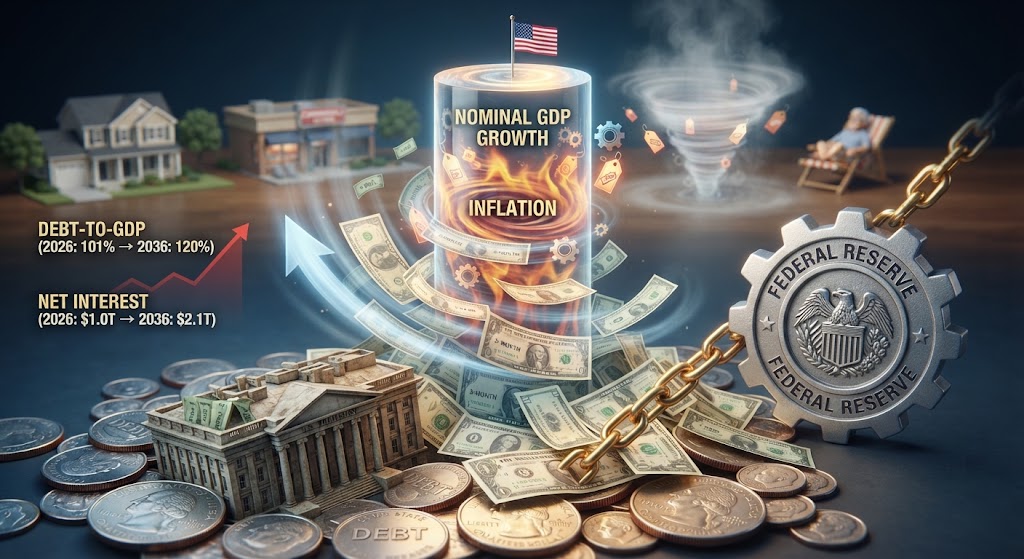
| Net interest, FY2026 → FY2036 | $1.0T → $2.1T |
| Debt held by public, 2026 → 2036 | 101% → 120% of GDP |
| CPI inflation (Aug 2026) | 3.4% |
| 10-year / 30-year Treasury (Sept 28) | 5.24% / 5.56% |
| Fed funds target (Sept 16) | 3.75%–4.00% |
The Deficit Is Structural, Not Cyclical
A Peacetime Economy Running Wartime Deficits
The U.S. economy is not in recession, unemployment is fairly low, and yet the deficit keeps growing. CBO’s February baseline projected a $1.9 trillion FY2026 deficit, equal to 5.8% of GDP, rising to 6.7% by 2036. That compares with an average of 3.8% over the past 50 years. By April, CBO had already raised its FY2026 estimate to $2.1 trillion.
Deficits from 2026 to 2035 are projected to total $23.1 trillion. By 2030, debt surpasses the post-World War II record of 106% of GDP. CBO’s own director stated plainly that the fiscal trajectory is not sustainable.
Interest Is Now the Driver
The defining feature of today’s deficit is that interest costs are feeding on themselves. Net interest outlays rise from $1.0 trillion in 2026 to $2.1 trillion in 2036, from 3.3% of GDP to 4.6%. The government’s interest bill now exceeds what it spends on national defense.
This is why many analysts consider the deficit functionally out of control. CBO projects the primary deficit, which excludes interest, actually improves slightly, falling from 2.6% of GDP to 2.1% over the decade. The overall deficit still worsens because interest growth overwhelms any restraint on program spending. The Committee for a Responsible Federal Budget has flagged that the average rate paid on the debt could exceed the economy’s growth rate as early as FY2031. That is the classic precondition for a debt spiral.
Congress Has Added to the Problem
Recent legislation widened the gap rather than closing it. CBO estimates the 2025 reconciliation act adds $4.7 trillion to deficits from 2026 to 2035. Tariffs were expected to offset about $3 trillion.
Much of that offset has since been lost. Treasury Secretary Scott Bessent said the Supreme Court’s decision striking down the “Liberation Day” tariffs cost roughly $180 billion that would otherwise have gone to paying down the deficit.
The New Plan Is Growth
“Grow Our Way Out of This”
The administration’s stated answer is growth rather than austerity. In a September 8 appearance at SMU in Dallas, Bessent said the U.S. can grow its way out of debt if it achieves 3% annual growth and contains spending.
That is the heart of his “3-3-3” framework: deficits of 3% of GDP or less, growth of 3% or more, and a 3-million-barrel daily increase in domestic energy production.
The Deficit Target Is Slipping
The growth leg may be achievable. The deficit leg is not close. One June analysis put the deficit at about 5.7% of GDP and noted the 3% target was last reached for a full year in 2015. Even so, Bessent told Congress in June that the deficit could have “a three in front of it” by the end of the president’s term, a target the government’s own projections do not support.
To his credit, Bessent says he is working with OMB Director Russ Vought on a fiscal consolidation plan. But he also said he would rather not push it through a lame-duck Congress if Democrats win one or both houses in the midterms. That timing suggests meaningful deficit reduction is, at best, a 2027 conversation.
The Quiet Role of Inflation
How Inflation Shrinks the Debt Ratio
Debt is measured against nominal GDP, which includes inflation. When prices rise 3.4% a year instead of 2%, nominal GDP grows faster, and the debt-to-GDP ratio looks better even if nothing else changes. Existing long-term bonds, locked in at older, lower rates, get paid back in cheaper dollars.
No official describes inflation as a deficit strategy. But the math works in Washington’s favor as long as inflation stays moderate and the market does not demand much higher rates in return.
Where Inflation Stands Today
Headline CPI rose 3.4% over the 12 months ending August, the same as in July, while core CPI rose 2.4%. Energy is the swing factor: the energy index is up 16.3% over the past year, tied to the Iran conflict and oil prices above $100.
The Fed Is Not Cooperating
The inflation route has one major obstacle: the Federal Reserve. On September 16, the Fed voted 12-0 to raise rates a quarter point, its first hike since 2023. Chair Kevin Warsh said inflation is too high and has been for too long. The median official now expects one more hike this year.
The White House called the decision a “rather unfortunate decision.” That tension matters. A central bank willing to fight inflation limits how much help the Treasury can get from rising prices, and higher short-term rates make the T-bill strategy more expensive.
The Market Isn’t Pricing Runaway Inflation
Here is an important nuance. As of September 24, the 30-year Treasury yielded 5.47% while the 30-year inflation-protected yield was 3.21%. That implies long-run inflation expectations of only about 2.3%, in line with the 30-year breakeven rate of 2.25% in August.
In other words, investors aren’t demanding high long-term rates because they fear inflation. They’re demanding higher real returns — a term premium — for holding long-dated U.S. debt at all. That is a sign of concern about supply and fiscal credibility, not just prices.
Part 4: The T-Bill Strategy
Financing the Gap at the Short End
The Treasury funds deficits by selling bills (one year or less) and coupons (notes and bonds from two to 30 years). With the three-month bill near 3.8% in August versus 4.6% on the 10-year and above 5% on the 30-year, Bessent has leaned heavily on cheaper short-term borrowing. That holds down reported interest costs today but increases exposure to rising rates.
The August quarterly refunding confirmed the pattern. Treasury said it expects to keep coupon auction sizes unchanged for at least the next several quarters, while monitoring growing private demand for bills. Goldman Sachs estimated 2026 bill supply at $827 billion, up from roughly $360 billion in 2025.
The Advisory Committee’s Warning
The Treasury Borrowing Advisory Committee (TBAC), the panel of dealers and investors that advises Treasury, warned in its August 5 minutes that at current auction sizes the government faces a $1.45 trillion funding shortfall in fiscal 2027–28. Either coupon sizes rise, pushing more long-term supply into the market, or bills take an even larger share.
The “Treasury Twist”
In August, Treasury went a step further. On August 19 it at least doubled its long-end buybacks for bonds maturing in 10 to 30 years, raising the maximum from $2 billion to at least $4 billion per operation. That runs through November 4.
Bessent himself called it a “Treasury Twist,” echoing the Fed’s Operation Twist, in which long bonds are bought and financed with short-term issuance. He has built the Treasury General Account to around $950 billion, giving him cash to deploy.
The results so far are limited. The 30-year yield fell briefly on the announcement, then rebounded. Evercore ISI called the plan a weak form of Operation Twist. The 30-year yield hit 5.56% on September 28.
The Irony
Bessent was once the strategy’s sharpest critic. In 2024, he amplified an analysis by Stephen Miran and Nouriel Roubini accusing Janet Yellen’s Treasury of “activist Treasury issuance” — flooding the market with bills to hold down long-term yields. At the time he warned clients that concentrating issuance in short maturities raises refinancing risk and creates the potential for a financial accident. He now occupies Yellen’s chair and is doing much the same thing.
The Case Against the “Out of Control” View
A fair analysis must include the counterarguments.
- The primary deficit is improving. CBO projects non-interest deficits shrinking over the decade. The problem is interest, which falls if rates decline.
- Bill demand is real. Money market funds, stablecoin issuers, and the Fed are all growing buyers of short-term Treasuries. Treasury argues it is responding to demand, not manipulating the curve.
- Growth could surprise. If the AI build-out produces a sustained productivity boom, 3% growth is possible, and debt-to-GDP could stabilize.
- A consolidation plan is in the works. Bessent and Vought say one is coming. Its size and whether Congress passes it are unknown.
- No buyers’ strike has occurred. Auctions continue to clear. Foreign holders have been diversifying into gold, but not dumping Treasuries.
What It Means for Florida
| Florida Stakeholder | Impact |
|---|---|
| Homebuyers | Mortgage rates track the 10-year; long-end yields above 5% keep rates elevated |
| Retirees and savers | T-bill and money market yields near 4% remain attractive |
| Commercial real estate | Refinancing at higher long-term rates squeezes values |
| Small businesses | Higher borrowing costs as the Fed tightens |
| Bond investors | Long-duration Treasuries carry more volatility risk |
Florida’s economy is unusually exposed to this setup. The state depends heavily on real estate, construction, and retirees living on interest income. Mortgage rates are benchmarked to Treasury yields and sit above 6%, while much of the developed world pays closer to 4%. A spike in the long end would hit Florida housing directly. A steady diet of T-bills paying near 4% is a quiet windfall for the state’s retiree savers.
Brian’s Take
After 15 years out of money management, I still read a budget the way I read a balance sheet. By that standard, the federal deficit is functionally out of control. It isn’t that Washington couldn’t fix it. It’s that nobody in power has a credible plan to try, and interest costs now grow on their own.
What replaced deficit control is a three-part bet: grow fast, let moderate inflation lift nominal GDP, and use the Treasury’s balance sheet to keep long-term rates from breaking. The T-bill shift and the long-end buybacks are the tools of that third leg. They are designed to prevent a disorderly spike in 10- and 30-year yields, the one outcome that would make the arithmetic unmanageable.
The problem is that each leg is fighting something. Growth faces higher rates. Inflation faces a Fed that just hiked. And the T-bill strategy shortens the debt’s maturity at the exact moment rates are rising, which means higher costs roll through faster. The bond market has noticed: long-term real yields are high even though inflation expectations are not.
For Florida investors, my practical read is simple. The short end pays you to wait. The long end asks you to trust Washington’s math. I’d let the Treasury prove the plan works before lending it money for 30 years.
Frequently Asked Questions
How big is the federal deficit in 2026?
CBO’s updated projection puts the FY2026 deficit at about $2.1 trillion, or roughly 6% of GDP, well above the 50-year average of 3.8%.
Has the U.S. government given up on reducing the deficit?
Officially, no. Treasury Secretary Bessent still targets a 3%-of-GDP deficit and says a consolidation plan is in the works. In practice, CBO projections show deficits growing, and the administration’s emphasis has shifted to growth.
What does “growing our way out of debt” mean?
If GDP grows faster than the debt, the debt-to-GDP ratio falls even without spending cuts. Bessent says 3% growth combined with spending restraint can achieve this. Many fiscal analysts are skeptical.
How does inflation affect the national debt?
Moderate inflation raises nominal GDP and lets the government repay older fixed-rate bonds in cheaper dollars, which reduces the debt ratio. If inflation pushes interest rates higher, new borrowing costs rise and the benefit fades.
Why is the Treasury issuing more T-bills?
Short-term bills currently carry lower rates than long bonds, and issuing fewer long bonds reduces supply pressure at the long end. Critics say this raises refinancing risk if rates keep climbing.
What is the Treasury “buyback” program?
Treasury buys back older long-dated bonds, largely financed with short-term issuance. It doubled the program’s size in August 2026 to help support liquidity and restrain long-term yields.
How does this affect Florida mortgage rates?
Mortgage rates track long-term Treasury yields. With the 10-year near 5.2% in late September, Florida mortgage rates remain elevated.
This article is for informational purposes only and is not investment advice.
Sources and Further Reading
- Congressional Budget Office, The Budget and Economic Outlook: 2026 to 2036 — https://www.cbo.gov/publication/61882
- CBO, Director’s Statement on the Budget and Economic Outlook for 2026 to 2036 — https://www.cbo.gov/publication/62050
- CBO, Testimony on the Budget and Economic Outlook: 2026 to 2036 — https://www.cbo.gov/publication/62207
- Bipartisan Policy Center, Deficit Tracker — https://bipartisanpolicy.org/report/deficit-tracker/
- Yahoo Finance, “Bessent: We Can Grow Our Way Out of Debt with 3% GDP Growth” — https://finance.yahoo.com/economy/policy/article/bessent-we-can-grow-our-way-out-of-debt-with-3-gdp-growth-230032528.html
- Financial Advisor, “Bessent’s 3-3-3 Economy Is Slipping Out of Reach” — https://www.fa-mag.com/news/bessent-s-3-3-3-economy-is-slipping-out-of-reach-87774.html?section=68
- Economic Collapse Report / Just The News, “Bessent Backs 3% Deficit Goal Despite 5% Budget Forecasts” — https://economiccollapse.report/bessent-backs-3-deficit-goal-despite-5-budget-forecasts/
- Crypto Briefing, “Bessent Says US Must Grow Its Way Out of Debt” — https://cryptobriefing.com/bessent-us-growth-reduce-debt/
- Bureau of Labor Statistics, Consumer Price Index – August 2026 — https://www.bls.gov/news.release/cpi.nr0.htm
- Schwab, “Fed Hikes in 12-0 Vote, Commits to Inflation Fight” — https://www.schwab.com/learn/story/fomc-meeting
- J.P. Morgan Asset Management, FOMC Statement: September 2026 — https://am.jpmorgan.com/us/en/asset-management/adv/insights/portfolio-insights/fixed-income/fixed-income-perspectives/fomc-statement-september-2026/
- Yahoo Finance, Fed Meeting Live Updates, September 16, 2026 — https://finance.yahoo.com/economy/policy/live/federal-reserve-meeting-live-updates-chairman-kevin-warsh-143452661.html
- Federal Reserve, H.15 Selected Interest Rates — https://www.federalreserve.gov/releases/h15/
- FRED, 30-Year Breakeven Inflation Rate — https://fred.stlouisfed.org/series/T30YIEM
- StreetStats, U.S. Treasury Yield Curve — https://streetstats.finance/rates/treasuries
- U.S. Treasury, Quarterly Refunding Statement, August 5, 2026 — https://home.treasury.gov/news/press-releases/sb0590
- U.S. Treasury, Increased Long-End Buybacks, August 19, 2026 — https://home.treasury.gov/news/press-releases/sb0607
- Fortune, “How Scott Bessent Used Financial Engineering to Fund the $2 Trillion Deficit” — https://fortune.com/2026/08/08/treasury-borrowing-tbac-145-trillion-shortfall-bessent-debt/
- CNBC, “Bessent’s Efforts in the Treasury Market So Far Haven’t Worked” — https://www.cnbc.com/2026/08/20/bessents-efforts-in-the-treasury-market-so-far-havent-worked-heres-what-else-he-can-try.html
- CNBC, “Bessent Could Tap Near $1 Trillion Treasury General Account” — https://www.cnbc.com/2026/08/24/bessent-1-trillion-treasury-general-account-bond-buybacks.html
- Paul Krugman, “Scott Bessent Fails to Gaslight the Market” — https://paulkrugman.substack.com/p/scott-bessent-fails-to-gaslight-the
- Heisenberg Report, “The Bessent Put” — https://heisenbergreport.com/2026/08/20/the-bessent-put/
- Ryan Research, “Bessent’s Bond Boiler Room Boogaloo” (citing Goldman Sachs via Reuters) — https://ryanresearch.substack.com/p/bessents-bond-boiler-room-boogaloo