By Brian French, Former Stock Analyst and Portfolio Manager
Quick Answer: A stock price assumes the business will last indefinitely, keep growing, and eventually return more cash than investors paid in. History shows many companies never do. Stocks still win investor capital because savings must go somewhere, and US equities offer unmatched liquidity, legal protection, and a long record of beating bonds. That record is no guarantee about the future.
What Are You Actually Buying When You Buy a Stock?
A share of stock is a claim on a company’s future cash flows. You own a slice of the earnings, assets, and dividends after creditors are paid. The price you pay today is the market’s estimate of what those future cash flows are worth in today’s dollars.
That estimate rests on assumptions most investors never examine. The most important one: the business will eventually hand back your original investment plus a return that compensates you for the risk you took.
The Core Assumption: Your Money Comes Back With Interest
Every valuation model starts with a simple promise. Money invested today must return more money later, adjusted for risk.
Finance professionals express this as a required rate of return. It is typically built from two parts:
| Component | What It Represents |
|---|---|
| Risk-free rate | Return on government bonds |
| Equity risk premium | Extra return for bearing business risk |
| Required return | The sum of both |
If a stock’s expected cash flows cannot clear that hurdle, rational investors should not buy it. The market price adjusts until expected returns line up with the perceived risk.
The catch: “expected” is doing a lot of work. No one knows what cash a company will produce over the next 50 years. Investors are pricing a forecast, not a contract.
Why Stock Valuation Requires Never-Ending Growth
The most widely taught valuation tool, the dividend discount model, values a stock as the sum of all future dividends discounted back to today. The simplest version, the Gordon Growth Model, looks like this:
Price = Next Year’s Dividend ÷ (Required Return − Growth Rate)
Notice what the formula assumes:
- The company lasts forever. The model sums cash flows to infinity.
- Growth continues indefinitely. The growth rate never stops.
- Growth stays below the required return. If it doesn’t, the math breaks.
This is not a quirk of one formula. In a standard discounted cash flow analysis, the “terminal value,” which represents everything after the first five or ten years of forecasts, commonly accounts for well over half of a company’s estimated value.
In other words, most of what you pay for when you buy a stock is the distant future. Remove the assumption of perpetual operation and growth, and the present value of many companies shrinks dramatically. A business expected to shut down in 15 years is worth only the cash it produces in those 15 years plus whatever its assets fetch at liquidation.
Do Companies Really Last Forever? History Says No
The perpetual-life assumption runs straight into the historical record.
The East India Companies
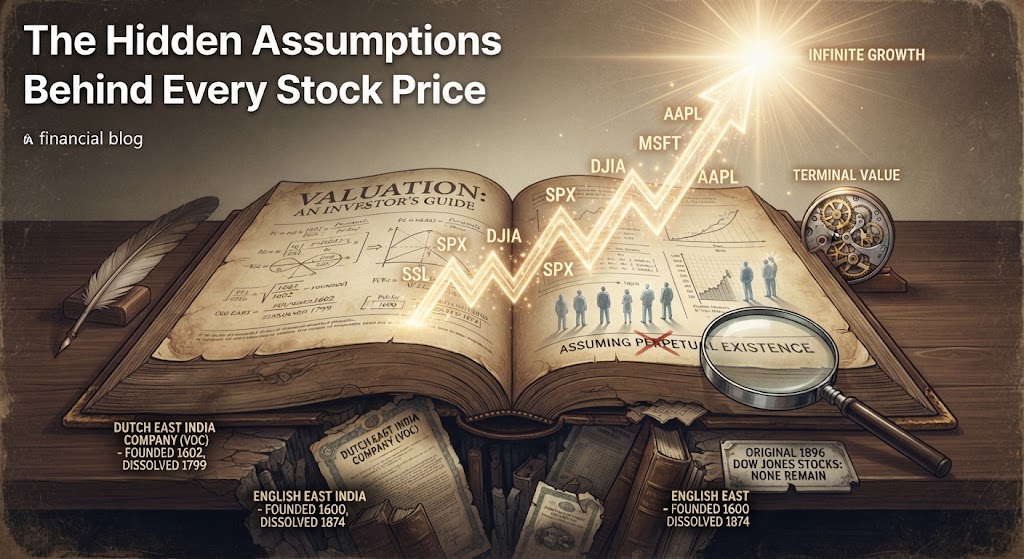
The Dutch East India Company (VOC), founded in 1602, is widely regarded as the first company to issue publicly traded shares. At its height it was among the most powerful commercial enterprises in the world. It was hit by debt, corruption, and war, was taken over by the Dutch state in the 1790s, and was formally dissolved in 1799.
Its English rival, the East India Company, chartered in 1600, ruled much of the Indian subcontinent. After the 1857 rebellion, the British Crown took over its governing role, and the company was dissolved in 1874. Its shareholders were bought out by Parliament, but the business itself, once the largest corporation on earth, simply ceased to exist.
Neither company is around to pay dividends today. A valuation model that assumed perpetual existence for either would have been wrong.
The Pattern Continues in Modern Markets
| Evidence | What It Shows |
|---|---|
| Original 1896 Dow Jones stocks | None remain in the index today |
| S&P 500 company tenure | Average stay has shrunk to under 25 years |
| Bessembinder study, 1926–2016 | About 4% of US stocks created all net wealth gains |
| Same study | Most individual stocks trailed Treasury bills |
The last two findings deserve attention. Research by Arizona State University professor Hendrik Bessembinder found that more than half of US common stocks delivered lifetime returns below one-month Treasury bills. The market’s overall gains came from a small minority of extraordinary winners.
The index survives forever. Most of the companies inside it do not.
Will Dividends Ever Repay Your Investment?
Whether a typical stock will return its full purchase price to shareholders through dividends alone is genuinely debatable.
Consider the math. A stock yielding 1.5% (close to the recent S&P 500 average) would need roughly 67 years of flat dividends just to return the original investment, before any return on that capital. Dividend growth shortens that timeline. Business failure, dividend cuts, or dilution lengthens it, sometimes to infinity.
Many companies pay no dividend at all. Their investors rely entirely on two things:
- Future dividends the company may someday pay.
- Resale value, meaning another investor’s willingness to buy the shares at a higher price.
That second source is where critics see a weakness. If returns depend largely on someone else paying more later, the stock’s value rests partly on market confidence rather than cash returned. Defenders counter that buybacks, retained earnings reinvested at high returns, and acquisitions are all legitimate ways businesses return value, even without dividends.
Both views have merit. What is clear is that the “return of capital plus a risk-adjusted return” assumption is a belief about the future, not a guarantee.
The Real Issue: Savings Have to Go Somewhere
Here is the practical reality that matters more than any valuation model. Capital must be stored somewhere. Every dollar saved by a household, pension fund, endowment, or foreign central bank has to sit in some asset.
The options are limited:
| Asset | Key Trade-off |
|---|---|
| Cash and deposits | Safe, but eroded by inflation |
| Government bonds | Predictable, historically low real returns |
| Real estate | Tangible, but illiquid and costly to trade |
| Gold and commodities | No cash flow, price driven by sentiment |
| Private businesses | Potentially high returns, hard to sell |
| Public stocks | Liquid, transparent, volatile |
Stocks do not need to be perfect. They need to be better than the alternatives in the eyes of the people allocating capital.
Why US Stocks Hold a Structural Advantage
US equities have several features that keep global capital flowing toward them, regardless of debates over valuation theory.
Marketability. US exchanges are the deepest and most liquid in the world. Investors can buy or sell billions of dollars of shares in seconds at narrow spreads. Liquidity itself has value, because it lets investors change course.
Confidence in the system. Investors trust US securities law, SEC disclosure requirements, audited financial statements, and enforceable property rights. That confidence lowers the risk premium investors demand.
Scale. In recent years, US companies have represented roughly 60% of global stock market value, giving them a dominant share of the world’s investable equity.
Dollar status. As the world’s primary reserve currency, the dollar draws foreign savings into US assets, including stocks.
None of these advantages guarantees future returns. Together, they explain why US stocks command a premium and why capital keeps arriving.
Stocks Have Historically Beaten Bonds
Over long stretches, the historical record favors equities. Long-run studies of global markets by London Business School professors Elroy Dimson, Paul Marsh, and Mike Staunton, published annually in the UBS Global Investment Returns Yearbook, show US stocks have delivered real returns of roughly 6% to 7% per year since 1900. US government bonds have delivered a fraction of that after inflation.
| Asset Class (US, since 1900) | Approximate Real Annual Return |
|---|---|
| Stocks | ~6–7% |
| Government bonds | ~1.5–2.5% |
| Treasury bills | ~1% |
That gap, the equity risk premium, is the reward investors earned for accepting volatility, crashes, and the failure of individual companies.
But “historically” is the key word. The US was among the most successful economies of the 20th century. Investors in Russian stocks in 1917 or Chinese stocks in 1949 lost nearly everything. Japanese stocks took decades to recover from their 1989 peak. Past results reflect a specific history, not a law of nature.
No One Knows the Future
The honest conclusion is uncomfortable. Stock valuations rest on assumptions of perpetual life and perpetual growth that individual companies rarely meet. Whether dividends will repay any given investment is uncertain. The market’s historical success is real, but it was earned in a particular era by a particular country.
What investors can rely on is narrower: savings must go somewhere, US stocks offer liquidity and institutional trust that few alternatives match, and diversified ownership of the whole market has historically captured the gains of the rare companies that do grow for generations.
Understanding the assumptions doesn’t mean abandoning stocks. It means owning them with clear eyes.
Frequently Asked Questions
Why does a stock need perpetual growth to have value?
Standard valuation models discount cash flows to infinity. Most of a stock’s estimated value comes from the distant future, so assuming the business ends early sharply reduces its present value.
Was the East India Company the first public company?
The Dutch East India Company, founded in 1602, is generally considered the first company with publicly traded shares. It was dissolved in 1799.
Do most stocks beat Treasury bills?
No. Research covering 1926 to 2016 found more than half of individual US stocks delivered lifetime returns below one-month Treasury bills. Market gains came from a small group of top performers.
Why do investors prefer US stocks?
Deep liquidity, strong legal protections, transparent disclosure, large market scale, and the dollar’s reserve-currency status.
Will stocks keep outperforming bonds?
No one knows. Stocks have outperformed bonds over most long US periods, but past returns do not guarantee future results.
This article is for informational purposes only and is not investment advice.
Sources and Further Reading
- Bessembinder, Hendrik. “Do Stocks Outperform Treasury Bills?” Journal of Financial Economics, 2018.
- Dimson, Elroy, Paul Marsh, and Mike Staunton. UBS Global Investment Returns Yearbook (annual editions).
- Dimson, Marsh, and Staunton. Triumph of the Optimists: 101 Years of Global Investment Returns. Princeton University Press, 2002.
- Gordon, Myron J. The Investment, Financing, and Valuation of the Corporation. 1962.
- Damodaran, Aswath. Investment Valuation, 3rd ed. Wiley, 2012.
- Gelderblom, Oscar, Abe de Jong, and Joost Jonker. “The Formative Years of the Modern Corporation: The Dutch East India Company VOC, 1602–1623.” Journal of Economic History, 2013.
- Robins, Nick. The Corporation That Changed the World: How the East India Company Shaped the Modern Multinational. Pluto Press, 2012.
- Innosight. “Corporate Longevity Forecast” (2018 and 2021 editions).
- S&P Dow Jones Indices. Historical index methodology and constituent records.