By Brian French | FlFinancialNews.com | October 2, 2026
Quick Answer
Probably not in the near term. Corn is about $5 a bushel, up roughly 19% from a year ago, but large U.S. stockpiles are holding prices down. The real risk is the 2027 crop. If the Iran war keeps fertilizer expensive through this winter and weather turns bad next summer, a sharp rally becomes possible.
Where Are Corn Prices Today?
Corn traded near $4.99 per bushel on October 2, 2026. It is down 3.25% over the past month but still about 19% above a year ago. Prices fell to a five-week low after USDA’s quarterly stocks report on September 30.
Corn Market Snapshot
| Measure | Latest |
|---|---|
| Spot corn (Oct 2) | ~$4.99/bu |
| Dec 2026 futures (Sept 24) | $5.28/bu |
| July 2027 futures (Sept 24) | $5.52/bu |
| USDA 2026/27 farm price | $4.80/bu |
| 2026/27 U.S. ending stocks | 1.567 billion bu |
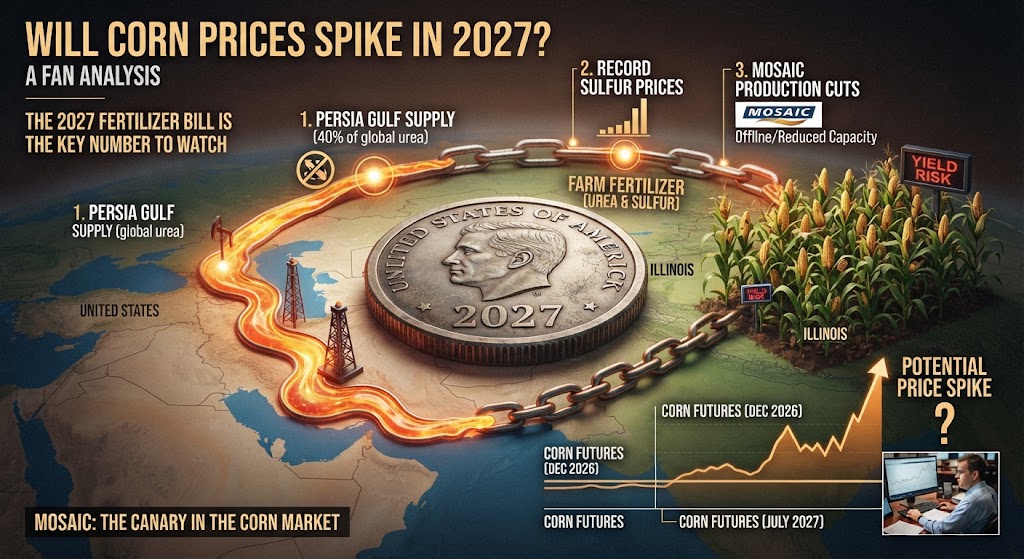
The futures curve tells the story. On September 24, CBOT corn settled at $5.275 for December 2026 and $5.515 for July 2027. Traders are pricing in modest upside for next year, not a spike.
Why Aren’t Corn Prices Skyrocketing Now?
A Record Cushion From 2025
The 2025 U.S. corn crop topped 17 billion bushels, a record. That surplus carried into this marketing year and is absorbing the shock.
The 2026 Crop Is Still Large
In its September report, USDA lowered its 2026 corn production forecast by 213 million bushels to 15.8 billion. The national yield estimate is 178.5 bushels per acre. That’s smaller than 2025, but still one of the largest U.S. crops on record.
Projected 2026/27 ending stocks fell to 1.567 billion bushels from 1.653 billion. That figure still came in above the 1.533 billion traders expected, because USDA also cut feed use by 150 million bushels.
Fertilizer Was Locked In Early
Many U.S. farmers bought nitrogen for the 2026 crop before the war. Anhydrous ammonia averaged $828 per ton from September 2025 through February 2026, the main buying window. That protected 2026 yields.
Why Is 2027 the Real Risk?
Corn is the most fertilizer-intensive major U.S. crop. Illinois nitrogen recommendations for 2026 ran about 180 to 200 pounds per acre. Every input shock hits corn first.
Three Pressure Points for the 2027 Crop
1. Nitrogen costs. The Persian Gulf normally supplies about 40% of globally traded urea and 44% of seaborne sulfur. By mid-April, anhydrous ammonia averaged $1,114 per ton nationally. University of Illinois analysts warn the 2027 fertilizer purchase window may be more exposed than spring 2026 was.
2. Phosphate costs. Sulfur tightness keeps DAP prices high longer than nitrogen, which erases the timing advantage farmers had this year. That is where Mosaic comes in.
3. Fewer corn acres. Farmers are shifting acres from fertilizer-hungry corn to soybeans. About 70% of surveyed farmers said they could not afford all the fertilizer they needed this year.
How Does Mosaic Fit In?
Tampa-based Mosaic (NYSE: MOS) supplies more than half of America’s annual phosphate crop nutrient needs. Corn growers depend on that phosphate.
Record sulfur prices forced Mosaic to cut production. On the August 5 earnings call, its Louisiana operations were described as completely offline and Bartow, Florida as running near 40% of capacity, with New Wales and Riverview in the low-to-mid 70s.
Mosaic CEO Bruce Bodine said global phosphate production could fall short of last year by up to 30 million tons. Less phosphate on corn fields next spring means more yield risk for 2027.
Mosaic Financial Snapshot
| Metric | Value |
|---|---|
| Q2 2026 revenue | $2.82 billion |
| Q2 2026 net result | –$272.8 million |
| Market cap | ~$6.6 billion |
| Dividend yield | ~4.1% |
| Next earnings (est.) | Nov. 3, 2026 |
Mosaic’s second-quarter revenue was $2.82 billion with a loss of $272.8 million. Yahoo Finance lists the next earnings date as November 3, 2026, and a forward dividend yield of about 4.06%.
Management says it can ramp back to full production within weeks once sulfur flows resume. That makes Mosaic’s restart one of the clearest early signals for 2027 corn input costs.
What Would It Take for Corn to Spike?
History shows corn spikes need more than one shock. The 2012 drought and the 2022 Ukraine invasion both coincided with tight stocks.
2027 Corn Scenarios
| Scenario | Conditions | Price Pressure |
|---|---|---|
| Base case | Hormuz normalizes, normal weather | Modest; near current futures |
| Elevated | Fertilizer stays high, corn acres drop | Moderate rally |
| Spike | Renewed Gulf disruption + 2027 drought | Sharp rally possible |
Scenarios are FAN analysis, not forecasts.
There are signs pointing toward the base case. On September 29, reports indicated Persian Gulf oil flows were approaching pre-war levels. Grain markets also absorbed this shock better than in 2022: in the first 161 days of the conflict, grain and oilseed prices rose an average of 11.6%, versus 18.4% after Russia invaded Ukraine.
There are also signs of tightening. The FAO’s Director-General warned that fertilizer scarcity will reduce yields and tighten food supplies into 2027. Global corn ending stocks for 2026/27 are projected at 272.1 million metric tons, down 2.6 million from August.
Brian’s Take
Having spent years as a money manager, I look for the number the market isn’t watching yet. For corn, that number is next spring’s fertilizer bill, not this fall’s harvest.
The 2026 crop is safe because fertilizer was bought early and the 2025 surplus is large. The 2027 crop has neither protection. Farmers are buying 2027 inputs now, at war-time prices, from a phosphate industry running well below capacity. A modest futures premium for July 2027 suggests the market sees that risk but isn’t panicking.
Three things to watch:
- Mosaic’s Q3 earnings, expected around November 3. Any restart at Bartow or Riverview would be a bearish signal for corn input costs.
- USDA’s first 2027 acreage indications. A large corn-to-soy shift would tighten supply.
- Strait of Hormuz shipping. Sustained normal flows ease the whole chain; renewed attacks reset it.
A spike is a real possibility, not the likely outcome. Florida investors should treat Mosaic as the canary for the 2027 corn market.
This article is market commentary, not investment advice.
Frequently Asked Questions
Will corn prices go up in 2027?
Futures suggest a modest increase, with July 2027 corn near $5.52 versus about $5.28 for December 2026. A spike would likely require high fertilizer costs combined with bad weather or renewed Middle East disruption.
Why are corn prices higher in 2026?
Corn is up about 19% from a year ago. USDA cut its 2026 production forecast, and the Iran war raised fertilizer and fuel costs for farmers.
How does fertilizer affect corn prices?
Corn needs more nitrogen and phosphate than most crops. When fertilizer costs rise, farmers apply less or plant fewer acres, which can reduce supply the following year.
What does Mosaic have to do with corn?
Mosaic, headquartered in Tampa, supplies more than half of U.S. phosphate fertilizer. Its production cuts due to record sulfur prices could reduce fertilizer available for the 2027 corn crop.
When does Mosaic report earnings next?
Mosaic’s next quarterly earnings report is estimated for November 3, 2026.
Is a food crisis coming because of corn?
Not immediately. U.S. corn stocks are still large. The FAO warns supplies could tighten into 2027 if farmers keep cutting fertilizer use.
Sources and Further Reading
- Trading Economics — Corn Price, Historical Data and News (Oct. 2, 2026)
- USDA AMS — Illinois Grain Bids Report (Sept. 24, 2026)
- USDA WASDE — September 2026 Report
- High Plains Journal — USDA Lowers Corn Production Forecast (Sept. 2026)
- DTN — USDA Releases September Crop Production, WASDE Reports
- AgOptimus — September 2026 WASDE Scorecard
- Texas A&M AgriLife Extension — Market Outlook (Jan. 12, 2026)
- farmdoc daily — Fertilizer Cost Increases Resulting from the Iran Conflict
- farmdoc daily — Middle East Ceasefire Fails to Ease U.S. Fertilizer Price Pressure
- farmdoc daily — Strait of Hormuz Disruption Scenarios and Fertilizer Purchasing Risks
- Coalition for a Prosperous America — Food Security Is Fertilizer Security
- Federal Permitting Dashboard — Mosaic Riverview East Stack Extension
- Alliance Chemical — Sulfuric Acid Plant Curtailments 2026
- BigGo Finance — Mosaic Q2 2026 Earnings Call Summary
- Yahoo Finance — The Mosaic Company (MOS) Quote
- FreightWaves — More Oil Out of the Gulf Translating to Lower Prices (Sept. 29, 2026)
- Economist Impact — Beyond the Farm Gate: Lessons from the 2026 Fertiliser Shock
- FAO Newsroom — Fertilizer Scarcity Will Affect Next Harvests and Food Supplies