By Brian French | FlFinancialNews.com | October 27, 2026
Quick Answer
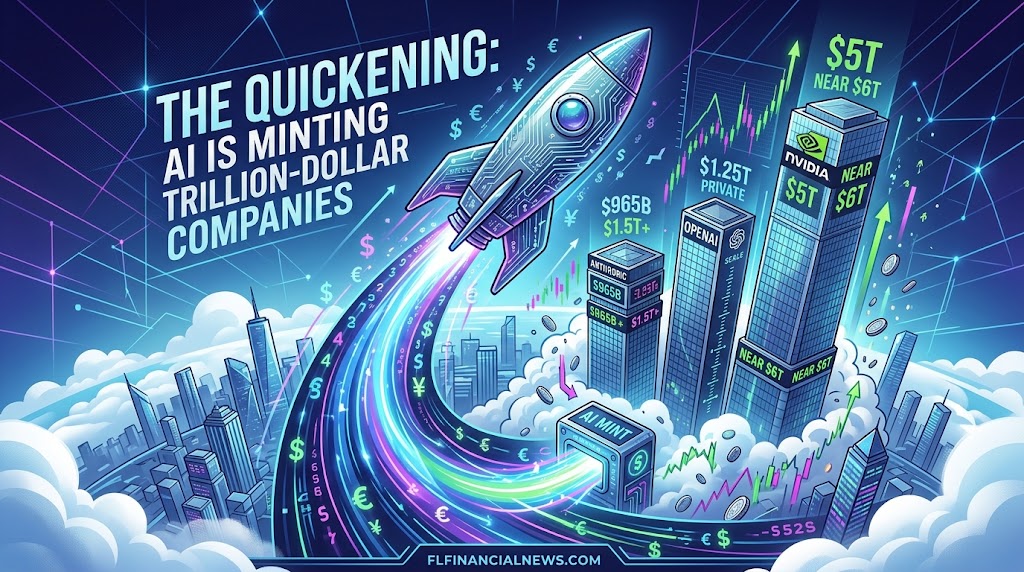
AI’s exponential growth is now showing up in financial results at a speed markets have never seen. Anthropic grew from a $61.5 billion valuation in March 2025 to $965 billion in May 2026 and is preparing an IPO discussed at $1.5 trillion or more. OpenAI is negotiating at $1.25 trillion. Nvidia is approaching $6 trillion. Companies that once took decades to reach a trillion dollars are now doing it in a year or two, and the pace is accelerating.
Key Takeaways
- Anthropic’s annualized revenue run rate rose from about $9 billion at the end of 2025 to $65 billion by the end of July 2026, roughly seven times higher than a year earlier.
- Anthropic’s valuation rose about 16-fold in 14 months, and its IPO, targeted for mid-November, has been discussed at $1.5 trillion to $2 trillion.
- OpenAI is reportedly raising up to $30 billion at a $1.25 trillion pre-money valuation, up from $852 billion in March.
- There were no trillion-dollar companies in 2017. By 2026, there are between 15 and 17, depending on the day.
- Big Tech plans to spend about $725 billion on AI-heavy infrastructure in 2026, and analysts project more than $1 trillion in 2027.
- AI startups are scaling revenue about five times faster than software companies did in the cloud era.
The Quickening in Valuations
| Company | Early Mark | 2026 Mark |
|---|---|---|
| Anthropic | $61.5B (Mar 2025) | $965B (May 2026) |
| OpenAI | $300B (Mar 2025) | $1.25T talks (Oct 2026) |
| Nvidia | $1T (May 2023) | Near $6T (Oct 2026) |
| Cursor | Startup (2023) | $60B valuation |
| Trillion-dollar club | 0 (2017) | 15–17 (2026) |
Compounding Has Never Moved This Fast
Every investor learns the same lesson eventually: compounding is the most powerful force in finance. A company growing 20% a year doubles in under four years. Most of the great fortunes of the last century were built on growth rates like that, sustained for decades.
AI has broken that scale. The leading AI companies are not growing 20% a year. They are growing 200%, 500%, even 700% a year, and they are doing it at sizes that used to be considered impossible.
The human brain struggles with this. Research on what economists call exponential growth bias shows that people consistently picture compounding as a straight line and underestimate where it leads, even when they are trained in finance. That bias is why so many investors are still waiting for AI to “prove itself” while the revenue and valuations are already rewriting the record books.
This is the quickening: the period when exponential growth in technology turns into exponential growth in revenue, and then into exponential growth in shareholder value.
Anthropic: The Fastest Revenue Ramp in Business History
No company better illustrates the quickening than Anthropic, the maker of the Claude AI models.
In January 2025, Anthropic’s annualized revenue run rate was about $1 billion. By December 2025, it was about $9 billion. Then it accelerated:
- February 2026: about $14 billion
- April 2026: more than $30 billion, passing OpenAI for the first time
- May 2026: about $47 billion
- End of July 2026: about $65 billion, according to Bloomberg
That is roughly $18 billion of new annualized revenue added in about two months. For perspective, Snowflake took roughly a decade to reach $1 billion in run-rate revenue. Anthropic’s coding product, Claude Code, reached $1 billion in annualized revenue within about six months of launch on its own.
The valuation followed. Anthropic was valued at $61.5 billion in March 2025, $380 billion in February 2026, and $965 billion after a $65 billion Series H in May 2026. That is a gain of about 16 times in 14 months, and more than 2.5 times in just three months. Anthropic is now preparing an IPO as soon as mid-November, with valuation talk ranging from about $1.5 trillion to $2 trillion.
Early investors in that company have seen returns that would rank among the best in venture capital history, and they earned them in a fraction of the usual time.
OpenAI and the Trillion-Dollar Private Company
OpenAI tells the same story from a different angle. The company closed a funding round in March 2026 at an $852 billion post-money valuation. In October, CNBC and TechCrunch reported that OpenAI was close to raising up to $30 billion at a $1.25 trillion pre-money valuation, with Coatue and investors from the United Arab Emirates among the likely participants. If completed, it would be the most valuable private company in history.
OpenAI’s annualized revenue run rate topped about $40 billion in August 2026, roughly double where it stood at the end of 2025.
Two private companies approaching or exceeding a trillion dollars in value at the same time has never happened before. A decade ago, the idea of a single private company worth $100 billion was considered remarkable.
Nvidia and the Infrastructure Gold Rush
The companies selling the tools of the AI boom have been rewarded just as dramatically. Nvidia crossed $1 trillion in market value in mid-2023 and became the world’s first $5 trillion company in October 2025. On October 5, 2026, its shares closed at a record, leaving it within about 4% of becoming the first $6 trillion company. Nvidia now represents about 13% of the Nasdaq and 8% of the S&P 500.
The demand behind those numbers is enormous. Microsoft, Alphabet, Amazon, and Meta plan to spend about $725 billion on capital expenditures in 2026, up about 77% from roughly $410 billion in 2025. Goldman Sachs estimates hyperscaler capex will total about $1.15 trillion from 2025 through 2027, and Bank of America and Evercore project annual spending will pass $1 trillion in 2027. Global semiconductor sales are expected to reach $1 trillion in 2026 for the first time.
Alphabet CEO Sundar Pichai summed up the logic: for his company, the risk of investing too little in AI is far greater than the risk of investing too much. When the largest companies in the world adopt that view, a massive amount of capital flows to the suppliers, builders, and energy providers behind the boom.
The Trillion-Dollar Club Is Exploding
Apple became the first U.S. company to reach $1 trillion in August 2018. In 2017, no company in the world was worth that much. By 2020 there were five. By 2024 there were 11. In 2026 the count has ranged from 15 to 17, depending on the day’s trading.
Look at who joined or strengthened their position this cycle: Nvidia, Broadcom, TSMC, Meta, Micron, SK Hynix. Nearly all of them are riding AI infrastructure demand. Two private AI labs are knocking on the door from the outside, and their IPOs could add them to the club in a matter of months.
The pattern is clear. It took about 40 years of the modern stock market to produce the first trillion-dollar company. It took about eight years to produce more than a dozen. The quickening suggests the next wave will form even faster.
Trillion-Dollar Companies Built in a Single Year
Here is the bold possibility investors should take seriously: the time it takes to build a trillion-dollar company is collapsing from decades to a single year.
Consider what the data already shows:
- Anthropic added roughly $900 billion in private valuation between March 2025 and May 2026.
- OpenAI added about $400 billion in valuation between March and October 2026.
- Mercor, an AI hiring platform, doubled its annualized revenue from $1 billion to $2 billion in about four months.
- ElevenLabs, an AI voice company, went from $100 million to $2 billion in annualized revenue in about 13 months and is reportedly in talks at a $50 billion valuation.
- Cursor, the AI coding tool, went from zero to $2 billion in annual recurring revenue in under three years and carries a $60 billion valuation.
- Lovable, an AI app builder, reached $100 million in annual revenue in March 2026 with just 146 employees.
Deloitte’s Tech Trends 2026 report found that AI startups scale from $1 million to $30 million in revenue about five times faster than software-as-a-service companies did. Forbes reported that the companies on its 2026 AI lists have collectively raised $305.6 billion.
Why can this happen so quickly? Three reasons:
- Instant global distribution. An AI product can reach millions of businesses through the cloud on day one, without stores, factories, or sales teams in every market.
- Small teams, huge output. AI companies are generating revenue per employee that rivals Nvidia, because AI does much of the work.
- Capabilities compound monthly. Every new model release opens new markets, from coding to law to medicine, often overnight.
When a company can add tens of billions in revenue in a single year and markets value that revenue at 15 to 30 times sales, a trillion-dollar valuation inside 12 months moves from fantasy to arithmetic.
America Owns the Quickening
The United States sits at the center of this wealth creation. According to Stanford’s 2026 AI Index, U.S. private AI investment reached $285.9 billion in 2025, about 23 times China’s $12.4 billion. American companies produced 50 notable AI models in 2025 versus China’s 30, and the U.S. hosts 5,427 data centers, more than 10 times any other country.
PwC’s 2026 Global Top 100 report found that U.S. companies account for about 75% of the combined market value of the world’s 100 largest public companies, a total that grew 24% in a year to $38.76 trillion. Every leading frontier AI lab of this era was founded in America, and American capital markets are where their value is being created and realized.
For Florida, that matters directly. South Florida has become one of the country’s fastest-growing hubs for hedge funds, private equity, and family offices, and Florida investors are among those holding the shares, funds, and private stakes that are compounding at these rates.
Bold Doesn’t Mean Blind
Exponential markets move fast in both directions, and the last two weeks showed it. Reuters reported that some investors at Anthropic’s October investor day discussed a valuation around $1.5 trillion, down from about $2 trillion previously expected. OpenAI reportedly trimmed its target from $1.4 trillion to $1.25 trillion after investor pushback. An MIT study in 2025 found that most companies experimenting with generative AI were not yet seeing measurable returns.
Those adjustments do not change the direction of the trend. They are a reminder that in a quickening, volatility is the price of admission. The investors who capture the biggest gains will be the ones who understand both the scale of the opportunity and the size of the swings.
What Investors Should Watch
- Run-rate revenue trends. Watch how fast leading AI companies add revenue, not just how much they have.
- The IPO calendar. Anthropic’s expected listing and OpenAI’s eventual offering will set public-market prices for the AI leaders.
- Capex guidance. Big Tech spending plans are the clearest signal of demand for chips, data centers, and power.
- New categories. Coding, voice, hiring, and drug discovery are early examples. The next breakout company may be in a field few are watching yet.
- Concentration risk. With Nvidia alone at 8% of the S&P 500, diversification decisions matter more than ever.
Brian’s Take
I managed money for years, and I have never seen anything like this. Early in my career, a company that doubled its revenue in a year was a rare find. Today, the leading AI companies are adding the revenue of a Fortune 500 company every few months.
The math of the quickening is simple. When capabilities double every few months, revenue follows, and valuations follow revenue. We have gone from zero trillion-dollar companies to more than a dozen in under a decade, and two private companies built in the last 11 years are now valued near or above a trillion dollars. I fully expect we will see companies go from little-known startup to trillion-dollar enterprise in a single year before this decade is over.
That does not mean every AI stock will win. Many will not, and the swings will be violent. But investors who keep thinking in straight lines are going to miss the steepest part of the most important curve in financial history. Learn to think in doublings, watch the revenue, and understand that the quickening is just getting started.
FAQ
What is “the quickening” in AI investing?
It describes how AI’s exponential improvement is turning into exponential revenue and valuation growth, with companies reaching milestones in months that once took decades.
How fast has Anthropic grown?
Its annualized revenue run rate rose from about $1 billion in January 2025 to about $65 billion by the end of July 2026, and its valuation rose from $61.5 billion to $965 billion between March 2025 and May 2026.
Is OpenAI worth more than $1 trillion?
OpenAI was valued at $852 billion in March 2026 and is reportedly negotiating a new round at a $1.25 trillion pre-money valuation.
How many trillion-dollar companies are there?
None existed in 2017. In 2026, the count has ranged from about 15 to 17 depending on daily market moves, led by AI and semiconductor companies.
Can a company really reach $1 trillion in one year?
The 2026 data suggests it is increasingly possible. Anthropic added roughly $900 billion in valuation in about 14 months, and AI startups are scaling revenue about five times faster than cloud software companies did.
What are the risks?
Valuations can swing sharply, as recent trims to Anthropic and OpenAI valuation talks show. Many companies have not yet seen measurable returns from AI, and market concentration in a few stocks is high.
Sources and Further Reading
- Bloomberg — Anthropic’s Annualized Revenue Tops $65 Billion Before IPO (August 2026)
- Unite.AI — Anthropic Run-Rate Revenue Hits $65 Billion as IPO Looms
- Simon Willison — Anthropic run-rate revenue disclosures, February–May 2026
- TechCrunch — OpenAI working on new $30B raise at $1.25T valuation ahead of IPO (October 22, 2026)
- FinanceFeeds — Anthropic IPO Targets Mid-November as OpenAI Races for $30 Billion
- FourWeekMBA — Anthropic and OpenAI’s Valuation Drop, Checked (Reuters and CNBC reporting)
- Exploding Topics — Anthropic Revenue and Valuation Statistics (October 2026)
- Crypto Briefing — Nvidia nears $6 trillion market cap
- OfficeChai — From No Trillion-Dollar Companies in 2017, There Are Now 17 in 2026
- Founder Pin — Top 10 Trillion-Dollar Companies in the World in 2026
- Yahoo Finance — Hyperscaler capex set to reach $725 billion in 2026
- Trader Insights Media — 2026 AI Capex Tracker (Goldman Sachs, Bank of America, Evercore estimates)
- Silicon Canals — Four U.S. tech giants steering toward roughly $725 billion in 2026
- Stanford HAI — The 2026 AI Index Report
- Longbridge — PwC 2026 Global Top 100 Companies by Market Capitalisation summary
- AI Business Weekly — Top AI Startups to Watch in 2026
- BERI — AI Startups Growing 5x Faster Than SaaS (Deloitte Tech Trends 2026)
- MarketScale — Forbes 2026 AI 50 and Next Billion-Dollar Startups lists
- Levy and Tasoff — Exponential-Growth Bias and Overconfidence
This article is for informational purposes only and is not investment advice.