By Brian French | FlFinancialNews.com | October 27, 2026
Quick Answer
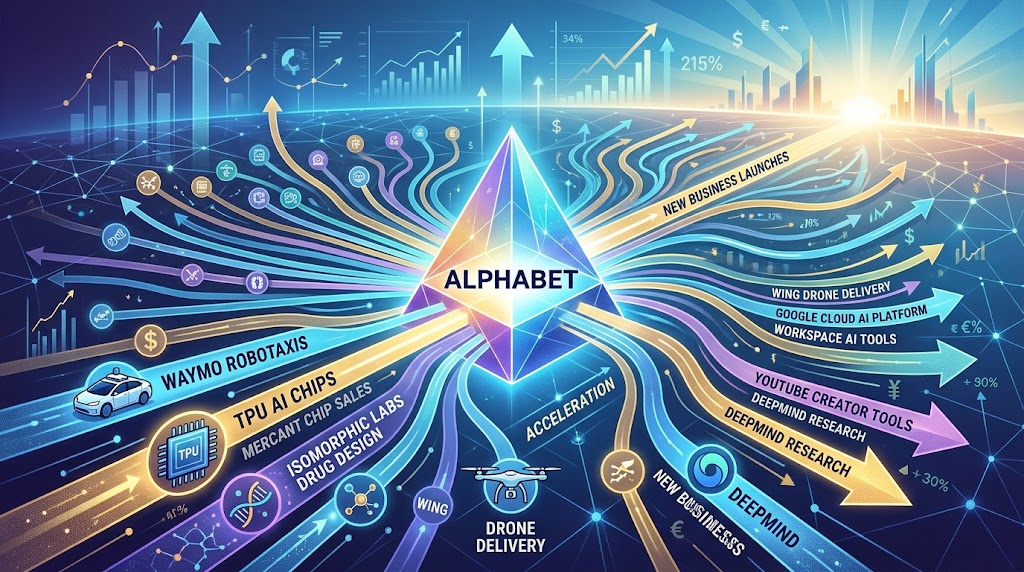
The second derivative measures whether growth itself is speeding up. In AI, the company with the strongest second-derivative profile and the deepest bench of new businesses is Alphabet. It already runs or owns stakes in more than 20 distinct AI-driven businesses, from Waymo and AI chip sales to drug discovery and drone delivery, and it has built a pipeline designed to spin out more every year. Over the next decade, 20 to 50 meaningful new AI businesses could emerge from inside Alphabet.
Key Takeaways
- Google Cloud growth accelerated to 63% in the first quarter of 2026, up from roughly 28% a year earlier, a textbook second-derivative signal.
- Waymo grew from 50,000 weekly paid rides in May 2024 to about 500,000 by March 2026 and was valued at $126 billion in February.
- Alphabet began selling its TPU AI chips directly to outside customers in 2026, creating a new hardware business that competes with Nvidia.
- Alphabet’s 2015 investment of about $900 million in SpaceX was worth roughly $78 billion to $94 billion after SpaceX’s June 2026 IPO.
- Alphabet’s X moonshot factory expects to graduate about two new companies a year, now funded through a dedicated outside venture fund.
- Nvidia is the strongest runner-up, acting as the AI economy’s most active investor rather than a business builder.
The Second Derivative in Alphabet’s Numbers
| Metric | Earlier | Latest |
|---|---|---|
| Google Cloud growth | ~28% (Q1 2025) | 63% (Q1 2026) |
| Waymo weekly rides | 50K (May 2024) | ~500K (Mar 2026) |
| Waymo valuation | ~$45B (late 2024) | $126B (Feb 2026) |
| SpaceX stake value | $900M (2015) | ~$78–94B (2026) |
| Quarterly capex | $17B (Q1 2025) | $36B (Q1 2026) |
What the Second Derivative Means for Investors
Most investors focus on the first derivative: how fast a company is growing. A company growing revenue 20% a year is moving at 20% speed.
The second derivative asks a sharper question: is that growth rate rising or falling? A company whose growth accelerates from 20% to 30% to 45% is in a fundamentally different position from one that is steady at 20%, even if both look healthy today. Acceleration is what drives the biggest revisions to earnings estimates, and those revisions are what drive the biggest stock moves.
In the AI era, there is also a second meaning. Second-derivative thinking looks past the first-order winners, the companies selling chips and cloud capacity today, to the second-order businesses those tools make possible. The internet’s first-order winners sold servers and routers. Its second-order winners were search engines, online retailers, streaming services, and social networks, and they created far more value.
The question for AI investors is which major company is best positioned on both measures: accelerating growth in its core business, and the ability to launch many new businesses on top of it.
Why Alphabet Is the Answer
Alphabet was literally designed for this. In 2015, Google reorganized itself into Alphabet specifically so that it could incubate new businesses alongside its search and advertising core. For years, investors treated those “Other Bets” as an expensive hobby, with cumulative losses topping $40 billion. AI has changed that math.
Today Alphabet has four advantages that no other company combines:
- World-class AI research. Google DeepMind produced AlphaFold, which shared the 2024 Nobel Prize in Chemistry, and builds the Gemini family of models.
- Its own AI chips. Tensor Processing Units give Alphabet computing power without depending entirely on Nvidia.
- Massive distribution. Search, Android, YouTube, Chrome, Gmail, and Workspace reach billions of people, and Apple signed a multi-year deal to use Gemini on iPhones.
- A built-in business factory. X, the moonshot lab, plus venture arms GV and CapitalG, give Alphabet an internal engine for creating and funding new companies.
The Businesses Already Running
Count the AI-driven businesses Alphabet already operates or owns meaningful stakes in, and the list passes 20 before reaching any future spinouts.
Core AI platforms
- Gemini consumer app and subscriptions
- Gemini API for developers and enterprises
- AI Overviews and AI Mode in Search, which helped search sales grow 19% in the first quarter of 2026
- Google Cloud, which grew 63% to about $20 billion in the first quarter
- Workspace AI across Gmail, Docs, and Meet
- YouTube AI tools for creators and advertisers
- Android and Pixel AI
New hardware and infrastructure
- TPU chip sales. In April 2026, Alphabet said it would sell TPUs to select customers for their own data centers, after signing a multiple-gigawatt TPU agreement with Anthropic and a reported multibillion-dollar chip deal with Meta. Morgan Stanley has projected 500,000 to 1 million TPU shipments a year by 2027.
- Quantum computing through Google Quantum AI.
Transportation and logistics
- Waymo, the robotaxi leader
- Wing, drone delivery, expanding with Walmart to 150 cities this year
Health and life sciences
- Isomorphic Labs, the DeepMind spinout that raised $2.1 billion in May 2026 to design drugs with AI
- Verily, now Verily Health, which raised $300 million in March 2026, with Alphabet keeping a significant minority stake
- Calico, focused on the biology of aging
- Fitbit health data and wearables
Security and data
- Wiz, the cloud security company Google acquired
- Mandiant threat intelligence
Equity stakes in other AI leaders
- Anthropic, where Alphabet has invested about $23 billion and holds an option to buy up to $10 billion more at the IPO price
- SpaceX, which merged with xAI in February 2026 and went public in June
- Hundreds of startups held through GV and CapitalG
Waymo: Proof That the Model Works
Waymo is the clearest evidence that Alphabet can turn a research project into a major business. It started as a secretive Google project in 2009. By May 2024, it was giving about 50,000 paid rides a week. By March 2026, that figure had reached about 500,000 across 10 U.S. cities, including Miami and Orlando, a tenfold increase in under two years.
In February 2026, Waymo raised $16 billion at a $126 billion valuation, nearly triple the roughly $45 billion valuation it carried just over a year earlier. Its leadership has set a target of 1 million paid rides per week by the end of 2026 and plans to lay groundwork in more than 20 additional cities, including London and Tokyo.
The growth has not been perfectly smooth. Some analysts noted signs of slower organic growth early in 2026, and per-city launches are expensive. But Waymo shows the pattern Alphabet can repeat: years of patient research, then a sudden inflection when the technology works and capital floods in.
The TPU Business: A New Second-Derivative Engine
Alphabet’s decision to sell TPUs directly is one of the most important and least appreciated moves of 2026. For a decade, Google only rented its custom chips through its cloud. Now it is becoming a merchant chip supplier, entering a market Nvidia has dominated.
The early customer list is impressive. Anthropic signed for multiple gigawatts of next-generation TPU capacity with Google and Broadcom, expected to begin coming online in 2027. Meta reportedly signed a multibillion-dollar deal. Alphabet’s CFO said some TPU hardware revenue would appear this year, with a larger impact in 2027.
This is a brand-new revenue line that barely existed two years ago. If AI chip demand continues at its current pace, TPUs alone could become a business worth hundreds of billions of dollars.
The Spinout Machine
The real reason Alphabet could produce 20 to 50 new AI businesses is that it has industrialized the process.
In 2024, Alphabet’s X lab faced a problem: some of its best projects had more potential outside Alphabet than inside it. The solution was Series X Capital, an independent venture fund run by former YouTube and Facebook CFO Gideon Yu. It gets the first outside look at X’s pipeline and invests exclusively in X projects.
In its first 18 months, Series X backed:
- Taara, high-speed wireless connectivity using light
- Chorus, AI-powered supply chain orchestration
- Anori, AI software that speeds up housing and real estate development approvals
- Verily, which it led a funding round for in March 2026
X leader Astro Teller has said he expects the lab to graduate roughly two companies a year going forward. Add Google DeepMind’s science spinouts like Isomorphic, new product lines inside Google itself, and companies seeded through GV and CapitalG, and a pipeline of 20 to 50 meaningful AI businesses over the next decade is a realistic projection, not a stretch.
Not every bet will succeed. Intrinsic, the robotics software company that graduated from X in 2021, was folded back into Google in February 2026. But the model only needs a few Waymos to pay for everything else.
The Hidden Value Already Compounding
Alphabet’s investment record shows what happens when a company owns early stakes in transformative businesses.
In 2015, Google invested about $900 million in SpaceX, then valued near $12 billion. After SpaceX’s IPO in June 2026, Alphabet’s stake was reported at about $94.1 billion at its peak, and roughly $78 billion at mid-August prices, more than an 86-fold return. Alphabet became SpaceX’s largest reported institutional shareholder.
Its Anthropic position could be similarly large. Estimates of Alphabet’s stake range from at least 6.6% on a fully diluted basis to as much as 15%, with valuation talk for Anthropic’s upcoming IPO between $1.5 trillion and $2 trillion.
These stakes are largely invisible in Alphabet’s day-to-day earnings, but they represent tens or even hundreds of billions of dollars in value that can surface through IPOs and revaluations.
The Runner-Up: Nvidia, the Kingmaker
If Alphabet is the AI economy’s business builder, Nvidia is its banker. Nvidia joined 53 venture rounds of $100 million or more between January and August 2026, more than any venture capital firm, according to Dealroom. Its quarterly filing for the period ending July 26, 2026, valued its equity investments at about $99 billion, up from roughly $7 billion a year earlier. It contributed $30 billion to OpenAI’s $122 billion funding round.
Nvidia’s portfolio touches nearly every important AI company, from OpenAI and Anthropic to robotics, quantum computing, and drug discovery startups. Its investments strengthen demand for its chips and give it a seat at the table across the industry.
The difference is that Nvidia funds other people’s businesses, while Alphabet creates and runs its own. For investors seeking a company that will itself launch dozens of new AI businesses, Alphabet has the edge. For investors seeking the broadest financial exposure to the AI startup ecosystem, Nvidia is a powerful complement.
Amazon and Microsoft deserve mention too. Amazon has a history of building new businesses from within, with AWS as the most famous example, and Microsoft owns about 27% of OpenAI. But neither has an incubation structure as purpose-built as Alphabet’s.
How Investors Can Own the Second Derivative
- Alphabet common stock. Class A (GOOGL) or Class C (GOOG) shares give exposure to the core business plus every Other Bet, investment stake, and future spinout.
- Index funds. Alphabet is one of the largest holdings in the S&P 500 and Nasdaq-100.
- Pair with a kingmaker. Combining Alphabet with Nvidia covers both the builder and the investor sides of the AI economy.
- Watch the spinouts. As X companies raise outside money and Alphabet-backed companies like Anthropic go public, new direct investment opportunities will appear.
The Risks
- Spending is enormous. Alphabet expects to spend $180 billion to $190 billion on capital expenditures in 2026, and its free cash flow fell 38% year over year in the first quarter.
- Most moonshots fail. Other Bets have lost tens of billions of dollars over the years, and some projects, like Intrinsic, get folded back in.
- Regulation. Alphabet faces ongoing antitrust scrutiny of its search and advertising businesses.
- Competition. OpenAI, Anthropic, Microsoft, Meta, and Amazon are all competing for the same customers, and Nvidia still holds the large majority of the AI chip market.
- Hidden value is not cash. Investment stakes can lose value, and lockups limit when they can be sold.
Brian’s Take
In my years managing money, the best investments I saw were rarely the companies growing fastest. They were the companies whose growth was about to accelerate, before everyone else noticed. That is the second derivative, and it is where the largest gains are made.
Alphabet is showing every sign of it. Its cloud business more than doubled its growth rate in a year. Waymo went from novelty to a $126 billion company. A $900 million bet on SpaceX turned into roughly $80 billion or more. And it just launched a chip business that could compete directly with Nvidia.
What excites me most is the structure. Alphabet has built a machine for turning research into businesses, and AI is the fuel that makes that machine run faster. I believe the next decade will see Alphabet launch or spin out dozens of AI businesses, many worth billions and a few worth hundreds of billions. Investors who own the parent company own the whole pipeline, and I think that is one of the most underappreciated opportunities in the market today.
FAQ
What is second-derivative investing?
It focuses on whether a company’s growth rate is accelerating, not just how fast it is growing. Accelerating growth often leads to the largest upward revisions in earnings estimates and stock prices.
Why is Alphabet positioned to create so many AI businesses?
It combines leading AI research, its own chips, global distribution, and a dedicated incubation system through X, GV, CapitalG, and the Series X Capital fund.
How many AI businesses does Alphabet already run?
More than 20, including Gemini, Google Cloud, TPU chip sales, Waymo, Wing, Isomorphic Labs, Verily, Calico, Wiz, and stakes in Anthropic and SpaceX.
How valuable is Waymo?
Waymo was valued at $126 billion after raising $16 billion in February 2026, and it handles about 500,000 paid rides per week.
Why is Nvidia the runner-up?
Nvidia is the most active investor in large AI funding rounds, with equity investments valued at about $99 billion, but it mainly funds other companies rather than building new businesses itself.
What are the main risks of investing in Alphabet?
Heavy capital spending, failed moonshots, antitrust regulation, intense competition, and the uncertain value of private investment stakes.
Amazon vs. Microsoft: Who Can Build AI Businesses Fast?
By Brian French | FlFinancialNews.com | October 27, 2026
Quick Answer
Amazon has strong AI business-building skills. It invented cloud computing, and in 2026 it built a custom chip business with a run rate of more than $25 billion in a few years. Microsoft is better at selling AI than inventing new businesses. Its AI revenue run rate tops $37 billion, but most of it comes through Azure, Office, and GitHub, not through standalone new companies. Alphabet remains the strongest business creator, Amazon is a close second, and Microsoft is the best monetizer.
Key Takeaways
- AWS growth accelerated for five straight quarters to 36.7% in the second quarter of 2026, its fastest pace in 18 quarters, with a $496 billion backlog.
- Amazon’s AI business and its custom chip business each passed a $25 billion annual revenue run rate, both growing at triple-digit rates.
- Microsoft’s AI business reached a $37 billion run rate, up 123%, and Azure grew 40% in the March 2026 quarter.
- Microsoft has more than 20 million paid Microsoft 365 Copilot seats, but that is only about 4.4% of its commercial customer base.
- Microsoft has no equivalent of Alphabet’s X lab or Amazon’s history of launching standalone businesses. Its strength is distribution, not incubation.
- Amazon lacks a leading frontier AI model of its own and relies heavily on Anthropic. Microsoft is still reducing its reliance on OpenAI.
The AI Business-Building Scorecard
| Capability | Alphabet | Amazon | Microsoft |
|---|---|---|---|
| Own frontier models | Strong | Weak | Developing |
| Custom AI chips | Strong | Strong | Early |
| Cloud growth (latest) | 63% | 37% | 40% |
| Enterprise distribution | Good | Good | Strongest |
| Incubation engine | Strongest | Strong | Weak |
| AI lab stakes | Anthropic, SpaceX | Anthropic | OpenAI |
What It Takes to Build Businesses on the Fly
Creating new AI businesses quickly requires more than money. Every major technology company has money. The companies that can launch new businesses at the speed AI demands need five things:
- Their own AI models, so they are not dependent on a rival for the core technology.
- Their own chips, so they control costs and capacity.
- Distribution, so new products can reach customers on day one.
- A culture of starting new things, including tolerance for failure.
- A structure that lets new businesses grow, without being smothered by the core business.
Alphabet scores well on all five. Amazon and Microsoft each have real strengths, and some telling gaps.
Amazon: The Builder With a Track Record
A history of inventing businesses
Amazon may have the best record of any large company for turning internal projects into giant businesses. It started as an online bookstore and went on to build Prime, the Kindle, Alexa, Amazon Advertising, and, most importantly, Amazon Web Services. AWS began as an internal tool and became the world’s largest cloud provider.
That culture still matters. Andy Jassy, who built AWS before becoming CEO, noted that three years after AWS launched it had a revenue run rate of about $58 million. Amazon’s AI business, at a similar stage, is already measured in tens of billions.
The second derivative is accelerating
Amazon’s cloud numbers show exactly the kind of acceleration investors look for. AWS growth went from 24% in the fourth quarter of 2025 to 28% in the first quarter of 2026 to 36.7% in the second quarter, the fifth straight quarter of acceleration and the fastest growth in 18 quarters. AWS is now running at a $169 billion annual pace, which Jassy said would rank around 24th on the Fortune 500 as a standalone company.
The backlog of signed but undelivered contracts reached $496 billion, roughly 2.5 times the level a year earlier. Customers are signing deals faster than Amazon can build data centers to serve them.
The chip business: a new company inside Amazon
Amazon’s most impressive new AI business is its custom silicon. Its Trainium AI chips and Graviton processors together passed a $25 billion annual revenue run rate in the second quarter, up from about $20 billion one quarter earlier, with triple-digit growth. Amazon has more than $225 billion in committed Trainium revenue, anchored by multi-year, multi-gigawatt deals with Anthropic and OpenAI, and it has also signed customers including Meta and Uber.
Amazon is now exploring selling Trainium chips directly to outside data centers, which would put it in direct competition with Nvidia. One caveat: much of the reported chip revenue reflects internal pricing to AWS rather than sales to outside buyers, so the business is not yet comparable to a standalone chipmaker.
A long list of new AI products
Beyond cloud and chips, Amazon has launched or expanded a steady stream of AI-driven businesses in 2026:
- Amazon Bedrock, a marketplace for AI models used by hundreds of thousands of customers. Customers spent more in the second quarter than in all prior quarters combined.
- AWS Continuum, an AI security service that finds and fixes code vulnerabilities.
- Amazon Quick, an AI work assistant with autonomous agents.
- Amazon Supply Chain Services, selling Amazon’s logistics expertise to other companies.
- Amazon Now, 30-minute delivery, now in nine countries and more than 250 cities.
- Alexa+ and Alexa for Shopping, which reached 350 million users, with shoppers spending about 40% more per order.
- Amazon Advertising, which grew 26% to $19.8 billion in the quarter, powered by AI tools.
- Amazon Leo, the satellite internet network, approaching 400 satellites in orbit.
- Zoox, the robotaxi company.
Where Amazon falls short
Amazon’s biggest gap is that it does not have a leading frontier AI model of its own. Its Nova models are useful, but the most advanced models on Bedrock come from Anthropic, OpenAI, and others. Jassy has said he expects about half a dozen comparably strong frontier models within a few years and wants Amazon to build one of them. Until then, Amazon depends heavily on Anthropic, which is also its largest AI partner and investment. That relationship paid off spectacularly in the second quarter, when Amazon recorded $53.4 billion in pre-tax gains, primarily from its Anthropic investments.
Some of Amazon’s moonshots also lag rivals. Zoox remains far behind Waymo in commercial robotaxi rides. And the spending is enormous. Amazon raised its 2026 capital spending plan to about $220 billion, and its trailing 12-month free cash flow turned negative, at an outflow of $7.6 billion.
Amazon’s verdict
Amazon has the culture and the track record to create new AI businesses quickly, and its chip business proves it can still build something large from scratch. It is the strongest challenger to Alphabet as a business creator. The missing piece is a first-tier AI model of its own.
Microsoft: The Monetizer
Massive AI revenue, mostly through existing products
Microsoft has turned AI into revenue faster than almost any company. In the March 2026 quarter, its AI business passed a $37 billion annual revenue run rate, up 123% year over year and up from $13 billion in January 2025. Azure grew 40%, up from 33% a year earlier, and Microsoft’s commercial backlog of contracted future revenue reached $627 billion, nearly double the prior year, with a significant portion tied to OpenAI.
Microsoft’s strength is distribution. It sells to nearly every large organization in the world through Microsoft 365, Azure, GitHub, Dynamics, LinkedIn, and its security products. When Microsoft adds AI to those products, it can reach hundreds of millions of business users almost instantly. The company reported 420 million monthly active Copilot users in early 2026, and Agent Mode is becoming the default in Word, Excel, and PowerPoint.
Copilot: big numbers, small penetration
Microsoft 365 Copilot, the company’s flagship paid AI product for businesses, passed 20 million paid seats by its fiscal third quarter, up from 15 million in January. That growth is strong, but it represents only about 4.4% of Microsoft’s commercial customer base. For investors, that is both a weakness and an opportunity: Copilot has not yet become standard, but there is a long runway if adoption accelerates.
Building its own AI stack
Microsoft spent years relying on OpenAI for its most advanced models. It is now building independence:
- Microsoft AI and the Superintelligence Team. Led by DeepMind co-founder Mustafa Suleyman, who joined in 2024, the team was formally established in November 2025.
- MAI models. At its Build conference in 2026, Microsoft unveiled seven in-house models, including a reasoning model called MAI-Thinking-1 and a coding model already available in GitHub Copilot.
- Maia 200 chips. Microsoft’s second-generation AI chip, which it says offers 30% better performance per dollar, is in mass production and powering Microsoft 365 Copilot.
- Model choice. Customers can now route Copilot to OpenAI, Anthropic, or Microsoft’s own models.
Its OpenAI relationship remains valuable. Microsoft owns about 27% of OpenAI and receives 20% of OpenAI’s revenue through 2032. But the relationship has loosened. In April 2026, OpenAI ended its exclusive commitment to Azure and began offering its models through Amazon Web Services.
Where Microsoft falls short
Microsoft has no equivalent of Alphabet’s X lab or Amazon’s tradition of launching standalone companies. Its AI innovations almost always appear as features inside existing products, such as Copilot in Office, AI in Windows, or agents in Dynamics. That is excellent for revenue but rarely produces new, independently valued businesses.
Microsoft’s history also points in this direction. Its biggest growth moves have tended to come through acquisitions and partnerships, including LinkedIn, GitHub, Activision Blizzard, and OpenAI, rather than internal incubation. Its consumer track record has been uneven, and its personal computing segment is shrinking, with revenue declining and Windows sales to PC makers expected to fall sharply.
Microsoft’s own models and chips are also still catching up. Its MAI models are newer than those of Google, OpenAI, and Anthropic, and Maia has mainly been used inside Microsoft so far. Meanwhile, Microsoft expects to spend about $190 billion on capital expenditures in 2026, and its cloud gross margin has been compressing under the cost of the AI buildout.
Microsoft’s verdict
Microsoft is the best company in the world at turning AI into enterprise revenue through products customers already use. It is not built to spin out dozens of new AI companies. Investors buying Microsoft are buying an AI monetization machine and a large OpenAI stake, not an incubator.
A Quick Look at Meta and Apple
Meta is spending heavily, with 2026 capital expenditure guidance of $125 billion to $145 billion, and it uses AI effectively to improve ad targeting, which helped drive 33% revenue growth in the first quarter. But nearly all of its AI value flows back into its advertising business. Meta has also signed a reported multibillion-dollar deal to use Google’s TPU chips, showing it still relies on others for parts of its stack.
Apple signed a multi-year deal to use Google’s Gemini technology on iPhones. That makes Apple a powerful distributor of AI, but not a leading creator of AI models or new AI businesses.
Why the Difference Matters for Investors
Not every AI winner needs to create new businesses. There are three distinct ways large companies are capturing AI value:
- Creators launch and spin out new businesses. Alphabet leads, Amazon follows.
- Monetizers add AI to existing products and raise prices. Microsoft leads.
- Suppliers sell the chips and infrastructure everyone else needs. Nvidia leads, with Amazon and Alphabet entering the market.
Each model can produce excellent returns, but they behave differently. Creators carry more risk and more potential upside, because a single new business like Waymo or AWS can eventually be worth hundreds of billions. Monetizers offer steadier, more predictable growth tied to existing customers. Suppliers ride the spending cycle, which can swing sharply.
For investors seeking the second-derivative upside of new businesses, Alphabet and Amazon offer more of it. For investors seeking reliable AI revenue growth from a dominant enterprise franchise, Microsoft remains one of the strongest choices.
The Risks
- Spending. Amazon, Microsoft, and Alphabet together expect to spend well over half a trillion dollars on capital expenditures in 2026, pressuring free cash flow.
- Partner dependence. Amazon relies heavily on Anthropic, and Microsoft’s OpenAI relationship is no longer exclusive.
- Capacity limits. Both Amazon and Microsoft say they will remain capacity-constrained through 2026, which can cap near-term growth.
- Different definitions. Each company calculates its AI revenue run rate differently, so the figures are not directly comparable.
- Regulation. Microsoft faces a U.K. antitrust probe of its cloud practices, and all three face growing scrutiny.
Brian’s Take
When I evaluated management teams as a money manager, I learned to ask one question: has this company ever built something big from nothing? It tells you more about the future than any earnings report.
Amazon has done it repeatedly. AWS, Prime, and advertising were all built from scratch, and now it has built a chip business with a $25 billion run rate in a few years. That is a company that knows how to create. If Amazon closes its model gap, it will be a formidable rival to Alphabet in launching new AI businesses.
Microsoft is a different animal. It is the best distribution machine in enterprise technology, and it is converting AI into revenue at a remarkable pace. But Microsoft tends to buy or partner for its biggest breakthroughs rather than build them internally. That is not a weakness for shareholders, just a different kind of company.
My conclusion is that the AI economy will reward all three approaches. Investors should know which one they are buying. If you want the company most likely to give birth to the next Waymo or AWS, look first at Alphabet, then Amazon. If you want the company most likely to turn AI into steady enterprise profits, Microsoft is hard to beat.
FAQ
Does Amazon have strong AI capabilities?
Yes. AWS is growing at its fastest pace in 18 quarters, and Amazon’s AI and custom chip businesses each passed a $25 billion annual revenue run rate in 2026. Its main gap is the lack of a leading frontier AI model of its own.
How big is Microsoft’s AI business?
Microsoft reported an AI business run rate of more than $37 billion in its fiscal third quarter of 2026, up 123% year over year.
Can Microsoft create new AI businesses like Alphabet?
Microsoft is stronger at adding AI to existing products than launching standalone companies. It has no incubation structure comparable to Alphabet’s X lab.
Does Microsoft still depend on OpenAI?
Less than before. Microsoft owns about 27% of OpenAI and receives a revenue share, but it now builds its own MAI models and Maia chips, and OpenAI’s models are also available on Amazon’s cloud.
Which company is the best AI business creator?
Alphabet ranks first, followed closely by Amazon. Microsoft ranks first as an AI monetizer through its enterprise products.
What are Amazon’s new AI businesses?
Trainium and Graviton chips, Amazon Bedrock, AWS Continuum, Amazon Quick, Alexa+, Amazon Supply Chain Services, Amazon Now, Amazon Leo, and Zoox, among others.
Sources and Further Reading
- Asymco — Google to sell TPU chips as Gemini shows returns (Q1 2026 results)
- Yahoo Finance — Google to sell TPU chips to select customers in latest shot at Nvidia
- AI2Work — Google Begins Selling TPU Chips Directly to Customers
- Pulse 2.0 — Waymo Confirms $16 Billion Round at $126 Billion Valuation
- AI2Work — Waymo Hits Half a Million Weekly Rides as Robotaxi Lead Widens
- Sacra — Waymo revenue and ride estimates
- Om Malik — Is Waymo Worth $126 Billion?
- X, The Moonshot Factory — Bringing Moonshots to Market (Astro Teller, August 2026)
- TechCrunch — Alphabet’s X has a new spinout (Anori, March 2026)
- SiliconANGLE — Verily steps out from under Alphabet’s shadow after raising $300M
- CNBC — Former Alphabet moonshot Intrinsic is folding into Google
- FourWeekMBA — Alphabet Other Bets revenue and losses
- The Next Web — Google reveals it holds $94.1bn in SpaceX shares after the IPO
- Entrepreneur India — Alphabet’s SpaceX Investment Grows
- Bloomberg Law — Alphabet Poised for $100 Billion Windfall on SpaceX Investment
- Life Science Daily News — Isomorphic Labs $2.1 billion Series B
- Dealroom — Nvidia as a megaround investor (September 2026)
- TechCrunch — Nvidia’s AI empire: A look at its top startup investments
- BigGo Finance — Alphabet’s Anthropic investment and IPO option (Bloomberg calculations)
- Om Malik — What I Learned about Hyperscalers’ AI Spend (free cash flow data)
This article is for informational purposes only and is not investment advice. Investors should consult a licensed financial advisor before making investment decisions.