By Brian French | FlFinancialNews.com
Quick Answer
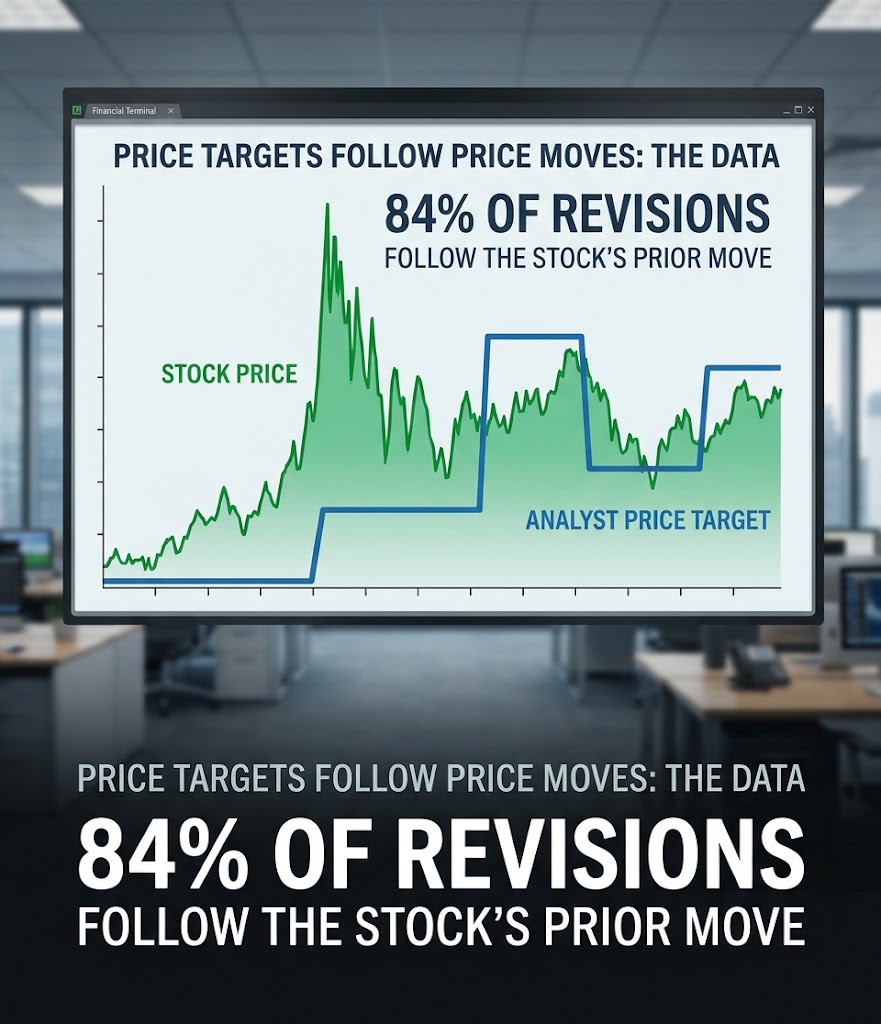
Analysts usually raise price targets after a stock has already risen and cut them after it has already fallen. A study of more than half a million revisions found the target followed the stock’s prior move about 84% of the time. Investors should treat a revised target as a lagging signal, not a forecast.
The Job Description Versus the Practice
A sell-side analyst has one core job: to tell investors where a company’s earnings and share price are going before the market figures it out. A 12-month price target is meant to express that judgment in a single number.
In practice, much of the price target business works in reverse. The stock moves first, and the target follows. When a company’s shares rally after an earnings beat, a wave of “price target raised” headlines arrives the next morning. When shares collapse, the cuts come just as fast. For a reader trying to use those targets to make decisions, a forecast that shows up after the move has done little forecasting.
The Data: 84% of Revisions Follow the Stock
The most complete recent look at the issue comes from AnaChart, an analyst-tracking firm. Its research desk matched 517,960 consecutive price target revisions against the share price change since the same analyst’s previous target on the same stock. In the 427,210 cases where both the target and the price moved, 83.9% of revisions went in the same direction as the stock. The correlation between the size of the revision and the size of the prior price move was 0.74, using data through October 1, 2026.
The pattern intensifies as the move gets bigger. After a drop of more than 30%, 97.1% of revisions were cuts; after a rise of more than 30%, 95.5% were raises.
| Stock’s Prior Move | Revisions in Same Direction |
|---|---|
| Fell more than 30% | 97.1% |
| Fell 15% to 30% | 91.9% |
| Fell 5% to 15% | 78.1% |
| Moved less than 5% | 62.4% |
| Rose 5% to 15% | 87.0% |
| Rose 15% to 30% | 93.6% |
| Rose more than 30% | 95.5% |
Source: AnaChart, data through Oct. 1, 2026
In other words, the louder the market has already spoken, the more uniformly analysts repeat what it said.
A Raised Target Often Means Less Upside
There is a subtle trap in the “target raised” headline. Among revisions that came after a stock gained more than 10%, the median target before the revision sat 17.9% above the price, and the median new target sat only 11.9% above it. The typical raise lifted the target 14.3% against a median prior gain of 21.9%, and three in four of those revisions left less implied upside than before.
So the analyst raised the number, the press release said “bullish,” and the actual expected return shrank.
Experience Doesn’t Fix It
One might expect veteran analysts to show more independence. They don’t. AnaChart found the follow rate was 83.8% for analysts with under four years of experience, 83.9% for four to twelve years, and 83.8% for twelve years or more. The behavior is built into the profession, not a rookie habit.
Accuracy Has Long Been Weak
Academic research has been raising the same flag for two decades. A study by Mark Bradshaw, Lawrence Brown and Kelly Huang of 12-month targets from 2000 through 2009 found that only 38% were met at the end of the forecast horizon, although 64% were touched at some point during the year.
Targets also lean optimistic. Alon Brav and Reuven Lehavy, publishing in the Journal of Finance, found the one-year target price averaged 28% above the current market price. And optimism matters most at the worst time. Research from Markus Buxbaum, Wolfgang Schultze and Samuel Tiras found that when investor sentiment is high, the link between target prices and future returns approaches zero. A European study went further: its authors concluded that Bloomberg’s 12-month consensus targets had no predictive power over future market prices.
Recent Examples of Targets Trailing Price
DraftKings. Shares had lost 42% for the year by Oct. 7, 2026, when Guggenheim cut its target to $30 from $33 while keeping a Buy rating. The cut came after the damage, and the rating did not change.
Fluence Energy. The company cut its fiscal 2026 revenue outlook to about $2.40 billion from a $3.00 billion midpoint, and the stock fell nearly 19% in premarket trading. On Sept. 17, 2026, an RBC Capital analyst slashed his target to $4 from $15. A $15 target that becomes $4 overnight was never a reliable forecast of where the business was heading.
Why Analysts Chase Price
There are honest explanations, and fairness requires stating them. Many valuation models apply a multiple to forward earnings, so when the market re-rates a stock, the target moves too, and the same news that moves a stock may also change an analyst’s estimates. Revisions also cluster around earnings reports, meaning a quarter of price action is already in the model when the target is updated. AnaChart itself cautions that its study shows association, not cause, and does not test whether targets predict later returns.
Other pressures are less flattering. An analyst whose target sits far below a soaring stock looks wrong in front of clients every day. One far above a collapsing stock looks worse. Moving toward the price is the safe career choice. Investment banking relationships and access to company management have historically discouraged sharp, independent calls, especially negative ones.
The result is a forecast product that too often behaves like a scoreboard.
What Florida Investors Should Do Instead
Florida is home to a large population of self-directed investors, retirees managing their own portfolios, and advisors who read analyst notes daily. A few practical rules:
- Read the gap, not the headline. Compare the new target to today’s price. A “raise” can still be a reduction in expected return.
- Check the date of the prior target. If the stock moved 25% between revisions, the new number is likely a catch-up, not new insight.
- Watch earnings estimates, not just targets. A target raised without a higher earnings estimate is mostly a multiple chasing the price.
- Value the outliers. The analyst who holds a target well away from the crowd, with a clear thesis, is doing the actual job.
- Look up track records. Several services now publish how often an individual analyst’s targets were reached and how long it took.
Frequently Asked Questions
Do analyst price targets predict stock prices?
Weakly at best. Long-running studies show most 12-month targets are not met at year-end, and targets tend to sit well above the current price.
Why do so many targets change right after earnings?
Analysts update models after quarterly results, and the stock’s post-earnings move is already reflected when they do.
Is a price target raise a buy signal?
Not by itself. After a rally, a raised target often implies less upside than the previous one.
Are some analysts more independent than others?
Yes. In the AnaChart data, the share of revisions that followed price ranged from the high 60s to the mid-90s across individual analysts with long records.
Brian’s Take
When I managed money, we had a simple house rule for the morning research pile: if a target change came after the stock move, it went to the bottom of the stack. The notes worth reading were the ones that disagreed with the tape and explained why, in earnings terms.
The analyst’s value is the forecast — earnings power two years out, the margin no one is modeling, the risk the market is ignoring. Raising a target because the stock went up is not analysis. It is bookkeeping. The data now confirms what experienced investors have long suspected: roughly five of every six revisions simply ratify what the market already did.
That does not make analysts useless. Their earnings models, industry knowledge and channel checks can be excellent. The fix is to use them for the inputs and ignore the price target headline. Florida investors who learn to read a revision as a lagging indicator will be better positioned than those who trade on it.
Sources and Further Reading
- AnaChart Research Desk, “Analyst price target revisions usually move with the stock’s prior move,” revised October 2026
- Bradshaw, Brown and Huang, “Do sell-side analysts exhibit differential target price forecasting ability?” Review of Accounting Studies, 2013
- Brav and Lehavy, “An empirical analysis of analysts’ target prices: Short-term informativeness and long-term dynamics,” Journal of Finance
- Buxbaum, Schultze and Tiras, “Do analysts’ target prices stabilize the stock market?” Indiana University Kelley School of Business, 2023
- Almeida, “Accuracy of European stock target prices,” University of Lisbon repository
- TIKR, “Guggenheim Cut Its DraftKings Target. It Still Sees 51% Upside,” October 2026
- Financial Modeling Prep, “Fluence Energy (FLNC) Price Target Cut on Revised Forecasts,” September 2026