By Brian French | FlFinancialNews.com | October 8, 2026
Quick Answer
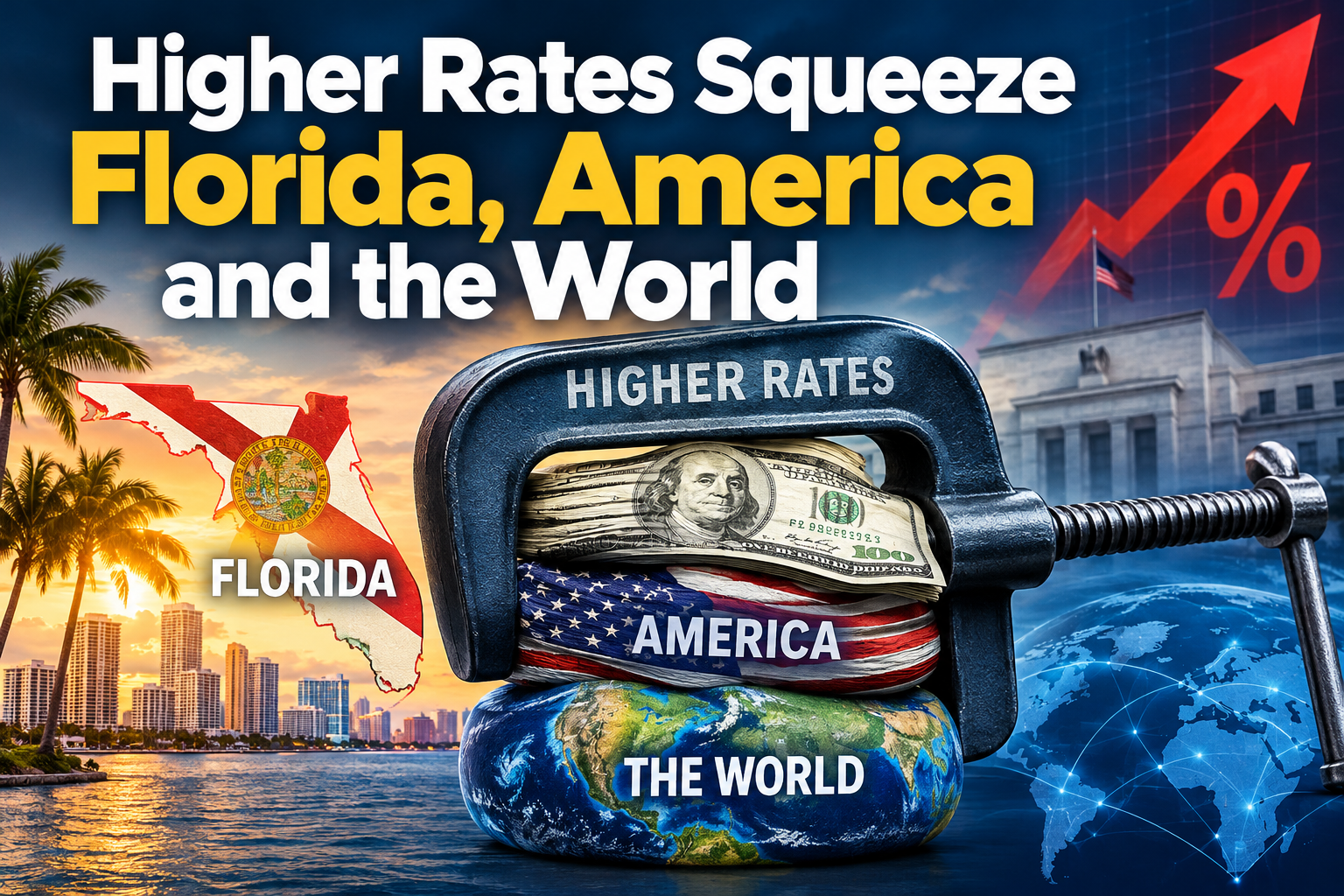
The Fed raised rates in September for the first time since 2023, and long-term yields jumped with it. Florida feels this through 7%+ mortgages and slowing home sales. The U.S. feels it through a $1 trillion federal interest bill. The rest of the world feels it through a stronger dollar and hikes of its own.
Key Takeaways
- Fed: The Fed raised the federal funds rate to 3.75%–4% on September 16, 2026, reversing part of 2025’s cuts.
- Mortgages: The 30-year fixed averaged 7.28% on October 1, 2026, up from 7.03% a week earlier and 6.34% a year ago.
- Florida housing: Median prices rose in August for single-family homes, condos and townhouses, but higher mortgage rates slowed sales growth.
- Federal debt: The 10-year Treasury yield is above 5%, and net interest costs reached about $1.05 trillion in the first 11 months of fiscal 2026.
- Global: The ECB, the Bank of Japan and the Bank of England are all leaning tighter, not looser.
Why Rates Went Up Again in 2026
The story of 2026 is that the long-expected rate-cutting cycle stalled and then reversed. The 10-year Treasury yield started 2026 near 4.15% and dipped below 4% in February. It then reversed sharply when the war involving the United States, Israel and Iran began that month, pushing oil prices and inflation expectations higher.
By late summer, inflation had not come down enough. Under Chair Kevin Warsh, the Fed moved. The September 16 hike to 3.75%–4% was followed within days by a Bank of Japan rate increase on September 18 and a Bank of England hold on September 17.
The key analytical point is that the Fed sets short-term rates, but the bond market sets long-term rates. Mortgages, commercial real estate loans and corporate debt are priced off the 10-year Treasury. That yield has climbed far more than the Fed’s quarter-point hike, which is why borrowers are feeling a much bigger squeeze than the headline Fed move suggests.
Rate Snapshot: One Year of Change
| Measure | A Year Ago | Now |
|---|---|---|
| Fed funds target | — | 3.75%–4.00% |
| 30-yr mortgage | 6.34% | 7.28% |
| 15-yr mortgage | — | 6.60% |
| 10-yr Treasury | ~4.15% (Jan.) | 5%+ |
Mortgage figures are Freddie Mac weekly averages as of Oct. 1, 2026. The 15-year fixed averaged 6.60%, up from 6.42% a week earlier.
How Higher Rates Are Hitting Florida
Florida is more rate-sensitive than most states. Its economy leans on real estate, construction, tourism, and in-migration of retirees and remote workers. All four depend on borrowing costs and on affordability.
Housing: Prices Hold, Volume Slips
The August data from Florida Realtors shows a market that is cooling at the margin rather than breaking. The single-family median rose just over 1% from August 2025 to $415,000, the sixth straight month of year-over-year gains. The condo and townhouse median rose almost 3% to just under $298,000.
Volume is where the rate pressure shows. Single-family closed sales fell about 1.5% year over year, and condo and townhouse sales fell just under 2%, ending 11-month streaks of annual gains in both categories. Florida Realtors’ chief economist Dr. Brad O’Connor described the numbers as a market leveling off rather than reversing, with tight inventory supporting prices even as the recent rate rise slowed sales growth.
Important timing note: August closings reflect contracts written when rates were still in the mid-6% range. The jump above 7% happened in late September. The September and October data, due out from Florida Realtors in mid-October and mid-November, will be the first real test of how Florida buyers react.
What 7.28% Costs a Florida Buyer
FlFinancialNews.com ran the payment math on Florida’s August median prices, assuming 10% down and a 30-year fixed loan (principal and interest only).
| Property | At 6.34% | At 7.28% | Monthly Change |
|---|---|---|---|
| Single-family ($415K) | $2,322 | $2,556 | +$234 |
| Condo/townhome ($298K) | $1,667 | $1,835 | +$168 |
Source: FlFinancialNews.com calculation. Excludes taxes, insurance and HOA dues.
That is roughly $2,800 a year more for the same median single-family home, before Florida’s property insurance and HOA costs, which are already among the highest in the nation. For a first-time buyer, that gap can be the difference between qualifying and not qualifying.
Florida Business and Commercial Real Estate
Higher long-term yields reprice commercial real estate loans, which are usually tied to Treasury rates plus a spread. Florida developers, hotel owners and multifamily investors refinancing 2021-era debt are now facing materially higher coupons. Expect fewer new project starts in the condo and multifamily pipeline, more pressure on owners with floating-rate debt, and more deals that only work with cash or private credit.
Small businesses feel it through credit lines and equipment loans tied to the prime rate, which moves in lockstep with the Fed.
The Florida Upside: Savers and Retirees
Florida has one of the oldest populations in the country, and many retirees live partly on interest income. For them, higher rates are a benefit. CDs, money market funds and Treasury bills now pay more than they have in nearly two decades. That income supports consumer spending in places like The Villages, Naples and Sarasota, which partly offsets the drag on housing.
How Higher Rates Are Hitting the U.S.
The Federal Interest Bill
The most consequential national effect is on Washington’s own borrowing costs. Net interest costs are estimated at about $1.05 trillion in the first 11 months of fiscal 2026, and the Congressional Budget Office projects federal debt held by the public at roughly 101% of GDP this year.
This creates a feedback loop. Higher yields raise interest costs, which widen the deficit, which requires more Treasury borrowing, which can push yields higher still. Analysts describe this self-reinforcing cycle as a debt spiral, a concept that has moved from academic theory to active debate on Wall Street as the 10-year has climbed.
Households and Credit
For consumers nationwide, the effect runs through mortgages, auto loans and credit cards. Housing affordability is the biggest pressure point: the jump from 6.34% to 7.28% on a 30-year loan wipes out much of the affordability gain buyers enjoyed in 2025. Credit card rates, which follow prime, are moving up with the Fed’s hike.
Markets
Bond investors have taken losses as yields rose and prices fell. Stocks face a higher hurdle as “risk-free” Treasury yields above 5% compete with equities for capital.
How Higher Rates Are Hitting the World
The U.S. is not tightening alone. Energy-driven inflation is pushing several major central banks in the same direction.
| Central Bank | Latest Move | Policy Rate |
|---|---|---|
| Federal Reserve | Hike (Sept. 16) | 3.75%–4.00% |
| European Central Bank | Hike (Sept. 10) | 2.50% deposit |
| Bank of Japan | Hike (Sept. 18) | 1.25% |
| Bank of England | Hold, 6–3 (Sept. 17) | 3.75% |
Europe
The ECB raised all three key rates by 25 basis points, taking the deposit rate to 2.50%, citing persistent Middle East-related inflation pressures expected to keep inflation well above target for an extended period. Staff projections put headline inflation at 3.0% in 2026, 2.5% in 2027 and 2.1% in 2028, with the later years revised higher. Growth remains thin, projected at 0.9% for 2026.
Japan and the United Kingdom
The Bank of Japan raised its overnight rate by 25 basis points to 1.25% at its September 17–18 meeting, yet the yen still fell. In London, the Bank of England kept its rate at 3.75% even though three of nine policymakers voted for a hike.
Emerging Markets and the Dollar
When U.S. yields rise faster than everyone else’s, global capital flows toward dollars. A stronger dollar makes dollar-denominated debt more expensive for emerging economies, raises import costs abroad, and tightens financial conditions worldwide even in countries whose central banks have not moved.
For Florida, the global angle matters directly. A strong dollar makes Florida vacations and condos more expensive for Canadian, European and Latin American buyers and tourists, a meaningful headwind for Miami, Orlando and the Gulf Coast.
Brian’s Take
Having managed money through prior rate cycles, I would watch one number above all others: the 10-year Treasury yield, not the Fed funds rate. The Fed’s quarter-point hike is modest. The bond market’s move is not. Florida’s housing market can absorb a 6.5% mortgage. It is far less clear it can absorb 7.5% for a year, especially on top of insurance costs.
My read is that Florida is entering a volume recession, not a price collapse. Inventory is tighter than headlines suggest, and a large share of Florida purchases are made in cash. Sellers who do not need to sell will wait. Buyers who need financing will hesitate. The result is fewer transactions, which hurts realtors, title companies, mortgage brokers, movers and builders before it hurts prices.
The opportunity side is real too. Florida retirees and savers are earning genuine income on cash for the first time in years, and well-capitalized buyers face less competition. Florida business owners should lock in fixed-rate financing where possible, stress-test any floating-rate debt at 1–2 points higher, and avoid assuming 2025-style rate cuts are coming back soon.
Frequently Asked Questions
Did the Fed raise interest rates in 2026?
Yes. The Federal Reserve raised its target range by a quarter point to 3.75%–4.00% on September 16, 2026, its first increase since 2023.
What are mortgage rates in Florida right now?
Florida rates track national averages closely. The Freddie Mac national 30-year fixed average was 7.28% as of October 1, 2026. Individual quotes vary by lender, credit score and down payment.
Are Florida home prices falling because of higher rates?
Not yet. August 2026 median prices rose year over year for both single-family homes and condos. Sales volume, however, dipped, and the data does not yet reflect the September rise above 7%.
How much more does a Florida home cost with higher rates?
On Florida’s $415,000 median single-family home with 10% down, a move from 6.34% to 7.28% adds about $234 a month in principal and interest, roughly $2,800 a year.
Why are long-term rates rising more than the Fed’s hike?
Long-term yields reflect inflation expectations, federal borrowing needs and global demand for U.S. debt. The 2026 energy shock and a federal interest bill above $1 trillion have pushed investors to demand higher yields.
Who benefits from higher interest rates in Florida?
Savers and retirees earn more on CDs, money markets and Treasury bills. Cash buyers face less competition in real estate. Banks with low-cost deposits can also earn wider margins.
Are other countries raising rates too?
Yes. The European Central Bank and Bank of Japan both raised rates in September 2026, while the Bank of England held with three members voting to hike.
Sources and Further Reading
- Florida Realtors — “Florida home prices hold firm in August” (September 2026): https://www.floridarealtors.org/news-media/news-articles/2026/09/florida-home-prices-hold-firm-august
- Trading Economics — “US Mortgage Rates Climb Further in October” (Freddie Mac PMMS data, October 1, 2026): https://tradingeconomics.com/united-states/30-year-mortgage-rate/news/588887
- Political.org — “Treasury yields surge past 5%, but analysts say U.S. fiscal apocalypse isn’t imminent yet” (October 4, 2026): https://political.org/2026/10/04/treasury-yields-surge-past-5-but-analysts-say-u-s-fiscal-apocalypse-isnt-imminent-yet/
- MTS Insights — “ECB Monetary Policy Decision” summary (September 10, 2026): https://www.mtsinsights.com/summaries/10870/
- Bursa — “Bank of Japan raises interest rate to 1.25%, Bank of England holds at 3.75% following Fed hike” (September 2026): https://www.bursa.ro/bank-of-japan-raises-interest-rate-to-125-procente-bank-of-england-holds-at-375-procente-following-fed-hike-44633062
FlFinancialNews.com is part of the Florida Authority Network. Payment estimates are FlFinancialNews.com calculations for illustration only and are not financial advice.