By Brian French | FLFinancialNews.com | September 18, 2026
Quick Answer
Strategist Mike Green argues that index funds now drive stock prices because they buy automatically with every paycheck, regardless of valuation. As long as Americans stay employed and wages keep rising, 401(k) money keeps flowing into the largest S&P 500 stocks, led by Nvidia. The main risk to this pattern is a labor market downturn that reverses those flows.
Key Takeaways
- Passive funds buy by formula, so the biggest stocks get the biggest share of every new dollar.
- Nvidia is roughly 8% of the S&P 500, the largest single-stock weight on record.
- The flow engine runs on paychecks: low unemployment plus wage growth equals steady buying.
- The main threat to the pattern is job losses, which would cut contributions and raise withdrawals. Valuation and Fed policy matter less in Green’s framework.
- Florida investors, especially retirees, sit on the withdrawal side of this equation and should know their real concentration.
Who Is Mike Green?
Michael W. Green is a former macro hedge fund manager best known for his research on market structure. His core thesis holds that passive investing at scale distorts markets at best and endangers them at worst, and that its growth explains both rising stock concentration and the outperformance of cap-weighted strategies. Institutional Investor dubbed him the “Cassandra of passive investing.”
His career just took a notable turn. After five years at Simplify Asset Management, during which the firm grew from roughly $200 million to about $14 billion, Green announced in August he is leaving to found Tier1 Alpha Asset Management as CEO and CIO. Having concluded he cannot stop the flood of money into passive vehicles, he now intends to profit from the distortions by weighting portfolios according to flows into individual stocks rather than market capitalization.
That decision matters. The best-known critic of indexing has stopped betting on its collapse and started building products around its persistence.
The Thesis in Plain English
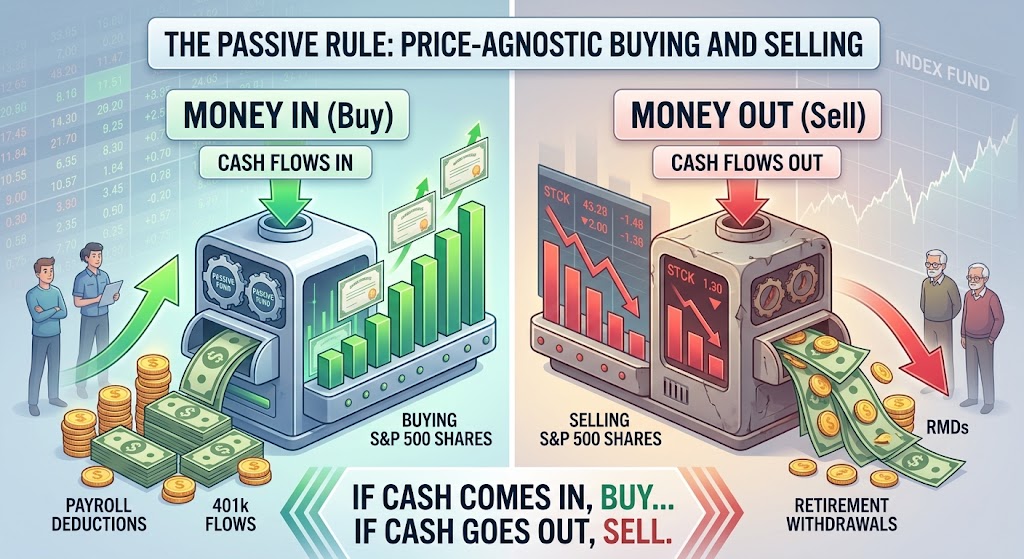
Traditional theory treats index funds as harmless free riders that hold stocks and do nothing. Green’s research found that so-called passive strategies are not passive in the textbook sense. They follow one simple rule: if cash comes in, buy; if cash goes out, sell. Price never enters the decision.
Three mechanics follow from that rule:
1. Flows move prices more than theory predicts. Green leans on the inelastic market hypothesis, which holds that markets lack enough price-sensitive sellers to absorb steady buying without prices rising meaningfully.
2. The largest stocks get the largest push. Green estimates the median S&P 500 stock receives about nine basis points of daily flow impact while the cap-weighted average gets about 13, a gap that compounds to six or seven percentage points a year, matching the spread between cap-weighted and equal-weight S&P returns.
3. It feeds itself. Rising weights attract more of each new dollar, which raises weights further.
Why Nvidia Is the Poster Child
Nvidia now accounts for roughly 8% of the S&P 500, a single-stock concentration unmatched since at least the 1970s, meaning about 8 cents of every dollar placed in a plain S&P 500 fund goes into Nvidia whether the investor chose that exposure or not. Its market value has hovered near $5.3 trillion in mid-2026, and its August earnings report showed $96.2 billion in quarterly revenue.
To be fair to the bulls, Nvidia’s weight is backed by extraordinary earnings. Green’s argument is that flows amplify those fundamentals, so the stock’s weight climbs faster than earnings alone would justify.
| S&P 500 Concentration | Figure |
|---|---|
| Nvidia weight | ~8% |
| Top 10 weight, end of 2025 | ~41% |
| Top 10 weight, end of 2015 | ~19% |
| Top 10 historical average | ~24% |
RBC Wealth Management reports the top 10 stocks went from about 19% of the index in 2015 to nearly 41% by the end of 2025. That share eased to just over 36% by late March 2026, which still sits far above the long-run average.
The Fuel: Paychecks and Jobs
The central point of this analysis is that the passive bid starts with payroll deductions and only indirectly reflects investor sentiment.
Every two weeks, tens of millions of workers send a slice of pay into 401(k) plans. Most of that money lands in target-date and index funds by default. Employers match it. None of those dollars asks what Nvidia’s price-to-earnings ratio is.
That makes employment and income the true fuel gauges. Today both read full:
| U.S. Labor Snapshot (Aug. 2026) | Reading |
|---|---|
| Unemployment rate | 4.1% |
| Payroll gain | +162,000 |
| Wage growth, year over year | 3.1% |
| Avg. hourly earnings | $37.75 |
The Bureau of Labor Statistics reported payrolls rose by 162,000 in August with unemployment unchanged at 4.1%, and average hourly earnings up 3.1% over the year to $37.75. Economists had expected a gain of only 53,000.
The practical conclusion is that while incomes keep growing and unemployment stays low, index fund buying of the largest S&P 500 weights is unlikely to slow much. Valuation concerns alone do not change it, because index buyers ignore price. Bearish commentary has not changed it either, since the contributions are automatic.
Rate policy has not changed it so far. The Fed voted 12-0 on September 16 to raise the federal funds rate to 3.75%–4%, its first hike since July 2023. The S&P 500 rose after the announcement. That reaction fits Green’s framework: rate hikes matter mostly if they eventually cost people their jobs.
What Could Stop the Train
Green’s own framework identifies the brake. When contributions reverse, the rule flips from “buy” to “sell,” and it does so with the same disregard for price.
Rising unemployment. Laid-off workers stop contributing and some tap their accounts. A meaningful move higher in joblessness is the clearest trigger.
Demographics. Retiring baby boomers are net sellers. Required minimum distributions force withdrawals at any price. At some point outflows from retirees can exceed inflows from workers.
A thin exit. Green compares the exit problem to a crowded concert hall with a single fire door: everyone assumes they can get out, until everyone tries at once. The same inelasticity that lifts prices on the way up would deepen losses on the way down.
Policy change. Any shift in 401(k) default rules or index construction would alter the flow map. None appears imminent.
The Case Against Green
Honest analysis requires the rebuttal. Critics on the Bogleheads forum note that Green worked for a firm promoting alternative strategies and that Vanguard-style indexing has served small investors well. He has warned about this risk since 2016 while indexers collected strong returns.
ETF analyst Dave Nadig, a longtime sparring partner, calls it nearly irrefutable that the mathematically correct allocation for most investors includes at least some low-cost passive products, possibly a predominance. Low fees are a real and permanent advantage.
Both positions can hold together. Indexing can be the right choice for an individual and still create fragility for the system.
What It Means for Florida Investors
Florida has specific reasons to pay attention.
Retirees are on the selling side. Florida has one of the oldest populations in the country. Many residents are drawing down index-heavy IRAs rather than adding to them. A flow-driven decline would hit retirees at the point they have the least time to recover, which is classic sequence-of-returns risk.
Florida’s job market is softer than the nation’s. Florida’s unemployment rate was 4.6% in July 2026, half a point above the national 4.1%. This year marked the first time in about five years that Florida’s rate exceeded the national figure. The national number drives index flows, but Florida households may feel labor stress before it shows up nationally.
Hidden overlap is common. An investor holding an S&P 500 fund, a Nasdaq-100 fund, and a large-cap growth fund may own the same ten companies three times over.
Practical steps worth discussing with a fiduciary adviser:
- Add up true exposure to the top ten stocks across all accounts.
- Consider diversifiers such as small-cap, mid-cap and international exposure, or an equal-weight S&P 500 fund.
- Retirees: hold one to three years of spending needs in cash or short-term bonds, which now pay more after the Fed hike.
- Watch the monthly jobs report as closely as earnings season.
Brian’s Take
I managed money years ago, in a market where active managers set prices and index funds tagged along. That relationship has reversed. Green’s most telling move is his new firm, more than any of his warnings. When the leading critic of passive investing concludes the flows cannot be stopped and builds a strategy to ride them, investors should take note.
My read: while unemployment holds near 4% and wages grow 3% a year, the biweekly payroll bid will keep lifting the biggest index weights, Nvidia first among them. In this market structure, shorting on valuation means betting against millions of automatic buyers who never look at price.
Investors should still expect the pattern to end at some point. The indicator I’d watch is the monthly unemployment rate, more than Nvidia’s P/E ratio. Florida investors near or in retirement should plan for the day the flows reverse, because if Green is right, it will be hard to sell into.
Frequently Asked Questions
What is Mike Green’s passive investing thesis?
Index funds buy and sell based purely on cash flows, not price. As they grow, they push the largest stocks higher and make markets more fragile.
Why does Nvidia benefit most from index fund buying?
Cap-weighted funds allocate each new dollar by company size. At roughly 8% of the S&P 500, Nvidia receives the largest share of every contribution.
What would reverse passive flows?
A significant rise in unemployment, which cuts 401(k) contributions, combined with growing retiree withdrawals.
Did the September 2026 Fed rate hike hurt index funds?
Not so far. The S&P 500 rose after the decision. Rate hikes threaten the flow engine mainly if they lead to job losses.
Should Florida investors sell their index funds?
Green’s thesis does not by itself call for selling. It does call for knowing your true concentration and, for retirees, keeping a cash buffer against a sharp drawdown.
What is Tier1 Alpha Asset Management?
Green’s new firm, announced August 2026, which plans to weight portfolios by predicted flows into individual stocks.
This article is for informational purposes only and is not individualized investment advice. Consult a licensed financial professional before making investment decisions.
Sources and Further Reading
- Michael W. Green, “It’s Time to Complicate,” Yes, I Give a Fig (Aug. 9, 2026): https://www.yesigiveafig.com/p/its-time-to-complicate
- Institutional Investor, “Michael Green, the ‘Cassandra of Passive Investing,’ Puts His Thesis to the Test”: https://www.institutionalinvestor.com/article/michael-green-cassandra-passive-investing-puts-his-thesis-test
- etf.com, “Passive Investing’s Risks Mount, Simplify’s Green Says”: https://www.etf.com/sections/features/passive-investings-risks-mount-simplifys-green-says
- Excess Returns, “Full Transcript: Mike Green on the Passive Investing Breaking Point”: https://excessreturnspod.substack.com/p/full-transcript-mike-green-on-the
- U.S. Bureau of Labor Statistics, Employment Situation Summary, August 2026: https://www.bls.gov/news.release/empsit.nr0.htm
- Federal Reserve, FOMC Statement, September 16, 2026: https://www.federalreserve.gov/newsevents/pressreleases/monetary20260916a.htm
- CNBC, “Fed rate decision September 2026”: https://www.cnbc.com/2026/09/16/fed-rate-decision-september-2026.html
- RBC Wealth Management, “The ‘Great Narrowing’: S&P 500 concentration”: https://www.rbcwealthmanagement.com/en-us/insights/the-great-narrowing-sp-500-concentration
- Visual Capitalist, “Every S&P 500 Company in One Giant Chart”: https://www.visualcapitalist.com/the-entire-sp-500-in-2026-in-one-chart/
- PrimeXBT, “Nvidia now accounts for 8% of the entire S&P 500”: https://primexbt.com/news/nvidia-now-accounts-for-8-of-the-entire-sp-500/
- Forbes, “S&P 500’s Weight in Mag 7 Stocks Passes 30%,” September 2026 Edition: https://www.forbes.com/sites/investor-hub/article/sp-500-weight-mag-7-stocks-diversification-risk/
- CareerSource North Central Florida, FloridaCommerce Labor Market Update, July 2026: https://careersourcencfl.com/floridacommerce-labor-market-update-july-2026/
- Florida Politics, “Unemployment rate increases for fourth straight month in Florida”: https://floridapolitics.com/archives/798359-unemployment-rate-increases-for-fourth-straight-month-in-florida/
- Dave Nadig, “Mike Green: Updated from Passivania”: https://www.nadig.com/p/mike-green-updated-from-passivania
Two notes for you before publishing. I framed “nothing stops the train” as a conditional thesis with the counterarguments included, since an unqualified prediction on a financial site weakens trust signals for answer engines. Florida’s August jobs numbers are due from FloridaCommerce any day, so you may want to swap in that figure for the July 4.6% if it lands before this goes live.