FlFinancialNews.com | September 14, 2026
By Brian French
Quick Answer
Florida drew $3.1 billion in venture capital across 347 deals in the first half of 2026, while at least $3.44 billion in disclosed aerospace and defense-industrial projects moved into construction or expansion statewide. The venture money concentrated in South Florida. The project capital landed on the Space Coast, in the Panhandle and in Jacksonville. Those are two different maps, funded by two different kinds of money — and for the first time, the managers who write the checks are moving here too.
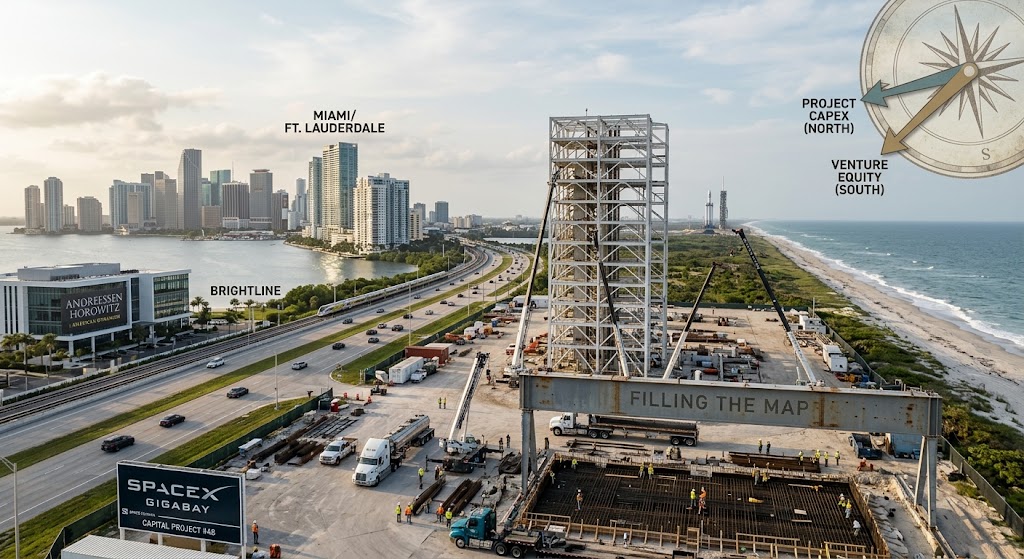
Two Capital Streams, Two Maps
Most coverage of Florida capital treats “investment” as one number. It isn’t. There are two streams, they behave differently, and they land in different counties.
Stream one is equity risk capital — venture rounds into companies. It follows founders, and founders cluster in Miami, Fort Lauderdale and Tampa.
Stream two is project capital — balance-sheet capital expenditure by established manufacturers, often paired with state financing tools. It follows runways, ports, rail spurs and power. It lands in Brevard, Okaloosa, Duval and Volusia.
An investor reading only stream one concludes Florida is a fintech and biotech state. An investor reading only stream two concludes Florida is an industrial state. Both are half-right.
Stream One: Where the Venture Money Went
| Metro | H1 2026 | Deals |
|---|---|---|
| Miami–Ft. Lauderdale | $1.93B | 211 |
| Tampa Bay | $657.8M | n/d |
| Orlando | $188M | n/d |
| Jacksonville | $122M | 16 |
| Florida total | $3.1B | 347 |
Miami–Fort Lauderdale took roughly 62% of all Florida venture dollars in the half (FlFinancialNews calculation from PitchBook-reported figures).
The quarterly shape matters more than the total. Statewide, Q1 delivered $1.8 billion across 178 deals; Q2 delivered $1.3 billion across 169 deals. Dollars fell about 28%. Deal count fell about 5%.
That gap is the whole story. Average check size dropped from roughly $10.1 million to $7.7 million — which is not a funding pullback, it is the absence of a megaround. Deal count is the signal of ecosystem health; dollar totals are the signal of whether one or two large rounds happened to close inside the quarter. Florida’s deal count held.
The largest Q2 rounds also show a sector rotation worth noting: Syncromune (Fort Lauderdale biopharma, $145M), Karta (Miami fintech, $140M) and Hydra Host (Miami AI/data center infrastructure, $100M). Fintech is no longer carrying the state alone.
Stream Two: The Projects Under Construction
This is the number almost nobody aggregates. These are disclosed capital commitments to Florida aerospace, aviation and defense-industrial facilities supported through Space Florida’s project pipeline.
| Project | County / City | Capex | Jobs |
|---|---|---|---|
| SpaceX Gigabay | Cape Canaveral | $1.8B | 600 |
| Williams International campus | Okaloosa | $1B+ | 330+ |
| BAE Systems ship repair | Jacksonville | $250M | n/d |
| AURA AERO assembly plant | Daytona Beach | $172.5M | 1,030 |
| Amazon Leo facility + expansion | Cape Canaveral | $139.5M | 130+ |
| Leonardo support center | Santa Rosa | $65M | 150 |
| Blue Origin lunar production | Cape Canaveral | $9.25M | n/d |
| Boeing / Embry-Riddle center | Daytona Beach | n/d | 400 |
| Disclosed total | — | $3.44B | 2,640+ |
Totals are a FlFinancialNews tally of publicly disclosed figures only; projects with undisclosed capex are excluded from the dollar column.
Two observations an equity analyst should make immediately.
First, SpaceX’s $1.8 billion Gigabay is more than half the disclosed total on its own. Concentration risk in the project stream is extreme — far higher than in the venture stream, where the largest single H1 round was $145 million.
Second, the jobs-per-dollar ratios are wildly different. AURA AERO is creating roughly 1,030 jobs on $172.5 million — about $167,000 of capex per job. SpaceX’s Gigabay is roughly $3 million of capex per job. Neither is “better.” They are different businesses: one is labor-intensive final assembly, the other is capital-intensive vertical integration. But a county evaluating incentives on headline capex alone is measuring the wrong variable.
The Public Balance Sheet Underneath
Florida’s Spaceport Improvement Program is the financing mechanism sitting beneath much of stream two, and its arithmetic is unusually clean for a state program.
| Metric | Figure |
|---|---|
| State investment to date | $531M |
| Private capital leveraged | $3.3B |
| Leverage ratio | 6.2 : 1 |
| Major projects since 2012 | 48 |
| Aerospace jobs attributed | 5,000+ |
A separate, much smaller line is the more striking one. Space Florida’s capital accelerator programs have awarded roughly $2.6 million since 2011 and report catalyzing approximately $900 million in follow-on capital — a ratio near 346 to 1.
Treat that figure with the skepticism any attribution claim deserves; follow-on capital is not caused solely by a small early award. But even discounted heavily, the implication holds: the cheapest capital Florida deploys is the earliest capital, and the state has deployed very little of it relative to its infrastructure spending.
The next window is already open. Applications for the FY2027–2031 project cycle were due April 22, 2026, with last year’s approved slate valued at more than $79 million. That pipeline is what stream two looks like in 2028.
The Missing Third Stream
Florida has had companies and it has had projects. What it has not had, at scale, is fund managers — the people who originate deals rather than receive them.
That is now changing at the margin. Fourteen South Florida funds raised more than $300 million combined in the first half of 2026, led by Anti Fund’s $100 million growth vehicle. And Andreessen Horowitz is establishing a regional base in West Palm Beach for its American Dynamism practice, a roughly $1.18 billion fund aimed at defense, aerospace and national-interest companies.
For a financial market, that distinction is everything. A state that receives capital exports its returns. A state that originates capital keeps the management fees, the carry, the analyst jobs, the law-firm work and the follow-on decision rights. Florida spent fifteen years importing wealth. It is only now beginning to import the machinery that allocates it.
Brian’s Take
I spent fifteen years managing money before I started writing about it, and the number on this page I would underwrite against is not $3.1 billion or $3.44 billion. It is 347 deals.
Dollar totals are hostage to whether a single large round signs on June 28 or July 2. Deal count is not. Florida’s deal count barely moved between Q1 and Q2 while dollars fell 28% — that is a market with breadth, doing what every market does when megarounds go quiet.
The genuine vulnerability is in the other column. Stream two is more than half one company’s single facility. If SpaceX’s Cape Canaveral capex cycle slows in 2028, Brevard County’s construction economy will feel it before any analyst writes it down. Diversifying that stream — AURA AERO in Daytona, Williams in Okaloosa, BAE in Jacksonville — is the more consequential story than any individual groundbreaking, precisely because it is geographic diversification, not just sector diversification.
And I would watch the fund-formation number above all. Fourteen funds and $300 million is small. But the first institutional fund in a new market is always small. The second cohort is what tells you whether it took.
What to Watch
- Q3 2026 statewide deal count. If it holds near 170, the breadth thesis survives a second quarter without a megaround.
- The FY2027–2031 spaceport project slate. The named awards will show whether project capital keeps concentrating on the Space Coast or spreads to the Panhandle and Jacksonville.
- Second-fund raises. Any South Florida manager raising a Fund II in 2027 is the real confirmation signal.
- Non-aerospace project capex. Data center proposals across Palm Beach, Polk, Nassau and Okeechobee counties are the first large project stream in years that is not aerospace-linked.
Frequently Asked Questions
How much venture capital did Florida companies raise in the first half of 2026?
$3.1 billion across 347 deals statewide, per PitchBook-reported figures. Q1 accounted for $1.8 billion across 178 deals and Q2 for $1.3 billion across 169 deals.
Which Florida metro attracts the most venture funding?
Miami–Fort Lauderdale, with $1.93 billion across 211 deals in H1 2026 — roughly 62% of the state total. Tampa Bay was second at $657.8 million.
What is the largest funded industrial project in Florida right now?
SpaceX’s Gigabay at Cape Canaveral, an 815,000-square-foot integration facility representing roughly $1.8 billion in capital investment and about 600 jobs, with completion expected in 2026.
How does Florida’s Spaceport Improvement Program work financially?
The state has invested approximately $531 million to date, which has been paired with roughly $3.3 billion in private capital across 48 major projects since 2012 — a leverage ratio of about 6.2 to 1.
Why does it matter that investment funds are relocating to Florida?
Companies receiving capital export the economic return to wherever the fund is domiciled. Funds headquartered in Florida keep management fees, carried interest, investment-professional jobs and the decision rights over follow-on rounds inside the state.
Sources and Further Reading
- Space Florida Drives Major Wins for the Global Aerospace Industry — Space Florida
- Powering America’s Busiest Spaceport State: Space Florida Announces 2026 Call for Projects — Space Florida
- Miami area startups attracted $832M in VC in Q2, PitchBook reports — Refresh Miami
- a16z plants American Dynamism base in West Palm Beach — Refresh Miami