The Florida-Headquartered Stock Landscape — and How Publix Stock Actually Works
The Direct Answer
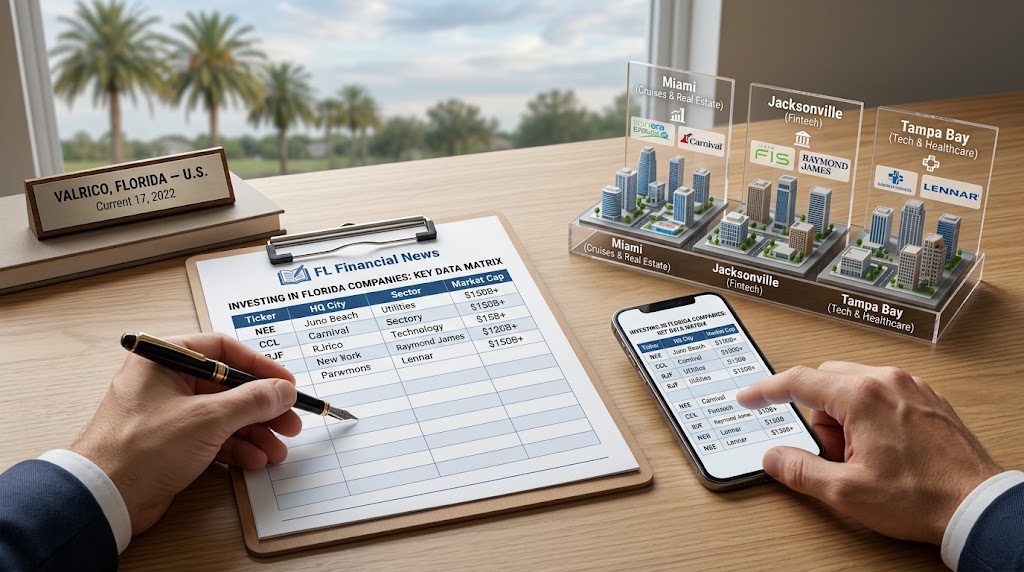
Florida is home to more than two dozen Fortune 500 companies and well over a hundred publicly traded companies with headquarters in the state (Fortune 500 list, filtered by headquarters state; SEC EDGAR company search by business-address state — confirm current counts), spanning the largest electric utility in the United States (NextEra Energy, Juno Beach), the world’s three largest cruise lines (Carnival, Royal Caribbean, Norwegian, all Miami), the largest U.S. homebuilder by revenue (Lennar, Miami), a major fintech and title-insurance cluster in Jacksonville (FIS, Fidelity National Financial, CSX, Landstar), and a growing roster of insurers, defense contractors, restaurant chains, and REITs. There is no widely tracked “Florida stock index” — no exchange or index provider publishes one — so the state’s public companies are best understood as a sector map, which this article provides. The single most-searched Florida stock question, however, concerns a company that is not publicly traded at all: Publix Super Markets of Lakeland, the largest employee-owned company in the United States (National Center for Employee Ownership, Employee Ownership 100), whose stock can be bought only by eligible Publix associates and directors, is priced by its board quarterly on the basis of an independent appraisal rather than on any exchange, and can be sold only back to the company or to other eligible holders (Publix Super Markets Form 10-K, “Market for Registrant’s Common Equity”; Publix investor relations). The Florida public-company sector map, the Publix explanation in full, the practical mechanics of investing in each, and a data source matrix follow.
Florida’s Public Companies: The Sector Map
(Composite of SEC filings, company investor relations pages, and the Fortune 500 and Florida Trend company rankings. Market capitalizations move daily and are omitted; consult a current quote. The list emphasizes the largest and most widely held; it is not exhaustive.)
Utilities and energy. NextEra Energy (Juno Beach; NYSE: NEE) — parent of Florida Power & Light, the largest electric utility in the country by retail customers, and of NextEra Energy Resources, the world’s largest generator of wind and solar power; consistently the most valuable Florida-headquartered company by market capitalization (NextEra Energy 10-K; company investor relations).
Cruise lines. Miami is the cruise capital of the world and the headquarters of the three global majors: Carnival Corporation (NYSE: CCL), Royal Caribbean Group (NYSE: RCL), and Norwegian Cruise Line Holdings (NYSE: NCLH) (each company’s 10-K, “Properties” and “Business”). Together they represent the largest single sector concentration among Florida public companies, and their stocks trade as a group on fuel costs, consumer travel demand, and — as 2020 demonstrated — public-health shocks.
Homebuilding and real estate. Lennar (Miami; NYSE: LEN), one of the two largest U.S. homebuilders; Regency Centers (Jacksonville; NYSE: REG), a shopping-center REIT; Rayonier (Wildlight; NYSE: RYN), a timberland REIT; SBA Communications (Boca Raton; NYSE: SBAC), a wireless-tower REIT (company 10-Ks).
Financial services and fintech. FIS — Fidelity National Information Services (Jacksonville; NYSE: FIS), a global payments and banking-technology provider; Fidelity National Financial (Jacksonville; NYSE: FNF), the largest U.S. title insurer; Raymond James Financial (St. Petersburg; NYSE: RJF), the largest Florida-based investment firm; Brown & Brown (Daytona Beach; NYSE: BRO), one of the largest insurance brokerages in the country; SouthState (Winter Haven; NYSE: SSB), the largest Florida-headquartered bank; and the Florida homeowners insurers — Universal Insurance Holdings (Fort Lauderdale; NYSE: UVE), HCI Group (Tampa; NYSE: HCI), Heritage (Tampa; NYSE: HRTG), American Integrity (Tampa; NYSE: AII), and Slide (Tampa; Nasdaq: SLDE) (company 10-Ks; see our companion articles on Florida banks and insurers).
Transportation and logistics. CSX (Jacksonville; Nasdaq: CSX), one of the two major eastern U.S. railroads; Landstar System (Jacksonville; Nasdaq: LSTR), an asset-light trucking network; Ryder System (Miami; NYSE: R), fleet leasing and logistics; Hertz Global (Estero; Nasdaq: HTZ), car rental; World Kinect (Miami; NYSE: WKC), fuel logistics (company 10-Ks).
Aerospace, defense, and technology. L3Harris Technologies (Melbourne; NYSE: LHX), a top-tier defense contractor; HEICO (Hollywood; NYSE: HEI), aerospace parts; Jabil (St. Petersburg; NYSE: JBL), electronics manufacturing services; Roper Technologies (Sarasota; Nasdaq: ROP), vertical software and engineered products (company 10-Ks).
Consumer, retail, and restaurants. AutoNation (Fort Lauderdale; NYSE: AN), the largest U.S. auto retailer; Chewy (Plantation; NYSE: CHWY), online pet retail; Darden Restaurants (Orlando; NYSE: DRI), Olive Garden and LongHorn; Bloomin’ Brands (Tampa; Nasdaq: BLMN), Outback Steakhouse; The ODP Corporation (Boca Raton; Nasdaq: ODP), Office Depot; MarineMax (Clearwater; NYSE: HZO), boat retail; Watsco (Miami; NYSE: WSO), HVAC distribution (company 10-Ks).
Hospitality and timeshare. Orlando is the timeshare capital: Hilton Grand Vacations (NYSE: HGV), Marriott Vacations Worldwide (NYSE: VAC), and Travel + Leisure Co. (NYSE: TNL) are all headquartered there, as is United Parks & Resorts (NYSE: PRKS), the SeaWorld parent (company 10-Ks).
Construction and infrastructure. MasTec (Coral Gables; NYSE: MTZ), infrastructure construction; Dycom Industries (Palm Beach Gardens; NYSE: DY), telecom construction (company 10-Ks).
Other notable names. ADT (Boca Raton; NYSE: ADT), security; The GEO Group (Boca Raton; NYSE: GEO), private corrections; Icahn Enterprises (Sunny Isles Beach; Nasdaq: IEP), the Icahn holding company; Pediatrix Medical Group (Sunrise; NYSE: MD); Kforce (Tampa; Nasdaq: KFRC), staffing (company 10-Ks).
The departures. Florida’s public-company roster also records the failures and exits: Tupperware Brands (Orlando) filed for bankruptcy in 2024 and was delisted; Spirit Airlines (Dania Beach) filed for Chapter 11 in 2024 and again in 2025; several companies have been acquired and taken private (Tech Data, Sykes, Winn-Dixie’s parent) (SEC 8-K filings; bankruptcy court dockets; press coverage — confirm current status of each).
What the map shows. Florida’s public-company base is heavy in sectors tied to the state’s own economy — tourism and cruises, housing, insurance, logistics through the Jacksonville port and rail hub — and in companies that relocated for tax and lifestyle reasons rather than for a Florida customer base (Icahn, Hertz’s move from New Jersey to Estero, ADT’s move from Boca Raton back to Boca Raton after a period in Connecticut). It is notably light in large-cap technology and biotech relative to the state’s size, though the Miami “Wall Street South” migration (covered in our companion article) has begun to add private financial firms that may eventually list.
Brian’s take: There’s no Florida index because nobody built one — the state’s public companies are a sector map, not a theme. Cruise lines, homebuilders, insurers, and Jacksonville logistics are Florida’s economy in ticker form. If you want “Florida exposure,” you’re really choosing a sector, and you should know which one.
The Publix Question
No Florida stock is searched for more often than one that cannot be bought on any exchange.
The company. Publix Super Markets, founded in Winter Haven in 1930 by George W. Jenkins and headquartered in Lakeland since 1951, operates roughly 1,400 supermarkets across eight Southeastern states with annual sales approaching $60 billion and more than 250,000 employees, whom the company calls associates (Publix Form 10-K, “Business”; Publix corporate “Company Overview” — confirm current store count, revenue, and headcount). It is the largest employee-owned company in the United States and, by most rankings, one of the largest private companies in the country (NCEO Employee Ownership 100; Forbes America’s Largest Private Companies). It is also, unusually for a private company, an SEC registrant: because its stock is held by more than the threshold number of holders of record, Publix files annual 10-K and quarterly 10-Q reports, which makes it the most transparent private company in Florida (SEC EDGAR, Publix Super Markets Inc. filings; Securities Exchange Act § 12(g)).
Who owns it. Publix stock is held by its associates — through the company’s Employee Stock Ownership Plan (the “PROFIT Plan”), the 401(k) SMART Plan, and direct purchases — and by members of the Jenkins family and the company’s directors (Publix 10-K, “Security Ownership”; Publix “Stock Programs” page). Employees and their retirement plans collectively own the substantial majority of the company.
How associates get stock. Three ways:
- The PROFIT Plan (ESOP). Publix contributes company stock to eligible associates’ ESOP accounts each year at no cost to the associate, historically at a rate of roughly 8% to 8.5% of eligible pay, subject to eligibility (age, hours, and service thresholds) and a vesting schedule (Publix 10-K, “Employee Stock Ownership Plan”; Publix benefits summary — confirm current contribution rate and vesting).
- The 401(k) SMART Plan. Associates may direct contributions into Publix stock and receive a company match, paid in stock, up to a stated percentage (Publix 10-K; SMART Plan summary plan description).
- Direct purchase. Eligible associates may buy stock directly from the company during offering periods, at the current quarterly price, subject to limits (Publix 10-K, “Market for Registrant’s Common Equity”; Publix Stock Programs).
How the price is set. Publix stock does not trade on any exchange, so it has no market price. Instead, the board of directors sets the stock price — typically quarterly, effective on or about March 1, May 1, August 1, and November 1 — based on an appraisal by an independent valuation firm, which values the company by comparison with publicly traded supermarket peers and by other standard methods, together with the company’s financial results (Publix 10-K, “Market for Registrant’s Common Equity”; Publix investor relations stock-price history). The price is therefore smoother than a traded stock’s, moves in discrete quarterly steps, and reflects the company’s fundamentals with a lag. The current price and the full history are published on Publix’s investor relations site (corporate.publix.com → Investors → Stock Price — insert current price and date). Publix has split its stock periodically, most recently a five-for-one split in 2022 (Publix 8-K and press release, 2022).
How it can be sold. Publix stock carries transfer restrictions: a holder who wishes to sell must first offer the shares to Publix, which has a right of first refusal and has historically repurchased shares at the current price; shares may otherwise be transferred only to other eligible persons under the company’s rules (Publix 10-K, “Market for Registrant’s Common Equity”; Publix stock transfer policies). Publix discloses its repurchase activity each year, and it has spent billions of dollars over time buying back shares from associates and retirees — the mechanism that provides liquidity in a stock with no market (Publix 10-K, “Issuer Purchases of Equity Securities”). There is no guarantee that the company will repurchase shares in every case, which the 10-K’s risk factors note.
Dividends. Publix pays quarterly cash dividends on its stock, disclosed in the 10-K and on its investor site, with a long record of annual increases (Publix 10-K, “Dividends”; investor relations dividend history — insert current annual dividend).
Can the public buy it? No. The stock is available only to eligible associates and directors through the programs above. There is no secondary market, no brokerage listing, no ETF exposure, and no legitimate way for an outside investor to acquire Publix shares. Retired associates may keep their shares and continue to receive dividends and quarterly valuations. Any offer to sell Publix stock to the general public should be treated as a red flag (Publix investor relations FAQ; Florida Office of Financial Regulation investor alerts).
Why it matters financially. For Publix’s quarter-million associates, the stock programs are the core of their retirement savings — long-tenured store managers and even hourly associates have accumulated six- and seven-figure stock balances over careers, a fact widely reported and a central part of the company’s culture and turnover economics (press coverage: Tampa Bay Times, Fortune, The Wall Street Journal on Publix employee wealth; Publix 10-K ESOP asset figures). For everyone else, the Publix question is a lesson in how a company can be enormous, SEC-reporting, and still entirely closed.
Brian’s take: “How do I buy Publix stock” has one answer: get a job at Publix. The company files with the SEC, sets its own price four times a year, buys back its own shares to give employees liquidity, and lets nobody else in. It’s the best-run closed system in American retail — and anyone selling you Publix shares online is selling you a scam.
How to Actually Invest in Florida Companies
Individual stocks. Every company in the sector map trades on the NYSE or Nasdaq and can be bought through any brokerage. The Florida headquarters is, for investment purposes, mostly incidental: NextEra’s returns depend on interest rates and renewable-energy policy, Carnival’s on global travel, Lennar’s on national housing, CSX’s on freight volumes. A “Florida” portfolio built from them is a sector bet with a geographic label.
No Florida index fund. No ETF or mutual fund tracks Florida-headquartered companies (search of ETF databases — ETF.com, Morningstar — confirms no state-specific Florida equity fund; state-themed funds have historically been rare and short-lived). Investors wanting Florida exposure assemble it themselves or, more sensibly, own broad indexes in which the Florida companies already sit — NextEra, Carnival, Lennar, CSX, L3Harris, Roper, and others are all S&P 500 constituents (S&P Dow Jones Indices constituent list).
Florida municipal bonds. For Florida residents, the more distinctively “Florida” investment is not equity but debt: Florida state and local bonds are exempt from federal income tax, and because Florida has no state income tax, the usual in-state municipal advantage does not apply — a Florida resident can buy any state’s munis on equal after-tax footing (IRS Publication 550; Florida Constitution Art. VII § 5). Florida issuers — the state’s Division of Bond Finance, counties, school districts, utilities, and special districts — are major muni-market participants, and Florida’s credit ratings from Moody’s, S&P, and Fitch are among the highest of any state (Florida Division of Bond Finance; rating agency reports — confirm current ratings).
Florida-based fund managers. Investors sometimes seek Florida exposure through Florida-headquartered managers rather than Florida companies: Raymond James’s asset-management arms, Fairholme Funds (Bruce Berkowitz’s Miami-based fund family), and the growing roster of Miami and West Palm Beach hedge funds and private equity firms described in our Wall Street South article. A manager’s location says nothing about its portfolio; these are Florida businesses, not Florida investments.
Employee ownership beyond Publix. Florida has other significant employee-owned companies — the NCEO list and Florida Trend’s private-company rankings identify them — and associates of any company with an ESOP or stock purchase plan should understand the same mechanics the Publix section describes: how the price is set, how shares are sold, and what concentration in a single employer’s stock means for a retirement portfolio (NCEO Employee Ownership 100; Florida Trend Florida 500 private companies).
The concentration warning. The Publix associate with a seven-figure stock balance and the NextEra employee with a 401(k) full of company stock share the same risk: their income and their savings depend on the same enterprise. Federal law limits employer-stock concentration in some plans and requires diversification rights in ESOPs after age 55 and ten years of participation (IRC § 401(a)(28); ERISA § 204(j)) — rights that Publix’s plan documents describe and that associates should know they have.
Brian’s take: The honest answer to “how do I invest in Florida” is that you already do, through any index fund — NextEra, Carnival, Lennar, and CSX are all in the S&P 500. The Florida-specific edge is on the bond side: no state income tax means you can buy the best munis in the country regardless of where they’re issued. Don’t let a zip code pick your stocks.
Frequently Asked Questions
How do I buy Publix stock? You can’t, unless you are an eligible Publix associate or director. Publix stock is available only through the company’s employee stock ownership plan, its 401(k), and direct purchase programs for eligible associates. There is no public market (Publix 10-K; Publix investor relations).
How is the Publix stock price determined? By Publix’s board of directors, typically quarterly (effective around March 1, May 1, August 1, and November 1), based on an independent appraisal that compares Publix to publicly traded supermarket companies and on the company’s financial results (Publix 10-K, “Market for Registrant’s Common Equity”).
Can Publix employees sell their stock? Yes, subject to transfer restrictions: shares must first be offered to Publix, which has historically repurchased them at the current price. Publix discloses its repurchases annually (Publix 10-K).
What is the biggest company headquartered in Florida? By market capitalization, NextEra Energy (Juno Beach) has been the most valuable Florida-headquartered public company; by revenue, Publix (private) and several others rank at the top of the Fortune 500’s Florida contingent (Fortune 500; company filings — confirm current rankings).
Is there a Florida stock index or ETF? No. No index provider or fund sponsor tracks Florida-headquartered companies as a group. The largest Florida companies are constituents of the S&P 500 and other broad indexes.
Are cruise line stocks Florida stocks? The three largest — Carnival, Royal Caribbean, and Norwegian — are all headquartered in Miami, but their businesses are global and their stocks trade on travel demand, fuel, and debt levels rather than anything specific to Florida.
Do Florida residents get a tax break on Florida municipal bonds? Not a state-specific one, because Florida has no state income tax. All municipal bond interest is federally tax-exempt regardless of the issuer’s state, so a Florida resident can buy any state’s bonds on equal after-tax terms.
Sources
Company filings and investor relations:
- SEC EDGAR — Forms 10-K, 10-Q, 8-K for every public company named (sec.gov/edgar); EDGAR company search filtered by business-address state = FL
- Publix Super Markets, Inc. — Form 10-K (especially “Business,” “Market for Registrant’s Common Equity,” “Employee Stock Ownership Plan,” “Issuer Purchases of Equity Securities,” “Dividends”); investor relations at corporate.publix.com → Investors (stock price history, dividends, stock programs, FAQ)
- Publix 8-K and press release on the 2022 five-for-one stock split
Rankings and lists:
- Fortune 500 (annual), filtered by headquarters state
- Florida Trend — Florida 500 and public-company rankings
- National Center for Employee Ownership — Employee Ownership 100
- Forbes — America’s Largest Private Companies
- S&P Dow Jones Indices — S&P 500 constituent list
Law and regulation:
- Securities Exchange Act of 1934 § 12(g) (registration threshold for privately held companies)
- Internal Revenue Code § 401(a)(28) and ERISA § 204(j) (ESOP diversification rights); IRS Publication 550 (municipal bond taxation)
- Florida Constitution, Article VII, Section 5
Other:
- Florida Division of Bond Finance; Moody’s, S&P, and Fitch state credit reports
- Florida Office of Financial Regulation — investor alerts (flofr.gov)
- ETF.com and Morningstar — fund databases
- Press coverage of Publix employee ownership: Tampa Bay Times, Fortune, The Wall Street Journal; bankruptcy and delisting coverage of Tupperware and Spirit Airlines
Appendix: Data Source Matrix
| Field | Primary source | Cross-check | Access | Refresh |
|---|---|---|---|---|
| Count of Florida-HQ Fortune 500 companies | Fortune 500 list, filter HQ state | Florida Trend Florida 500 | fortune.com/fortune500 (filter by state) | Annual (June) — insert current count |
| Count of Florida-HQ public companies | SEC EDGAR company search, business-address state = FL | Florida Trend public company list; exchange listings | sec.gov/cgi-bin/browse-edgar → State/Country filter | Ongoing — insert current count |
| Each company’s HQ city, ticker, exchange, business description | Company 10-K cover page and “Business” section | Company investor relations page | EDGAR → company → latest 10-K | Annual |
| NextEra as most valuable Florida company | Market cap from exchange data; NextEra 10-K | Fortune/Forbes rankings | Any quote service; EDGAR | Daily (market cap) — omit specific figure or date it |
| Cruise line HQ facts | CCL, RCL, NCLH 10-Ks (“Properties”) | Company IR pages | EDGAR | Annual |
| Lennar “largest homebuilder” claim | Lennar 10-K; Builder magazine Builder 100 ranking | Press | EDGAR; builderonline.com | Annual — confirm ranking vs. D.R. Horton |
| FNF “largest title insurer” claim | FNF 10-K; American Land Title Association market share data | — | EDGAR; alta.org | Annual — confirm |
| Insurer and bank entries | See companion articles’ matrices | — | — | — |
| Tupperware bankruptcy/delisting; Spirit bankruptcies | Company 8-Ks; U.S. Bankruptcy Court dockets (PACER) | Press | EDGAR; PACER | On event — confirm current status |
| Acquisitions (Tech Data, Sykes, Winn-Dixie parent) | Acquirer 8-Ks and press releases | Press | EDGAR | Static |
| S&P 500 membership of Florida companies | S&P Dow Jones Indices constituent list | ETF holdings (e.g., SPY) | spglobal.com; fund sponsor holdings files | Ongoing |
| “No Florida ETF/index” claim | ETF.com, Morningstar fund database searches | S&P/MSCI/FTSE index catalogs | Database search for “Florida” equity funds | Annual re-check |
| Publix founding, HQ, store count, states, revenue, associates | Publix 10-K “Business”; corporate.publix.com Company Overview | Fortune 500 entry | EDGAR; corporate.publix.com | Annual — insert current figures |
| Publix “largest employee-owned company” | NCEO Employee Ownership 100 | Forbes largest private companies | nceo.org | Annual |
| Publix SEC registrant status and reason | Publix 10-K cover; Exchange Act § 12(g) | — | EDGAR | Static |
| Publix ownership breakdown (ESOP, 401(k), Jenkins family, directors) | Publix 10-K “Security Ownership of Certain Beneficial Owners” | Proxy statement (DEF 14A) | EDGAR | Annual |
| PROFIT Plan contribution rate and vesting | Publix 10-K ESOP note; benefits summary | Plan Form 5500 (DOL EFAST) | EDGAR; efast.dol.gov | Annual — confirm current rate |
| SMART Plan match terms | Publix 10-K; SMART Plan SPD | Form 5500 | EDGAR; efast.dol.gov | Annual |
| Direct purchase eligibility and limits | Publix 10-K “Market for Registrant’s Common Equity”; Stock Programs page | — | EDGAR; corporate.publix.com | Annual |
| Quarterly pricing dates and appraisal method | Publix 10-K “Market for Registrant’s Common Equity” | Investor relations FAQ | EDGAR | Annual |
| Current stock price and price history | corporate.publix.com → Investors → Stock Price | 10-K quarterly price table | corporate.publix.com | Quarterly — insert current price and effective date |
| 2022 five-for-one split | Publix 8-K and press release (2022) | 10-K | EDGAR | Static |
| Transfer restrictions and right of first refusal | Publix 10-K “Market for Registrant’s Common Equity”; risk factors | Investor FAQ | EDGAR | Annual |
| Repurchase volumes | Publix 10-K “Issuer Purchases of Equity Securities” | Cash flow statement | EDGAR | Annual — insert latest year’s total |
| Dividend amounts and history | Publix 10-K “Dividends”; IR dividend page | — | EDGAR; corporate.publix.com | Quarterly — insert current dividend |
| Employee stock wealth anecdotes | Press coverage (Tampa Bay Times, Fortune, WSJ) | Publix 10-K ESOP total plan assets | Press archives; EDGAR | — (use press with attribution) |
| ESOP diversification rights | IRC § 401(a)(28); ERISA § 204(j) | Publix plan documents | law.cornell.edu; plan SPD | Static |
| Municipal bond tax treatment | IRS Publication 550; Fla. Const. Art. VII § 5 | — | irs.gov; Online Sunshine | Annual |
| Florida state credit ratings | Moody’s, S&P, Fitch reports; Florida Division of Bond Finance | — | bondfinance.state.fl.us | On change — confirm current |
| Fairholme, Raymond James asset management as Florida managers | Fund prospectuses; RJF 10-K | Form ADV (SEC IAPD) | EDGAR; adviserinfo.sec.gov | Annual |
| Gap: a maintained “Florida public company” list with sector, market cap, and index membership | No public source maintains one consistently | — | FLFN builds and maintains the “Florida 50” table from EDGAR + exchange data; republish annually with a cite-as line | Annual |
| Gap: Publix stock price history as a single downloadable series | Publix publishes it on its site but not as structured data | — | FLFN compiles from IR page and 10-K tables into a dated CSV | Quarterly |
| Gap: annual performance recap of Florida-HQ stocks | No source computes it | — | FLFN computes from exchange data each January; cite-as line | Annual |
This article is educational information about publicly available company data and securities mechanics. It is not investment advice, and nothing in it is a recommendation to buy or sell any security. Company figures, stock prices, dividends, and rankings change constantly and are drawn from the sources cited inline; readers should confirm current data through SEC filings and company investor relations pages and consult a licensed financial adviser about their own situation. Publix stock is available only to eligible Publix associates and directors; the authors have no affiliation with Publix.