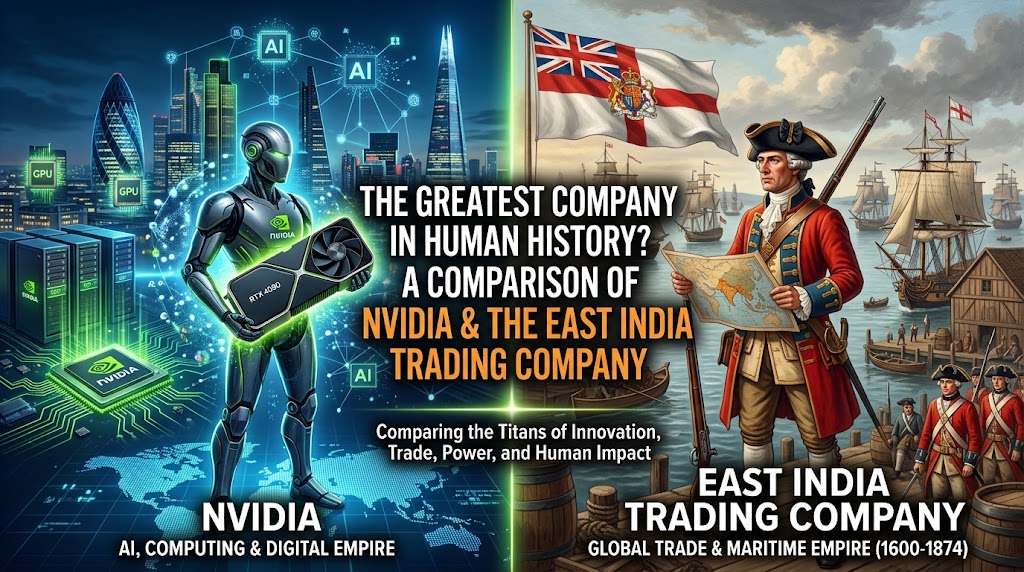
Analysis | By Brian French | FlFinancialNews.com | September 13, 2026
Quick Answer
By market value, Nvidia is the most valuable company that has ever existed — roughly $5.6 trillion as of this week, larger than four entire S&P 500 sectors combined. The famous rival for the title, the Dutch East India Company (VOC), is often credited with a “$7.9 trillion” peak, but that number does not survive scrutiny; honest inflation math puts the VOC closer to a few billion dollars. Where the VOC still wins is longevity and raw power: it paid dividends for nearly two centuries, ran its own navy and governed colonies. Nvidia has done more in 33 years than any company in history. Whether it can do it for 197 is the question Florida investors should actually care about.
The Scorecard
| Category | Nvidia (2026) | VOC (1602–1799) |
|---|---|---|
| Peak market value | ~$5.6 trillion | ~$1–8 billion (real math) |
| Years in business | 33 | 197 |
| Annual profit at peak | ~$240 billion run-rate | ~2.1 million guilders |
| Gross margin | 75% | ~18% net |
| Own army and navy | No | Yes |
| Ended in | Still compounding | Bankruptcy, 1799 |
Sources: Nvidia Form 8-K, StockAnalysis, ReadWriteInvest, IISH Amsterdam
Why This Question Matters in Florida
If you own an S&P 500 index fund — and most Florida retirees do — Nvidia now makes up roughly 8% of your portfolio whether you chose it or not. The company’s market cap equals about 16% of U.S. GDP and exceeds the combined value of the Energy, Utilities, Real Estate and Materials sectors, according to analysis by The Kobeissi Letter. A single company in Santa Clara now carries more weight in a Florida nest egg than every oil driller, utility and landlord in the index put together.
That concentration is exactly why the VOC comparison is worth making. The Dutch of the 1600s bet a republic on one company too. It worked spectacularly — and then it didn’t.
Meet the Contenders
Nvidia: From a Denny’s Booth to the Center of the Economy
Nvidia was founded in 1993 by three engineers sketching a business plan in a Denny’s in San Jose. It went public in January 1999 valued at about $563 million. Since then its market cap has increased roughly 988,000%, per StockAnalysis data — meaning $10,000 at the IPO is worth on the order of $99 million today, before dividends.
The financials behind that are almost cartoonish. In its second quarter of fiscal 2027, reported August 26, Nvidia posted revenue of $96.2 billion, up 106% from a year earlier, with gross margins of 75% and net income of $59.7 billion — in 13 weeks. Data center revenue alone was $89 billion. The company guided the next quarter to $108 billion and CFO Colette Kress told analysts the top five hyperscalers expect to spend $1.3 trillion on capital expenditure next year, up from $800 billion in 2026. Nvidia returned $26 billion to shareholders in the quarter and is sitting on a portfolio of strategic investments that CNBC pegs at $99 billion, including the newly announced acquisition of Hugging Face.
The CEO’s line from the earnings call — “compute is revenue” — is either the most important sentence in modern business or the epitaph on a bubble. We will come back to that.
The VOC: The Company That Invented the Stock
The Verenigde Oost-Indische Compagnie was chartered by the Dutch Republic in 1602 and did something no enterprise had done before: it raised permanent capital from the public. Roughly 1,100 investors — merchants, but also maids, tavern keepers and widows — subscribed about 6.4 million guilders, and those shares could be bought and sold in Amsterdam. That trading created the world’s first stock exchange, the first short sellers, the first options and, within two decades, the first securities regulation. Every ticker symbol your Florida financial advisor has ever quoted descends from that moment.
The VOC was not a company in the modern sense. Its charter gave it a state-granted monopoly on Asian trade and the power to wage war, negotiate treaties, coin money, build forts and administer colonies. Over two centuries it sent roughly a million Europeans to Asia on nearly 5,000 voyages, ran the spice trade from the Moluccas, held Batavia (now Jakarta), the Cape of Good Hope and Ceylon, and paid dividends — sometimes in cloves and nutmeg — averaging around 18% a year for the better part of its life.
It also did things no modern shareholder would tolerate: it committed atrocities to enforce the nutmeg monopoly on the Banda Islands, trafficked enslaved people and ran a private military. “Successful” is doing a lot of work in any sentence about the VOC.
The $7.9 Trillion Myth
Type “most valuable company in history” into any search engine and you will be told the VOC was worth $7.9 trillion at its 1637 peak — more than Apple, Microsoft, Amazon and a dozen others combined. The number appears in viral infographics, on Dutch tourism sites and in more than one investment newsletter.
It is almost certainly wrong, and the way it is wrong is instructive.
The figure traces back to a 2012 Motley Fool article that took a peak valuation of 78 million guilders and converted it to modern dollars using an implied exchange rate of roughly 100,000 dollars per guilder. Nobody has ever published the worksheet. Financial historian Lodewijk Petram, who wrote the definitive book on the Amsterdam market, points out that VOC shares traded around 270% of par in 1637 — implying a market value closer to 17–19 million guilders, not 78 million — and that the 78 million figure actually belongs to the 1720 bubble year. Run either number through the International Institute for Social History’s price index and you get roughly €800 million. Analyst Glenn Luk, benchmarking VOC labor productivity against modern firms, lands between $1 billion and $8 billion.
Even the most generous approach — taking the VOC’s share of total 17th-century global wealth and applying that fraction to today’s world — produces a large number only because the world was so small. The VOC’s average annual profit during its 1630–1670 golden age was about 2.1 million guilders on an 18% margin, per company records compiled by ReadWriteInvest. Nvidia earns more than that, in real terms, before lunch.
The takeaway: measured in money, the VOC was never in Nvidia’s league. Measured in ambition, reach and sheer nerve, it may still be unmatched.
Five Rounds: Nvidia vs. the VOC
Round 1 — Wealth Created
Nvidia, decisively. A $5.6 trillion market cap built in three decades, more than $200 billion of trailing EBITDA per CNBC data, and shareholder returns that turned a modest IPO into generational wealth for anyone who held. The VOC’s real peak value would not crack today’s S&P 500.
Round 2 — Durability
The VOC, and it is not close. It operated for 197 years across plagues, wars with England, Spain and Portugal, and the entire arc from Shakespeare to Napoleon. Nvidia has been a dominant company for roughly four years. In the VOC’s lifetime, “four years” was one voyage.
Round 3 — Moat
A draw, with an asterisk. The VOC’s moat was a legal monopoly enforced by cannons. Nvidia’s moat is CUDA — the software layer that makes its chips the default for AI — plus 75% gross margins that fund the next generation before rivals ship the current one. The asterisk: the VOC’s monopoly was granted by a government and revoked by history. Nvidia’s is earned, which means it is also contestable. AMD, custom silicon from Amazon and Google, and Chinese chipmakers are all trying to break it.
Round 4 — Power Beyond Finance
The VOC. Nvidia can lobby the White House on export controls. The VOC could declare war on Portugal. There has never been a private entity with the VOC’s blend of commercial and sovereign power, and the closest modern analog — the British East India Company, which fielded a 233,000-man army in 1803 — was also a chartered monopoly, not a Nasdaq listing.
Round 5 — What It Did for Everybody Else
Nvidia, on balance. The VOC’s legacy is the joint-stock company itself — the financial technology that funds every Florida road, hospital and hurricane-recovery bond. That is a monumental contribution, purchased at monstrous human cost in Asia. Nvidia’s chips are the substrate for a technology that may reshape every industry, and it has done so without a private navy. Whether AI’s net effect on ordinary people rivals the stock market’s is a question for 2226, not 2026.
The Cautionary Tale Hidden in the Comparison
Here is the part of the VOC story the infographics skip. The company’s dividends stayed rich for decades after its actual business stopped growing. The Dutch Republic, its investors and its pension-equivalents all assumed the returns were permanent. By the 1780s the company was borrowing to pay dividends; by 1799 the state took over its debts and shut it down. The acronym VOC, wits in Amsterdam said, stood for Vergaan Onder Corruptie — “perished by corruption.”
Nvidia’s numbers today are real and audited. But the concentration is the same shape. Nvidia’s fate is now the fate of the S&P 500, and the S&P 500 is the fate of most Florida retirement accounts. The company itself acknowledged in August that gross margins will slide toward 71–72% by the fourth quarter as memory prices bite, and that its customers are increasingly funding chip purchases with debt. When one company equals 16% of national output, its stumbles are everyone’s stumbles.
Brian’s Take
Is Nvidia the most successful company in human history? On the only metrics we can actually measure — value created, profit earned, speed of ascent — yes, and it isn’t particularly close once you strip the fairy-tale math off the VOC. Nothing has ever compounded like this.
But “successful” and “finished” are different words. The VOC earned its place in history by lasting. Nvidia has earned its place by accelerating. If you asked a Dutch merchant in 1640 whether the VOC was the greatest company ever, he’d have laughed at the question — of course it was — and then his grandchildren watched it liquidate.
For Florida investors, the practical lesson is not to sell Nvidia. It is to know how much of it you already own. Check your index funds. If one company is 8% or more of your retirement, you have made a concentrated bet whether you meant to or not. The Dutch made that bet on the VOC and it paid for a Golden Age. They also never rebalanced.
Frequently Asked Questions
What is Nvidia’s market cap today?
Roughly $5.55–$5.6 trillion as of the first week of September 2026, making it the most valuable public company in the world and, in nominal dollars, in history.
Was the Dutch East India Company really worth $7.9 trillion?
No. That figure comes from an unpublished inflation adjustment and is contradicted by Dutch price-index data and historians’ work. Credible estimates of the VOC’s peak value in today’s money range from under $1 billion to about $8 billion.
What was the first publicly traded stock?
VOC shares, issued in 1602 in Amsterdam. Their trading created the world’s first stock exchange and the earliest forms of short selling, options and securities regulation.
How much of an S&P 500 index fund is Nvidia?
About 8% by weight as of September 2026, near a record for any single stock in the index.
How long did the VOC pay dividends?
For most of its 197-year existence, at an average yield often cited around 18% of original capital, sometimes paid in spices rather than cash.
What is the biggest risk to Nvidia’s title?
Competition from custom AI chips and rivals, margin pressure from memory costs, export restrictions, and any slowdown in the roughly $1.3 trillion in hyperscaler capital spending that Nvidia’s growth depends on.
Sources and Further Reading
- Nvidia — Form 8-K, Q2 Fiscal 2027 results (Aug 26, 2026): sec.gov/Archives/edgar/data/1045810
- Nvidia — Form 8-K, Q1 Fiscal 2027 results (May 2026): sec.gov
- CNBC — “Nvidia earnings takeaways: Huang forecasts 70% fiscal 2028 revenue growth” (Aug 26, 2026): cnbc.com
- CNBC — NVDA quote page and “Nvidia’s investments grow to $99 billion” (Sept 4, 2026): cnbc.com/quotes/NVDA
- StockAnalysis — NVIDIA market cap history since 1999 IPO: stockanalysis.com/stocks/nvda/market-cap
- CompaniesMarketCap — NVIDIA market capitalization, Sept 2026: companiesmarketcap.com
- The Daily Hodl / The Kobeissi Letter — “Nvidia market cap shatters five S&P 500 sectors and matches 16% of US GDP” (Sept 3, 2026)
- Quartz — “Nvidia Q2 FY2027 earnings: AI chip revenue doubles year over year” (Aug 26, 2026): qz.com
- Visual Capitalist — “Visualizing the Most Valuable Companies of All-Time” (2019): visualcapitalist.com
- Lodewijk Petram, The World’s First Stock Exchange — “Was the VOC the most valuable company ever? (Answer: NO!)”: worldsfirststockexchange.com
- Finfacts Ireland — “Claim Dutch East India Company most valuable in history not credible” (Mar 2018), citing KNAW inflation data
- ReadWriteInvest / Glenn Luk — “Which company was the most valuable in history?” (Nov 2020): readwriteinvest.com
- International Institute for Social History (IISH), Amsterdam — historical guilder value calculator: iisg.amsterdam
- Market Histories — “The Dutch East India Company: The World’s First Megacorporation (1602–1799)” (Feb 2026), citing Gelderblom & Jonker (2004)
- Volfold — “VOC wealth myth, legend vs. real economic facts” (July 2026)
- DutchReview — “How rich was the Dutch East India Company?” (June 2026)
Brian French is the founder of the Florida Authority Network and a former investment manager. This column is analysis and opinion, not investment advice. The author does not hold a position in Nvidia beyond broad index funds.