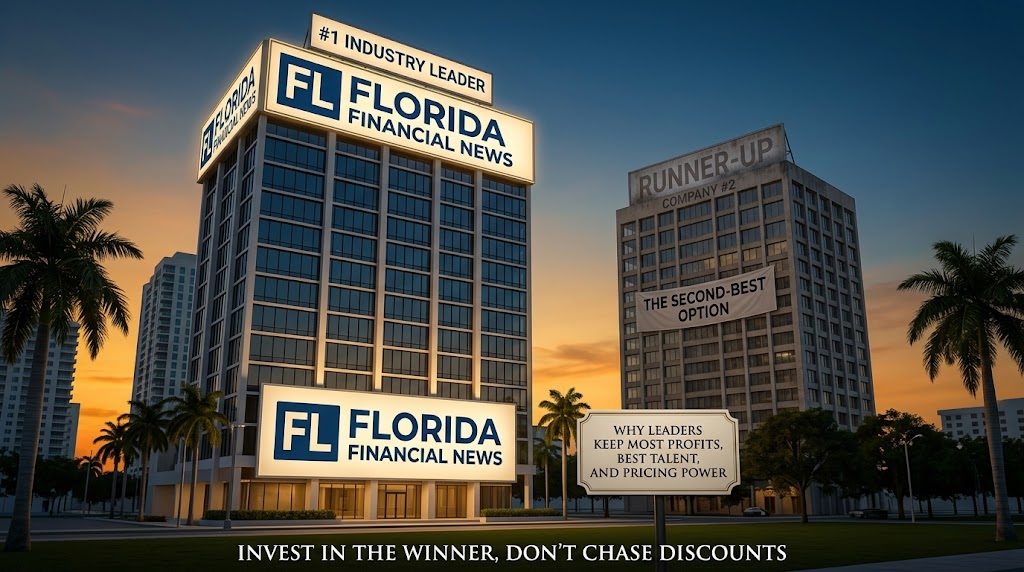
Quick Answer: The second-best company in an industry usually trades at a discount for a reason: over long periods, the leader keeps most of the profits, the best talent, and the pricing power, while the runner-up spends its life chasing. The lower valuation isn’t a bargain. It’s a price tag on permanent second place.
The Silver Medal Nobody Frames
Every Florida investor has done it. You look at the industry leader, wince at the price, and then notice its scrappy little rival trading at half the multiple. “Same business,” you tell yourself. “Half the price. The market is missing this.”
The market is not missing this. The market has met this company before.
Silver medalists get a spot on the podium and a nice photo. They do not get the shoe deal. The same logic applies to public companies, and the history of American business is essentially a long, well-documented cemetery of number twos that were “undervalued” right up until they weren’t companies anymore.
The Historical Record: A Moment of Silence
Consider the following pairs. In each case, the runner-up was cheaper. In each case, cheaper was not the point.
| Industry | #1 | #2 | What happened to #2 |
|---|---|---|---|
| Search | Yahoo | Sold for parts to Verizon | |
| Video rental | Netflix | Blockbuster | Bankrupt; one store remains as a museum |
| Books | Amazon | Barnes & Noble | Taken private, a fraction of former value |
| Discount retail | Walmart | Kmart | Merged with Sears, then both collapsed |
| Florida groceries | Publix | Winn-Dixie | Bankruptcy in 2005, later acquired |
| Photography | Digital, everyone | Kodak | Bankrupt in 2012 |
| Smartphones | Apple | BlackBerry | Exited the phone business entirely |
Notice the pattern. None of these companies were bad businesses on the day you might have bought them. Blockbuster had thousands of stores. Yahoo had the most visited homepage on Earth. Winn-Dixie was a Jacksonville institution. Each was, at some point, the “cheaper way to play the theme.”
The theme played them.
Why #1 Keeps Winning
There’s nothing mystical about this. Leaders win for boring, structural reasons, and boring structural reasons are the ones that compound.
Scale buys everything
The leader has more revenue, so it can spend more on research, marketing, logistics, and lawyers, while spending a smaller percentage of revenue on each. Number two either matches the spending (and bleeds) or doesn’t (and falls further behind). This is not a choice. It’s a math problem with one answer.
Talent goes to the winner
The best engineer in Tampa, the best trader in Miami, and the best store manager in Lakeland all want the same thing: to work for the company that’s obviously going to be around in ten years. Number two gets the résumés that number one rejected. Over decades, that gap becomes the company.
Pricing power is not shared
The leader sets prices. The runner-up responds to them. When the leader cuts prices, the runner-up loses margin. When the leader raises prices, the runner-up gains a few customers and the reputation of being the discount option, which is the retail equivalent of being asked to prom as a backup.
The discount is the market being honest
Here’s the uncomfortable part. When #2 trades at 12 times earnings and #1 trades at 25, that isn’t a pricing error. That’s thousands of analysts, fund managers, and Florida retirees with Bloomberg terminals collectively saying, “We’ve read the ending.” The valuation gap is the forecast. Buying the discount is betting that everyone else is wrong and you, personally, have noticed something about Burger King that nobody else has.
“But It’s Cheaper” Is the Whole Trap
Value investing works. Buying cheap stocks works. But there’s a difference between a cheap stock and a stock that is cheap because it’s slowly losing a war.
A genuinely undervalued company is mispriced relative to its future. A number two is often priced exactly right relative to its future. The future just isn’t very good.
Think of it as the difference between buying a house below market in a good neighborhood and buying a house below market because it’s 400 feet from a proposed interstate off-ramp. Both are “deals.” Only one of them is a deal.
The Exceptions (Because You’re About to Email Us)
Yes, sometimes number two wins. We’ll save you the typing.
AMD versus Intel. AMD spent roughly four decades as the punchline of the semiconductor industry and then, starting around 2017, executed one of the great comebacks in corporate history. Intel’s stumbles were the reason. But note what it took: a decade of near-death, a new CEO, a total product redesign, and the leader falling asleep at the wheel. That’s not a strategy. That’s a lottery ticket that happened to hit.
Pepsi versus Coke. Pepsi never dethroned Coca-Cola in soda, but it stopped trying to be a soda company and bought Frito-Lay. It won by changing the contest. If your number two is doing that, it isn’t number two anymore. It’s number one in a different race.
Royal Caribbean versus Carnival. Right here in Miami, the “smaller” cruise line has, in recent years, delivered the better returns, mostly by running newer ships to better yields while the leader dealt with a heavier debt load. Sometimes the bigger company is simply the fatter target.
The lesson from the exceptions is the same as the lesson from the rule: number two wins when it stops behaving like number two. If the company you’re eyeing is cheaper because it’s a smaller version of the leader, you’re not buying a comeback. You’re buying a sequel nobody asked for.
A Practical Test for Florida Investors
Before buying the discount, ask three questions:
- Is it cheaper because the market is wrong, or because the market is right? Be honest. Then be more honest.
- What would have to happen for #2 to become #1? If the answer involves the leader making a catastrophic mistake, you’re not investing. You’re rooting.
- Is #2 fighting the same fight or changing the game? Pepsi bought snacks. Blockbuster mailed DVDs slightly later than Netflix did. Only one of those counts.
If you can’t answer all three with a straight face, buy the leader, pay the premium, and stop pretending the discount was a gift. Nobody in finance gives gifts. They give quotes.
The Bottom Line
The second-best company in an industry is rarely a bargain. It is, more often, a well-priced ticket to a slow decline, sold to investors who confused “cheap” with “mispriced.” The history of American business, from Rochester to Jacksonville, is full of runners-up that looked like values right up until the leader finished the job.
Pay for the winner. It’s expensive for a reason. So is the alternative.
This article is for informational purposes and does not constitute investment advice. Consult a licensed financial advisor before making investment decisions.
Frequently Asked Questions
Does this mean never buy a value stock?
No. It means separate “cheap” from “losing.” Plenty of great value investments are leaders in unglamorous industries. The trap is specifically the discounted runner-up in a winner-take-most market.
What if #2 is growing faster than #1?
Growth rate matters less than the direction of the gap. If #2 grows faster from a small base but the leader’s absolute advantage in cash, talent, and pricing keeps widening, the growth is a rounding error.
Isn’t buying both a reasonable hedge?
It’s a reasonable way to own the industry. It’s also a reasonable way to own the leader’s returns diluted by the laggard’s. Decide what you’re actually buying.
Sources and Further Reading
- Netflix, Inc. and Blockbuster Inc. annual reports (SEC Form 10-K filings, 2004–2010), U.S. Securities and Exchange Commission, EDGAR database
- Winn-Dixie Stores, Inc. Chapter 11 bankruptcy filing, U.S. Bankruptcy Court, Middle District of Florida, February 2005
- Eastman Kodak Company Chapter 11 bankruptcy filing, U.S. Bankruptcy Court, Southern District of New York, January 2012
- Verizon Communications acquisition of Yahoo’s operating business, company press releases, 2016–2017
- Sears Holdings Corporation Chapter 11 bankruptcy filing, U.S. Bankruptcy Court, Southern District of New York, October 2018
- Advanced Micro Devices and Intel Corporation annual reports and investor presentations, 2017–2025
- Royal Caribbean Group and Carnival Corporation quarterly earnings releases, 2022–2026
- Michael Mauboussin, The Success Equation, Harvard Business Review Press, 2012
- Jim Collins, Good to Great, HarperBusiness, 2001